Welcome to SHENZHEN FENGXIANG TECHNOLOGY CO., LTD!

Email

info@lasercutoem.com

Chemical Etching of Precision Spring Sheets

Chemical Etching of Precision Spring Sheets

Chemical Etching Of Precision Spring Sheets Precision spring sheets, also known as flat springs, spring contacts or spring fingers, are fundamental elastic components widely used in electronic conne……
Send Inquiry
Description
Argument
Products Description
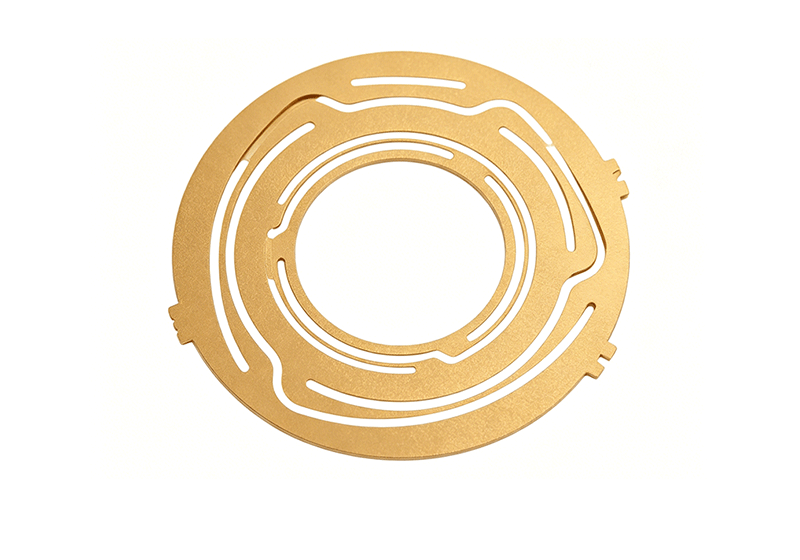
Chemical Etching Of Precision Spring Sheets

Chemical Etching Of Precision Spring Sheets

Precision spring sheets, also known as flat springs, spring contacts or spring fingers, are fundamental elastic components widely used in electronic connectors, precision mechanisms and automatic assemblies. They store and release mechanical energy to achieve electrical contact, position reset, gap compensation and vibration buffering. Their elastic consistency, fatigue life and dimensional accuracy directly determine the reliability and service life of entire products. Traditional manufacturing methods such as stamping, wire EDM and CNC milling face inherent limitations for ultra-thin precision springs: stamping introduces residual stress and burrs that degrade fatigue performance; CNC machining is inefficient for mass production of micro springs; laser cutting creates heat-affected zones that alter material elasticity. As an advanced non-contact cold subtractive process, photochemical etching has become the premium solution for high-precision spring sheet manufacturing. It fabricates complex spring geometries on thin metal foils while fully preserving native material properties, delivering burr-free edges and stress-free structure that meet stringent demands of modern precision manufacturing.

Key Product Characteristics of Etched Precision Spring Sheets

The photochemical etching process grants precision spring sheets unique performance advantages unreachable by conventional manufacturing methods, covering dimensional accuracy, elastic consistency, surface integrity and material adaptability. All specifications can be precisely tuned via etching parameters to meet industrial, medical and aerospace-grade quality standards.

1. Stress-Free Structure & Full Elastic Property Retention

As a room-temperature cold processing technology, etching applies no mechanical extrusion force or high-temperature thermal impact to the metal substrate, and does not generate residual internal stress or lattice deformation inside the material. Stamped springs typically carry residual stress that gradually releases during cyclic loading, causing force value drift and fatigue fracture. Etched stress-free springs maintain stable elastic force and mechanical properties throughout their service life, with zero distortion or material degradation.
This characteristic is critical for high-cycle applications. By preserving the original grain structure and elastic modulus of spring materials, etched springs achieve significantly higher fatigue strength and longer service life, making them ideal for mission-critical components that must perform reliably after millions of actuation cycles.

2. Micron-Level Precision & Complex Geometry Capability

Precision etching supports substrate thickness ranging from 0.02mm to 1.0mm, with dimensional tolerance stably controlled at ±0.005mm to ±0.01mm — far exceeding the accuracy of stamping and laser cutting. Intricate geometries such as multi-finger cantilever springs, spiral volute springs, serpentine beam springs and complex contoured contact springs can be formed in a single etching pass without secondary machining.
For miniaturized components like VCM camera springs and micro connector contacts, etching can produce sub-millimeter spring arms and fine features that stamping cannot achieve without tooling damage. Design complexity does not increase production cost, giving engineers maximum design freedom to optimize spring force curves and space utilization.

3. Burr-Free Smooth Edges & Consistent Contact Performance

Stamping and punching inevitably produce burrs, flanging and tool marks on spring edges. Sharp burrs cause abnormal wear on mating surfaces, increase contact resistance, and may shed micro debris that contaminates sensitive electronic systems. Etching removes metal through uniform chemical dissolution, forming smooth, vertical, rounded edges completely free of burrs, sharp corners and loose debris.
Smooth burr-free edges ensure stable and consistent contact force between spring contacts and mating surfaces, reduce contact resistance fluctuation, and improve electrical signal transmission reliability. For high-frequency and high-speed signal connectors, burr-free geometry prevents signal reflection and electromagnetic interference, guaranteeing integrity of data transmission.

4. Broad Spring Material Compatibility

The etching process is compatible with virtually all common spring materials, including beryllium copper (BeCu), phosphor bronze, 301/304/316L stainless steel, nickel silver, titanium alloy, Invar and high-temperature spring alloys. Customized etchant formulas are developed for different materials to fully retain native elastic, fatigue and corrosion-resistant properties.
Beryllium copper springs deliver the highest fatigue strength and excellent conductivity, ideal for high-cycle electrical contacts; 301 stainless steel springs provide high strength and corrosion resistance for harsh environments; phosphor bronze offers good elasticity and low cost for general electronic applications. All materials are fully traceable with corresponding material certification and compliance test reports.

5. Half-Etching Function for Integrated Forming

A unique advantage of etching is the half-etching process, which etches partially through the material thickness to create precise fold lines and positioning grooves. After etching, flat spring sheets can be easily bent along pre-etched lines into three-dimensional spring structures with highly consistent bending positions and angles.
This eliminates the need for complex bending dies, reduces tooling costs and lead times, and ensures assembly alignment accuracy. It is especially valuable for miniaturized 3D spring contacts and complex shaped spring assemblies used in compact electronic devices.

6. High Batch Consistency & Stable Quality

Etching production uses digital photomask imaging and uniform chemical reaction, ensuring that every spring on the same sheet has identical dimensions, shape and performance. Automated production lines with closed-loop process control achieve consistent quality across mass production batches, with spring force value deviation controlled within ±5%.
Compared with stamping, which suffers from gradual tool wear and performance drift over production runs, etching maintains stable accuracy from the first part to the millionth part. This high consistency reduces assembly adjustment work and improves final product yield and reliability.


Tags:

Technical parameter
Chemical Etching Of Precision Spring Sheets

Chemical Etching Of Precision Spring Sheets

Core Product Functions of Etched Precision Spring Sheets

As core elastic components in precision mechanical and electronic systems, etched spring sheets undertake five key functions: electrical contact conduction, elastic energy storage & reset, precision gap compensation, electromagnetic shielding & grounding, and long-cycle fatigue support, providing fundamental guarantees for equipment performance and operational stability.

1. Reliable Electrical Contact & Signal Conduction

This is the most widespread core function of precision spring sheets. In connectors, battery contacts and switch assemblies, spring contacts apply consistent normal force against mating surfaces to ensure stable low-resistance electrical connection. The burr-free smooth contact surface of etched springs minimizes contact resistance fluctuation and prevents signal interruption caused by poor contact.
For high-speed data connectors and RF components, etched spring contacts with precise geometry maintain stable characteristic impedance, reduce signal reflection and insertion loss, and support high-frequency signal transmission integrity. They are indispensable for modern high-speed communication interfaces and high-density connector systems.

2. Elastic Energy Storage & Reset Buffering

Flat springs store mechanical energy when deflected and release it when the load is removed, providing reset force, buffering and preloading functions. In precision mechanisms, optical systems and valve assemblies, etched springs deliver accurate and consistent spring force to achieve precise position reset, motion buffering and force balancing.
The stress-free structure ensures that spring force values remain stable over long-term cyclic operation without drift or attenuation. This predictable and consistent force performance is essential for precision instruments and metering equipment that require repeatable and accurate mechanical behavior.

3. Precision Gap Compensation & Positioning

In precision assembly, manufacturing tolerances and thermal expansion create dimensional gaps that affect alignment accuracy. Ultra-thin etched spring shims and wave springs can accurately fill these gaps while providing elastic preload, compensating for tolerance stack-up and absorbing dimensional changes caused by temperature fluctuations.
The micron-level thickness accuracy and flatness of etched springs ensure precise gap control. They are widely used in optical modules, semiconductor equipment and precision measuring instruments to maintain stable alignment and positioning accuracy under varying operating conditions.

4. Electromagnetic Grounding & Shielding

In electronic equipment, etched spring fingers and grounding springs establish reliable electrical contact between housings, shields and circuit boards, providing low-impedance grounding paths and electromagnetic shielding. They effectively suppress electromagnetic interference (EMI) and radio frequency interference (RFI), ensuring stable operation of sensitive electronic circuits.
Compared with solid grounding structures, spring contacts can tolerate assembly tolerances and thermal expansion mismatches while maintaining continuous grounding continuity. This makes them widely used in 5G communication equipment, automotive electronics and industrial control systems.

5. High-Cycle Fatigue & Long-Term Reliability

Etched springs preserve the full fatigue strength of base materials with no surface defects or residual stress that would initiate fatigue cracks. This enables them to withstand millions or even tens of millions of deflection cycles without fracture or performance degradation, providing long-term reliable operation in high-cycle applications.
For products with long design life requirements such as automotive electronics, medical implants and aerospace equipment, the high fatigue reliability of etched springs directly extends overall product service life and reduces maintenance and failure rates.

Main Application Fields of Etched Precision Spring Sheets

Driven by global trends of equipment miniaturization, precision improvement and reliability enhancement, demand for high-precision burr-free stress-free spring sheets is growing rapidly. Etched precision spring sheets are widely used across multiple high-end industries with their comprehensive performance advantages.

1. Consumer Electronics & 3C Products

This is the largest application field. Etched VCM springs are core components of smartphone camera autofocus motors, providing precise elastic support and reset force for lens movement. They are also used in battery contacts, SIM card connectors, button springs, antenna shrapnel and hinge structures of mobile phones, tablets and wearable devices. Their miniaturization, high precision and batch consistency perfectly match the demands of the consumer electronics industry.

2. Automotive Electronics Systems

In automotive electronics, etched spring sheets are used in connector systems, sensor modules, switch assemblies and battery management systems. They provide reliable electrical contact and elastic buffering under conditions of long-term vibration, temperature cycling and harsh environments. Applications include ABS brake systems, fuel injection systems, in-vehicle connectors and new energy battery pack components, meeting stringent automotive-grade reliability requirements.

3. Medical Devices & Implantable Instruments

Medical-grade beryllium copper and titanium etched springs are used in surgical instruments, implantable pacemakers, neurostimulators, insulin pumps and diagnostic equipment. They feature biocompatibility, high fatigue reliability and burr-free clean surfaces, comply with strict medical industry standards, and provide precise elastic actuation and reliable electrical connection for medical devices.

4. Aerospace & Defense Equipment

Aerospace and defense systems require springs that can withstand extreme temperatures, strong vibration and long service intervals. Etched high-temperature alloy and titanium springs are used in avionics connectors, flight control systems, satellite mechanisms and missile guidance components. Their stress-free structure and stable performance under extreme conditions meet the ultra-high reliability requirements of aerospace applications.

5. Telecommunications & RF Equipment

In 5G base stations, RF connectors, antenna tuners and communication modules, etched spring contacts and grounding springs provide stable high-frequency electrical performance and reliable grounding shielding. They support high-speed signal transmission, minimize insertion loss and ensure stable operation of communication equipment under long-term continuous operation.

6. Industrial Automation & Precision Instruments

Industrial control equipment, testing instruments, optical systems and semiconductor manufacturing equipment use etched precision springs for mechanism reset, force balancing, gap compensation and electrical contact. Their micron-level accuracy and long-term dimensional stability ensure equipment precision and repeatability, improving production efficiency and product quality in advanced manufacturing.
With the continuous upgrading of global precision manufacturing and the rapid development of miniaturized electronic products, performance requirements for precision spring components continue to rise. Photochemical etching, with its unique advantages of stress-free forming, micron-level accuracy, burr-free quality, complex geometry capability and cost-effective mass production, has become the mainstream manufacturing process for high-end precision spring sheets, gradually replacing traditional stamping and laser cutting solutions.
Etched precision spring sheets provide reliable elastic and electrical connection guarantees for electronics, automotive, medical, aerospace and other fields. As downstream industries such as new energy vehicles, 5G communications and intelligent manufacturing continue to expand, the market demand for high-precision etched spring sheets will maintain sustained growth, presenting broad market prospects and application value.

Leave Your Message


Leave a message