
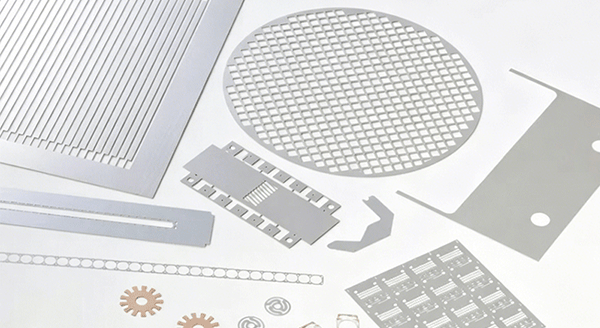
Chemical Etching Metal: Principle, Standard Process, Material Range, Technical Merits and Industrial Applications
1. Definition & Core Working Principle of Chemical Etching Metal
Chemical etching metal, commonly abbreviated as PCM (Photochemical Machining) or photo etching, is a non-contact, room-temperature cold subtractive manufacturing process for flat metal sheets.
The core logic is photolithographic masking + selective chemical dissolution:
- Cover the metal surface with UV-sensitive photoresist and transfer CAD patterns via UV exposure;
- Hardened resist protects non-etching areas, while exposed bare metal is dissolved into soluble metal ions by formulated acidic/alkaline etching solution;
- Material removal happens at molecular level without mechanical force or thermal impact.
It fundamentally avoids burrs, internal stress, work hardening, heat-affected zones and edge oxidation generated by stamping, laser cutting, CNC milling or wire EDM. The process supports metal thickness from 0.01 μm ultra-thin foil up to 2mm plate, and is widely adopted for high-precision, high-reliability planar micro-components in advanced manufacturing.
2. Full Standard Production Workflow for Chemical Etching Metal
The whole line runs with closed-loop automatic parameter control, with etchant formula, temperature and spray pressure adjusted according to different metal activity and passive film characteristics.
Step 1: Material Inspection & Surface Pre-Treatment (Most Critical Foundation)
Different metals form different oxide/passive layers, so customized pre-treatment is required:
- Flatness straightening and thickness verification for incoming metal blanks;
- Ultrasonic alkaline degreasing to eliminate oil, fingerprints and cutting fluid residues;
- Pickling/micro-etching to remove natural passive oxide film (especially critical for stainless steel, aluminum, titanium);
- Pure water rinsing and hot air drying to ensure clean, dry substrate for stable photoresist adhesion.
Poor pre-treatment directly causes resist lifting, pattern distortion, pinholes and uneven etching depth.
Step 2: Photoresist Coating / Dry Film Lamination
Two mainstream industrial methods:
- Dry film photoresist: Hot roller double-sided lamination for most stainless steel, copper alloy rigid plates, stable resolution and acid resistance;
- Liquid photoresist: Roller or spin coating for ultra-thin fragile foils below 0.05mm to prevent deformation.
No bubbles, wrinkles or gaps are allowed between resist and metal surface.
Step 3: UV Exposure & Graphic Transfer
- Output high-precision phototool negative from CAD drawings, reserve undercut compensation based on material thickness;
- Vacuum alignment double-sided exposure for symmetrical through-hole parts;
- UV light cures exposed resist into corrosion-resistant protective mask; unexposed areas remain soluble for developing.
Step 4: Developing & Thermal Curing
- Alkaline developer washes away unpolymerized photoresist, accurately exposing the etching zones;
- 100% visual inspection to clear broken lines, residual resist blockage on micro holes;
- Low-temperature post-bake curing strengthens mask acid resistance to resist long-time hot etchant spraying.
Step 5: Core Controlled Chemical Spraying Etching
This determines final dimensional accuracy and surface quality:
- Etchant selection by metal type
- Stainless steel, brass, phosphor bronze, beryllium copper, nickel alloy: Ferric chloride main solution with additives (accelerator, wetting agent, defoamer, undercut inhibitor);
- Aluminum alloy: Phosphoric-nitric acid mixed acid or weak alkaline etchant;
- Titanium alloy: Hydrofluoric acid + nitric acid mixed special acid (strict safety & waste liquid management required).
- Key controlled parameters
Constant temperature (45–55℃ for ferric chloride), balanced double-side spray pressure, solution Baume degree, conveyor speed. Line speed controls etching depth: slow speed for full through-cut, fast speed for partial half etching.
- Isotropic dissolution feature
Lateral undercut is inevitable, so designers pre-compensate dimensions on drawings to meet tolerance requirements.
Step 6: Resist Stripping & Multi-Stage Rinsing
- Alkaline stripping liquid removes all remaining photoresist completely;
- Multi-tank overflow pure water rinsing eliminates residual etching chemicals to avoid delayed rusting and surface staining.
Step 7: Post-Treatment, QC Testing & Packaging
Optional surface finishing
- Passivation: Mandatory for stainless steel, aluminum and titanium to rebuild anti-corrosion passive film;
- Blackening, brushing, sandblasting, matte finishing, anti-fingerprint coating as custom demands.
Quality inspection items
2D optical measuring instrument checks overall dimensions, hole tolerance, half-etched depth; appearance check for pitting, uneven etching, smooth burr-free edges; flatness test for thin foils.
Qualified parts are anti-statically packed for delivery.
3. Full Range of Metals Suitable for Chemical Etching Metal
3.1 Ferrous Metals
- 201/304/316L/321/430 stainless steel (largest application volume);
- Low-carbon steel, nickel sheets, Invar alloy, kovar alloy for electronic packaging.
3.2 Copper & Copper Alloys
Pure copper, brass, phosphor bronze, beryllium copper, red copper. High etching speed, ideal for conductive shrapnels, busbars, spring contacts and EMI shielding components.
3.3 Light Non-Ferrous Metals
Aluminum alloy 5052/6061, widely used for lightweight structural parts, heat dissipation grids and decorative panels.
3.4 High-Strength Corrosion-Resistant Special Alloys
Titanium alloy, nickel-based superalloy, mainly for medical implants, aerospace ultra-lightweight components and high-temperature resistant parts.
4. Unmatched Core Advantages of Chemical Etching Metal
4.1 Stress-Free Cold Processing, Original Material Properties Preserved
No mechanical stamping force, no laser thermal ablation. Tensile strength, elasticity, conductivity, thermal conductivity and corrosion resistance of metals stay unchanged. Perfect for elastic springs, ultra-thin conductive foils and fatigue-critical components.
4.2 100% Burr-Free Smooth Edges, No Secondary Deburring
Homogeneous molecular dissolution creates naturally rounded hole walls and outlines. No slag, sharp burrs or recast layers. Direct assembly available, reducing post-processing cost and avoiding short-circuit risk from falling metal debris.
4.3 Unique Precise Half-Etching One-Piece Forming
Controllable partial-depth etching with tolerance ±0.003mm for thin materials. Integrate bending indentations, positioning steps, anti-slip grooves and stepped platforms on one single metal piece, simplifying assembly structure and improving fitting accuracy.
4.4 Tooling-Free Digital Customization, Low R&D Iteration Cost
No expensive hard metal stamping molds. Only phototool film is needed. Modify CAD files directly for design updates, rapid prototype delivery within 24–48 hours. Extremely cost-effective for small batches, complex irregular shapes and frequent design revisions.
4.5 Micron-Level High Precision & Excellent Batch Consistency
Tolerance can reach ±0.005mm for ultra-thin foils. All patterns on the whole sheet are etched simultaneously without cumulative positioning errors like laser point-by-point cutting. Mass production yield and dimensional stability exceed 99.5%, meeting strict traceability rules for automotive, medical and aerospace industries.
4.6 Wide Thickness Compatibility & High Thin-Foil Yield
Process 0.01mm easily wrinkled ultra-thin foil to 2mm thick plate. Effectively solves tearing, warpage and low yield problems of thin metals caused by stamping and laser cutting.
4.7 Recyclable Etchant & Green Closed-Loop Production
Ferric chloride solution can be filtered, metal sludge removed, replenished and reused repeatedly. Modern production lines equip waste liquid treatment and metal recovery systems, lowering chemical consumption and environmental discharge.
5. Limitations of Chemical Etching Metal
- Mainly for flat planar metal sheets; poor effect on 3D solid blocks and curved surfaces (electrochemical marking is alternative for curved local etching);
- Isotropic etching brings unavoidable slight undercut, limiting ultra-high aspect ratio micro deep holes;
- Titanium and aluminum require hazardous mixed acid etchants, demanding strict workshop safety operation and waste water treatment;
- Unit cost for mass volume orders is higher than progressive stamping.
6. Main Industrial Application Fields
6.1 Electronics & Semiconductor Packaging
Stainless steel EMI shielding cans, copper alloy lead frames, connector springs, heat sink grids, wafer carrier fixtures, precision gaskets. Miniaturized, high-density electronic modules rely heavily on this technology.
6.2 Medical Devices & Biocompatible Components
316L stainless steel filter meshes, surgical instrument accessories, cell sieves, titanium alloy micro implant parts. Smooth edges prevent tissue scratching and withstand repeated high-temperature sterilization.
6.3 Aerospace & Defense Equipment
Ultra-thin adjusting shims, hydraulic micro filter screens, lightweight ventilation panels, sensor pressure diaphragms. Stress-free performance ensures stability under extreme temperature difference, vibration and salt spray environments.
6.4 New Energy & Automotive Electronics
Battery collector meshes, fuel cell flow field plates, vehicle sensor shrapnels, battery protection nets, automotive sealing gaskets. Meets long-term vibration and temperature fluctuation reliability standards.
6.5 Precision Optoelectronic Instruments
Encoder grating discs, optical slits, light barriers, precision diaphragms. Micron edge accuracy eliminates optical diffraction deviation for high-precision testing equipment.
6.6 Industrial Filtration & Environmental Protection
Uniform-aperture etched stainless steel filter elements for water treatment, chemical industry, food processing and hydraulic oil filtration. Stable aperture improves filtering efficiency and anti-clogging performance.
6.7 Hardware & Architectural Decoration
Etched nameplates, hollow decorative panels, metal artwork and interior partition screens with textured concave-convex effects.
7. Conclusion
Chemical etching metal is a mature, reliable precision cold working technology built on photolithography and controlled wet chemical corrosion. With flexible digital customization, stress-free processing, burr-free edge quality, controllable half etching and broad metal compatibility, it addresses the manufacturing bottlenecks of ultra-thin foils, intricate planar micro-parts and high-reliability elastic components that traditional machining cannot resolve efficiently.
As downstream industries keep upgrading requirements for component miniaturization, surface cleanliness and long-term operational stability, chemically etched metal components will maintain steady market growth. Future technological optimization will focus on lower undercut ratio, higher resolution patterning and environmentally friendly recyclable etching fluids, continuously empowering high-end precision manufacturing worldwide.