
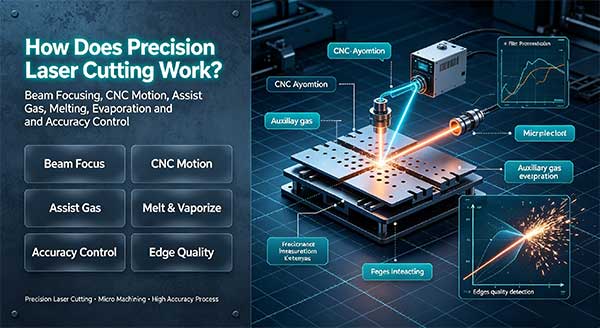
How Does Precision Laser Cutting Work | Principle & Process
Precision laser cutting is a non-contact thermal fabrication process that uses a focused, high-power laser beam to cut metal and non-metal materials into pre-designed shapes with tight tolerances.
Working Principle
The laser generator produces a high-energy coherent laser beam. This beam is focused through lenses into an extremely tiny spot, generating concentrated heat that instantly melts, vaporizes or burns through the workpiece. A high-pressure auxiliary gas (nitrogen, oxygen or compressed air) blows away the molten debris from the cutting kerf, separating the material and forming clean edges.
Since there is no physical cutting tool touching the material, no mechanical force or tool wear occurs during processing. It is especially suitable for thin sheets, complex contours and delicate components.
Step-by-Step Process
1. CAD File Preparation: Draw or receive 2D drawings, convert them into laser machine-readable cutting programs, set cutting path, speed and power parameters.
2. Material Loading: Fix flat sheet material onto the cutting bed.
3. Focus Calibration: Adjust lens to ensure the laser focal point sits exactly on the surface of the sheet.
4. Laser Cutting: The laser head moves following the programmed path. The laser beam continuously ablates the material while auxiliary gas expels slag.
5. Part Unloading: Once cutting finishes, remove finished parts from the sheet.
6. Post-processing & Inspection: Deburr, clean, and check dimension tolerance and edge quality before packing.
Suitable Materials
Metals: Stainless steel, copper, brass, aluminum, carbon steel, thin alloy sheets
Non-metals: Acrylic, wood, plastic, PCB
Core Advantages
-
Non-contact cutting: No workpiece deformation caused by clamping pressure
-
High precision: Fine kerf, tight dimensional tolerance, suitable for intricate patterns
-
Flexible: Quickly switch designs without custom moulds, ideal for prototypes and small-batch custom parts
-
Clean cutting edge: Less burr compared with mechanical stamping
Common Applications
Precision laser cutting is widely used for encoder discs, filter meshes, metal shims, shielding sheets, sheet metal prototypes, and custom thin metal components for automotive, electronics, fuel cell and instrumentation industries.