
How to Choose the Right Machining Method for Precision Components
Understanding how to choose the right machining method for precision components is a critical decision that directly affects product accuracy, manufacturing cost, delivery lead time and long-term service reliability. Common precision manufacturing processes include CNC machining, high precision laser cutting and photochemical etching, each with unique technical advantages, optimal application scenarios and economic ranges. There is no universally superior process; the optimal solution depends on a comprehensive assessment of dimensional tolerance requirements, material properties, part geometry, production volume and total cost budget. A scientific selection process can not only ensure product performance meets design requirements, but also significantly reduce comprehensive manufacturing costs, shorten R&D cycles and improve the market competitiveness of final products.
I. Core Characteristics of Mainstream Precision Machining Processes
Each precision machining process has inherent technical attributes determined by its forming mechanism. Clarifying the core characteristics of different processes is the foundation of scientific selection.
1. Dimensional Tolerance & Precision Level
Dimensional accuracy is the primary indicator for process selection. Photochemical etching achieves the highest precision for thin sheet parts, with stable tolerances of ±0.005mm to ±0.01mm and the finest feature size down to 0.02mm, making it ideal for micro-precision thin sheet components. High precision laser cutting delivers tolerances of ±0.01mm to ±0.03mm, with good performance for both thin and medium-thickness plates. CNC milling achieves the highest overall precision for three-dimensional solid parts, with tolerances up to ±0.002mm for small parts, but efficiency drops sharply for ultra-thin sheet structures. For projects with extremely strict tolerance requirements, the process with the smallest natural tolerance should be selected first to avoid additional secondary finishing costs.
2. Material & Thickness Compatibility
Material adaptability is another core selection dimension. CNC machining performs well for almost all metal and non-metal materials, especially for thick block and bar materials, but has high tool loss for superhard alloys and low efficiency for ultra-thin sheets. Precision laser cutting covers most common metal materials with thickness from 0.02mm foil to 20mm plates, but has limitations for highly reflective materials and ultra-thick structural parts. Chemical etching is optimized for thin sheet metals with thickness from 0.02mm to 2mm, and performs equally well for hard, brittle and soft materials, with processing difficulty independent of material hardness.
3. Geometric Complexity & Design Freedom
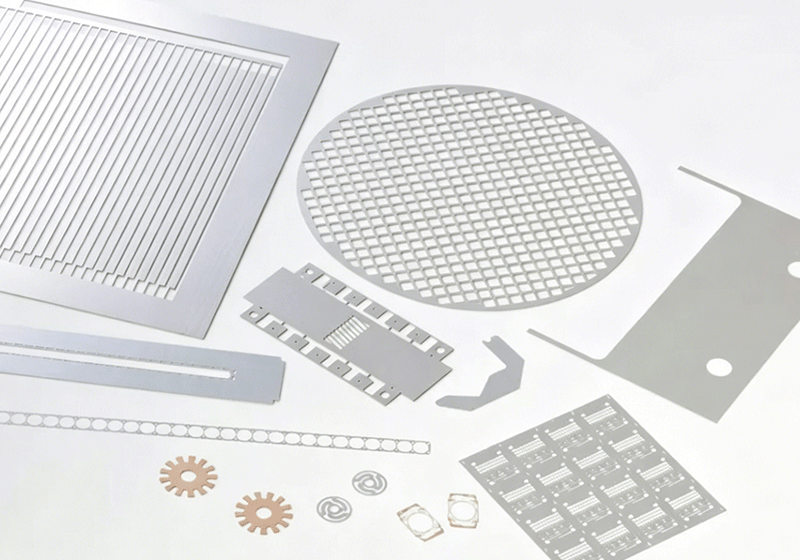
Process selection must match the geometric complexity of parts. Chemical etching has the highest design freedom, with no additional cost for complex patterns, dense holes and irregular contours, and supports precise half-etching structures that other processes cannot easily achieve. Laser cutting also supports arbitrary planar contours, but cost increases slightly for extremely dense features. CNC machining can process complex 3D structures, but deep cavities, narrow grooves and thin-wall structures will significantly increase processing difficulty and cost, and some special structures may even be impossible to machine due to tool interference.
4. Tooling Cost & Prototyping Cycle
Upfront tooling cost and prototyping speed are key considerations for small-batch and R&D projects. Both laser cutting and chemical etching use digital tooling with extremely low upfront cost, and prototype samples can be delivered within 24–48 hours, making them very suitable for rapid iteration of new products. CNC machining requires no special hard tooling for simple parts, but programming and setup take longer, and custom fixtures are needed for complex structures, resulting in higher unit price for single-piece prototypes. For stamping processes with high tooling cost, they are only economical for large batch orders above tens of thousands of pieces.
5. Material Property Retention & Stress Impact
For parts with high requirements for fatigue performance and corrosion resistance, the impact of processing on material properties must be considered. Chemical etching is a cold process with zero residual stress and no heat-affected zone, 100% retaining the original properties of the base material. Precision laser cutting has a small heat-affected zone of 5–15μm, with minimal impact on material properties. CNC machining introduces certain residual stress and work hardening, which may affect fatigue performance for key load-bearing parts.
6. Batch Production Efficiency & Consistency
For medium and large batch orders, production efficiency and batch consistency are core selection criteria. Chemical etching processes the entire sheet at the same time, with the highest efficiency for large-area thin sheet parts and excellent batch consistency. Laser cutting processes parts one by one, with stable and consistent quality, and efficiency is moderate for medium batches. CNC machining has high single-piece precision but relatively low unit time output, and is more suitable for small and medium batches of complex 3D parts.
7. Post-Processing Requirement & Total Cost
Total cost includes not only processing cost, but also post-processing cost and subsequent assembly cost. Chemical etching produces burr-free, stress-free parts that usually require no secondary treatment, with low total cost. Precision laser cutting has minimal burrs for thin plates, and most cases require no deburring. CNC machining usually leaves tool marks and burrs, requiring secondary polishing and deburring, which increases total cost.
II. Core Values of Scientific Machining Method Selection
Choosing the most suitable processing method according to part characteristics delivers six core functional values for product development and production operation.
1. Guarantee Dimensional Accuracy & Product Performance
Matching the right process according to tolerance requirements ensures that part dimensions and structural accuracy meet design indicators, thus guaranteeing the functional performance of the final product. Improper process selection may lead to out-of-tolerance dimensions, assembly failure and performance degradation, increasing rework and scrap costs.
2. Optimize Total Manufacturing Cost
Scientific selection can avoid over-processing and unnecessary high-cost processes, and select the most cost-effective solution under the premise of meeting quality requirements. For example, for thin sheet parts that can be completed by laser cutting, there is no need to choose more expensive CNC milling, which can significantly reduce comprehensive costs without affecting performance.
3. Shorten Production Lead Time
Selecting a process with fast proofing and high production efficiency can greatly shorten the product R&D cycle and mass production delivery time, helping enterprises seize market opportunities faster. For projects with tight delivery schedules, prioritizing processes with short setup time and high production efficiency can effectively avoid delivery delays.
4. Improve Batch Consistency & Reduce Quality Risk
Selecting a process with good batch stability can reduce quality fluctuation in mass production, lower scrap rate and rework rate, and reduce quality management costs. For industries with strict traceability requirements such as automobile and medical treatment, stable batch consistency is the basis of compliance management.
5. Extend Product Service Life & Enhance Reliability
Choosing a process with little damage to material properties can retain the original mechanical properties and corrosion resistance of materials to the maximum extent, extend the service life of products, and reduce after-sales maintenance and replacement costs. For key parts in aerospace and medical fields, this is directly related to use safety and reliability.
6. Support Agile Product Iteration & Customization
Selecting processes with low tooling cost and fast modification can support rapid iteration of product design and meet the demand for multi-variety and small-batch customized production. This is particularly important for industries with fast product upgrading such as consumer electronics and new energy.
III. Application Scenarios & Recommended Machining Methods
Different industries have different core requirements for precision parts, and correspondingly have different optimal processing schemes.
1. Aerospace & High-End Equipment
Aerospace parts prioritize fatigue reliability and dimensional accuracy, with most structures made of high-performance alloys. It is recommended to use CNC machining for thick structural parts, precision laser cutting for thin sheet structural parts, and electrochemical etching for surface microstructure treatment, so as to minimize processing damage to materials and ensure long-term reliable performance in extreme environments.
2. Medical Device & Life Sciences
Medical parts prioritize hygiene, burr-free performance and biocompatibility. For thin sheet precision parts such as filter screens and electrode sheets, chemical etching and high precision laser cutting are recommended, which produce no burrs and no residual impurities, are easy to clean and sterilize, and meet strict medical safety standards.
3. Automotive & New Energy Mobility
The automotive industry balances batch efficiency, dimensional stability and comprehensive cost. For body structural parts and battery tray parts, precision laser cutting is the first choice with high efficiency and stable quality; for complex solid power components, CNC machining is suitable; and for filter elements and shim parts, chemical etching has higher cost performance.
4. Electronics & Semiconductor Packaging
Electronic parts prioritize miniaturization, high precision and no burrs. For ultra-fine pitch lead frames, shielding covers and micro elastic parts, chemical etching has the best effect; for medium-precision housing and heat dissipation parts, precision laser cutting is more economical; and for complex structural parts, CNC machining is selected.
5. Industrial Automation & Precision Instruments
Industrial automation parts balance precision, strength and delivery cycle. For encoder discs, shims and thin sheet structural parts, precision laser cutting is preferred; for precision shaft parts and block structures, CNC machining is the mainstream solution; and for high-precision micro functional parts, chemical etching is more advantageous.
6. Mold & Tooling Manufacturing
Mold parts prioritize surface texture accuracy and structural strength. For cavity structure and overall processing, CNC machining is the core process; for surface texture and fine groove structure, electrochemical etching has irreplaceable advantages, which can achieve uniform and delicate texture effects.
7. Consumer Goods & Premium Hardware
Consumer products prioritize appearance effect, customization flexibility and cost. For decorative hollow parts and appearance panels, precision laser cutting is the most widely used; for high-end fine decorative parts and texture parts, chemical etching can achieve more delicate effects; and for solid hardware parts, CNC machining is selected.
Conclusion
In conclusion, choosing the right machining method for precision components requires comprehensive consideration of multiple dimensions such as accuracy requirement, material characteristics, structural complexity, production batch and cost budget. There is no absolute optimal process, only the most suitable solution for specific application scenarios.
By clarifying the core characteristics of different processes, matching them according to product demand priorities, and balancing performance, cost and cycle, enterprises can find the optimal processing scheme, effectively improve product competitiveness and reduce comprehensive operation costs. With the continuous progress of various precision processing technologies, the boundary between processes will continue to expand, and more combined process schemes will emerge to provide stronger support for the innovation and development of precision manufacturing.