Welcome to SHENZHEN FENGXIANG TECHNOLOGY CO., LTD!

Email

info@lasercutoem.com

Precision Chemical Etching of Metal Foils

Precision Chemical Etching of Metal Foils

Precision chemically etched metal foils, stress-free, burr-free, ultra-thin. Custom micro structures & shapes, intact material performance, widely used in electronics, filtration and sensing industries.

Send Inquiry
Description
Argument
Products Description
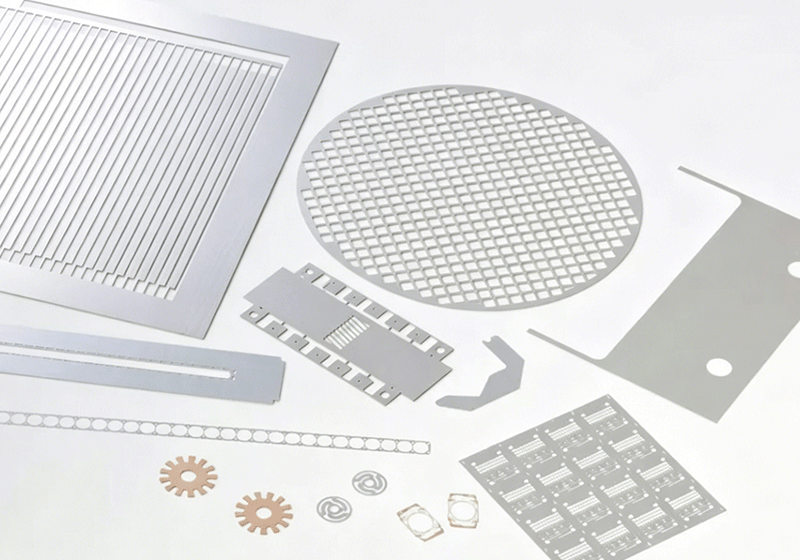
Precision Chemical Etching of Metal Foils

Precision Chemical Etching of Metal Foils

Ultra-thin metal foils are foundational substrates in modern precision manufacturing, serving as the core base for electronic circuits, sensing elements, filtration components and thermal management parts. Conventional processing methods such as stamping, laser cutting and CNC milling face inherent limitations when handling foils thinner than 0.2mm: mechanical force causes curling, deformation and even fracture; high-energy laser processing creates heat-affected zones that alter material properties; secondary deburring easily damages delicate foil structures. Photochemical etching, as a non-contact cold subtractive process, has become the premium manufacturing solution for precision metal foil components. It fabricates complex micro patterns on ultra-thin foils down to 0.005mm thickness while fully preserving native material performance, delivering burr-free edges and stress-free structure that meet stringent demands of high-end precision industries.

Key Product Characteristics of Precision Etched Metal Foils

The photochemical etching process grants metal foil components unique performance advantages unreachable by traditional manufacturing methods, covering dimensional accuracy, surface integrity, structural stability and material adaptability. All specifications can be precisely tuned via etching parameters to meet industrial, medical and aerospace-grade quality standards.

1. Ultra-Thin Forming with Sub-Micron Tolerance

Precision etching supports substrate thickness ranging from 0.005mm to 0.2mm, enabling processing of ultra-thin foils that are nearly impossible to shape via stamping or CNC without damage. Dimensional tolerance stably reaches ±0.005mm, with minimum achievable line width down to 10μm, and minimum aperture matching approximately 110% of material thickness according to mature process rules. The overall flatness of etched foils is controlled within ≤0.005mm, with no warping, curling or arching deformation even for 0.01mm ultra-thin foils.
This level of precision is critical for micro-scale components. Unlike stamping which produces dimensional deviation and springback on thin foils, etching delivers highly consistent feature dimensions across the entire sheet, ensuring uniform performance of every finished part in mass production.

2. Burr-Free & Damage-Free Surface Integrity

Etching removes metal through uniform atomic-level chemical dissolution, forming smooth, vertical, rounded edges completely free of burrs, flanging and micro cracks. There is no need for secondary deburring processes that would scratch or deform delicate thin foils. Surface roughness Ra can be adjusted between 0.2–1.6μm according to application requirements, with no tool marks or mechanical damage left on the surface.
The intact smooth surface eliminates particulate shedding risks in cleanroom applications, and prevents stress concentration points that would cause fatigue fracture under repeated bending. This feature is indispensable for medical implants, semiconductor components and high-reliability electronic devices.

3. Stress-Free Structure & Long-Term Dimensional Stability

As a room-temperature cold processing technology, etching applies no mechanical extrusion force or high-temperature thermal impact, and does not generate residual internal stress or lattice deformation inside the metal substrate. Stamped or laser-cut foils typically carry residual stress that gradually releases during temperature cycling and long-term use, causing dimensional drift and performance attenuation.
Etched stress-free foils maintain stable dimensions under sustained load, frequent cold-heat cycles and high-frequency bending, with dimensional fluctuation of less than 0.003mm throughout the service life. They reliably preserve preset geometric accuracy, eliminating the need for repeated calibration and adjustment in precision instruments.

4. Broad Material Compatibility with Full Property Retention

The etching process is compatible with virtually all common engineering metal foils, including 304/316L stainless steel, pure copper, beryllium copper, titanium, nickel, Invar, Constantan, molybdenum and Hastelloy. Customized etchant formulas are developed for different materials to fully retain native electrical conductivity, thermal conductivity, corrosion resistance and mechanical properties of the substrate.
For example, etched copper foils preserve 100% of original electrical conductivity for flexible circuits; titanium foils retain full corrosion resistance for medical and chemical applications; Constantan foils maintain stable piezoresistive properties for high-precision strain gauges. All materials are fully traceable with corresponding material certification and compliance test reports.

5. Complex Pattern Fidelity & Design Flexibility

Etching imposes no restrictions on graphic complexity. Micro circuits, grating patterns, micro-hole arrays, spring structures and irregular contours can all be integrally formed in a single etching pass, with no extra cost for design complexity. Digital photomasks replace expensive hard steel dies: design modifications only require adjusting the photomask file, and prototype samples can be delivered within 24–48 hours, greatly reducing R&D costs and shortening product launch cycles.
Patterns optimized via optical simulation, fluid dynamics simulation and mechanical simulation can be reproduced with high fidelity, enabling engineers to maximize product performance without being constrained by manufacturing limitations.

6. High Cleanliness & Batch-to-Batch Consistency

All etching processes are completed in constant-temperature Class 10,000 clean workshops. Finished foils go through multi-stage ultrasonic pure water cleaning and vacuum drying, with no oil stains, photoresist residue, metal debris or other pollutants on the surface, reaching electronic-grade cleanliness.
Automated closed-loop production lines achieve highly consistent quality across mass production batches, with dimensional uniformity above 99.5% and stable yield rate over 98.5%. Unlike stamping which suffers from gradual tool wear and quality drift, etching maintains identical accuracy from the first part to the millionth part.


Tags:

Technical parameter
Precision Chemical Etching of Metal Foils

Precision Chemical Etching of Metal Foils

Core Product Functions of Etched Metal Foils

As core functional substrates in precision systems, etched metal foils undertake five key functions: functional pattern integration, flexible electrical conduction, precision flow control, efficient thermal management and precision sensing reference, providing fundamental support for equipment performance and operational stability.

1. Precision Functional Pattern Integration

This is the most fundamental core function. Etching forms high-precision functional patterns directly on ultra-thin foils, including electrode circuits, sensing gratings, micro-hole arrays and elastic structures, enabling electrical, optical, fluidic and mechanical functions in a single thin foil component. It eliminates the need for multi-part assembly, reduces overall volume and improves structural reliability.

2. Flexible Electrical Conduction & Signal Transmission

Etched copper and alloy foil flexible circuits are ultra-thin, lightweight and bendable, serving as conductive interconnects in flexible electronics and wearable devices. They stably transmit power and high-speed data signals, and withstand millions of bending cycles without fracture or resistance drift. The stress-free structure ensures consistent electrical performance even under repeated flexing, making them ideal for foldable displays and wearable health monitors.

3. Ultra-Fine Filtration & Flow Regulation

Etched micro-hole foil filters feature precisely controlled uniform apertures down to 0.02mm, used for microfluidic medical devices, gas sensors and precision hydraulic systems. They accurately intercept micron-sized impurities and stably regulate fluid flow rate, with no fiber shedding that would contaminate the medium. Smooth hole walls provide low and stable flow resistance, avoiding gradual clogging caused by rough inner walls.

4. High-Efficiency Thermal Management & Heat Spreading

Metal foils have excellent native thermal conductivity. Etched vapor chamber foils, heat dissipation fins and thermal interface shims achieve ultra-thin form factors that fit tightly against heat sources with extremely low thermal resistance. They deliver efficient uniform heat spreading for 5G communication equipment, consumer electronics and semiconductor devices, effectively reducing hotspot temperature and improving long-term operational reliability.

5. Precision Sensing & Positioning Reference

Etched strain gauges, encoder gratings and positioning reference foils serve as the core sensitive elements of sensors to achieve high-precision detection of stress, displacement and angle. The stress-free structure ensures stable signal output with zero drift over long-term operation, improving measurement accuracy and repeatability of testing instruments and automation equipment.

Main Application Fields of Etched Metal Foils

Driven by global trends of device miniaturization, lightweight design and intelligent upgrading, demand for high-precision ultra-thin metal foil components continues to grow rapidly. Etched metal foils are widely applied across multiple high-end industries with their comprehensive performance advantages.

1. Electronics & Semiconductor Manufacturing

This is the largest application field. Etched metal foils are used for flexible circuit boards, semiconductor lead frames, EMI shielding sheets and chip packaging carriers. Their high precision, burr-free edges and high cleanliness adapt to the trend of high-density and miniaturized electronic components, ensuring signal integrity and packaging reliability.

2. Medical Devices & Biotechnology

Medical-grade stainless steel and titanium etched foils are used in surgical instrument components, implantable electrodes, microfluidic filter meshes and biosensors. They offer good biocompatibility, zero particulate shedding and resistance to high-temperature sterilization, fully complying with strict medical safety standards.

3. Aerospace & Defense Aviation

Titanium alloy and high-temperature alloy etched foil components are used in aerospace sensors, thermal protection liners and satellite elastic elements. They feature lightweight structure, stress-free stability and resistance to extreme temperature changes and strong vibration, meeting the ultra-high reliability requirements of aerospace applications.

4. New Energy & Energy Storage

In the hydrogen energy sector, etched foil bipolar plates improve power density of fuel cells; in the lithium battery industry, etched current collectors and electrode foils enhance energy density and cycle life. Their excellent corrosion resistance and electrical conductivity adapt to the long-life and high-performance demands of new energy equipment.

5. Precision Instrument & Optical Optics

Etched encoder discs, optical slits, precision shims and instrument springs provide micron-level accuracy and long-term dimensional stability, guaranteeing measurement accuracy and repeat positioning performance of optical instruments and testing equipment.

6. Flexible Wearable & Consumer Electronics

Flexible electrodes for wearable devices, conductive parts for foldable screens, acoustic springs and receiver meshes benefit from the ultra-thin, flexible and lightweight properties of etched foils, perfectly matching the development trend of thinner and more portable consumer electronics.
With the continuous advancement of global precision manufacturing and the rapid development of flexible electronics and new energy industries, performance requirements for ultra-thin metal foil components continue to rise. Photochemical etching, with its unique advantages of stress-free cold processing, micron-level accuracy, burr-free quality, broad material compatibility and flexible customization, has become the mainstream manufacturing process for high-end metal foil parts. It effectively solves the deformation, burr and performance degradation problems of traditional processes in ultra-thin foil processing.
Etched metal foil components provide core technical support for electronics, medical, aerospace, new energy and other high-end manufacturing sectors. As downstream industries continue to expand, precision chemical etching of metal foils will embrace broader market prospects and deeper application value.

Leave Your Message


Leave a message