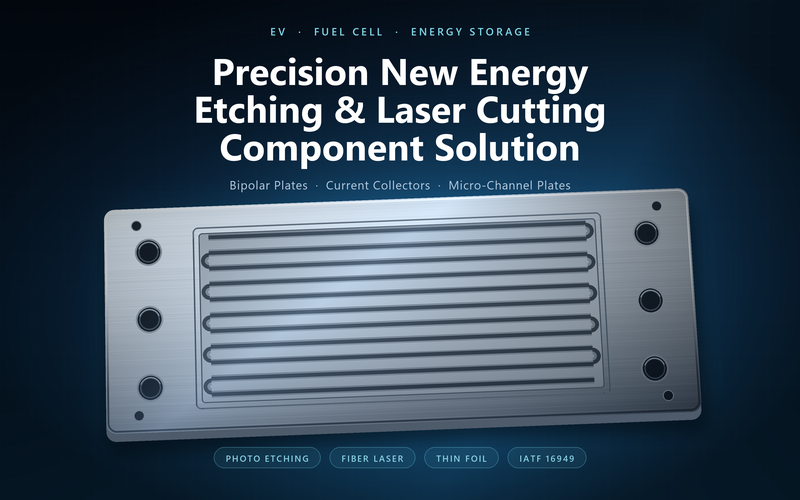
Photo-etched bipolar plate with serpentine flow channels.
The integrated processing solution combining photochemical etching and high-precision fiber laser cutting covers full-scenario manufacturing of electric vehicle (EV) power batteries, fuel cells, energy storage systems, and smart grid components. Supported by ISO 9001:2015 quality system and IATF 16949 automotive quality management system, it adopts composite processing technology of stress-free chemical etching and ultra-fine laser cutting to solve processing difficulties of ultra-thin current collectors, high-precision bipolar plates, complex electrode tabs, and micro-channel heat exchange components. Compliant with RoHS, REACH environmental standards and automotive electronic reliability specifications, it supports customized batch production for new energy vehicle manufacturers, battery factories, and energy storage system integrators.
Core Process Advantages for New Energy Components
Compared with traditional stamping, rolling, and single laser processing, the dual-process collaborative mode fully meets the high-current, high-precision, high-reliability processing requirements of new energy components with stronger process adaptability:
-
Photochemical Etching Process: Adopts low-temperature, high-precision chemical corrosion technology to form ultra-thin metal foils (0.01mm-2.0mm) with complex patterns in one piece. The process is stress-free, ensuring no warping or deformation of the material. It can achieve a minimum line width/space of 0.05mm, ensuring the high current density and uniform conductivity of components such as current collectors and bipolar plates. No custom mold is required, enabling rapid prototyping and flexible production.
-
Precision Laser Cutting Process: Uses a high-power, ultra-fast fiber laser system to achieve cold cutting of various metal materials. The heat-affected zone is minimal, avoiding material performance degradation caused by thermal processing. It can achieve a cutting precision of ±0.01mm, meeting the high-precision assembly requirements of new energy components. The non-contact processing method ensures no mechanical stress or damage to the workpiece surface, suitable for cutting high-value, thin, and fragile materials.
Applicable Materials for New Energy Processing
Custom processing available for full-range high-conductivity, high-corrosion-resistance, high-temperature-resistant special metals and alloys as follows:
Copper Foil, Aluminum Foil, Stainless Steel, Titanium Alloy, Hastelloy, Inconel, Nickel Alloy, Silver Alloy, Graphene-Coated Metal Foil
Full-range Processed New Energy Components
1. Electric Vehicle (EV) Power Battery Components
- Ultra-thin Current Collector (Copper/Aluminum Foil)
- Precision Electrode Tab
- Battery Module Spacer & Shim
- Thermal Management Micro-channel Plate
- Battery Pack EMI Shielding Cover
2. Fuel Cell Components
- High-precision Bipolar Plate
- Gas Diffusion Layer (GDL) Support Frame
- Catalyst Coating Mask
- Fuel Cell Stack Manifold
- Seal Gasket for Stack
3. Energy Storage System Components
- Grid-scale Battery Current Collector
- Energy Storage Container Heat Exchanger
- Power Conversion System (PCS) Metal Parts
- Battery Management System (BMS) Shielding Case
4. Smart Grid & Other New Energy Components
- Solar Cell Metal Electrode
- Wind Power Generator Blade Metal Parts
- Smart Meter Precision Components
- Supercapacitor Electrode Plate
Process Pain Points, Solutions & Optimization Benefits
| Traditional Processing Pain Points | Composite Process Solutions | Optimization Benefits |
|---|---|---|
| Stamping causes material stress and warping, reducing battery cycle life | Stress-free photochemical etching ensures flatness and material integrity | Increases battery cycle life by over 15%, improves energy storage efficiency |
| Single laser cutting has a large heat-affected zone, causing material performance degradation | Ultra-fast laser cold cutting minimizes thermal impact | Maintains 99%+ material conductivity, ensures component reliability |
| Complex component design requires multiple molds, high cost and long lead time | Digital photochemical etching and laser cutting, no mold required | Reduces new product development cost by 30%, shortens lead time to 3-5 days |
| Micro-channel processing is difficult, low efficiency and high cost | High-precision etching forms complex micro-channels in one piece | Improves heat exchange efficiency by 20%, reduces energy consumption |