

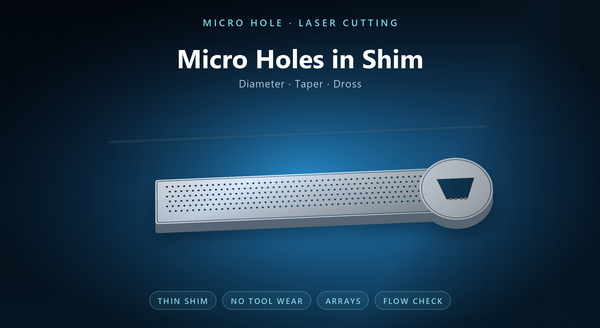
orifice plate laser cutting
Stainless steel shim micro hole laser cutting is the drilling and cutting of small holes — typically below a millimetre, often a few tenths — through thin stainless shim, using a focused beam rather than a drill, a die or a resist. The part is usually an orifice plate, a restrictor, a spray or acoustic aperture, or a gas-path shim, and its function is set by the holes rather than the outline. That makes the hole the specification: diameter, taper, edge and position, all in a sheet thin enough that heat and handling matter as much as the beam.
1. What a Micro-Holed Shim Does
A micro-holed shim is a flow element. It sets a restriction, meters a spray, tunes an acoustic path or distributes a gas, and its performance comes from the open area and the edge of each hole.
Four families cover most of the work. A restrictor or orifice plate sets a pressure drop or a flow rate in a hydraulic or fuel circuit. A spray or nozzle shim forms a pattern of jets. An acoustic shim tunes a cavity behind a membrane, and it is usually tuned by trial, which is another reason the pattern has to be easy to revise. A vacuum or air-bearing shim distributes pressure across a face.
In every case the hole diameter is a functional dimension, not a manufacturing detail, which is why a tolerance on a 0.2 mm hole is a different kind of tolerance from one on a 20 mm outline. The same shim often carries both, and the two are toleranced differently for the same reason: a flow shim is often the cheapest way to correct a circuit that was tuned on the bench.
2. Why Laser for Micro Holes
A mechanical drill below about half a millimetre becomes fragile, slow and prone to wander, and its burr on a thin sheet is a burr on the face that matters.
A laser has no tool to break, no burr from a cutting edge, and no die to wear. It can place a hole where the file says, change the diameter by changing a parameter, and cut a pattern of hundreds of holes in one program. It also cuts the outline and the holes in one setup, so the pattern and the edge register to each other, and fibre lasers have made micro holes in stainless routine because the wavelength couples well to steel.
The trade is heat. A laser puts energy into a thin sheet that has very little material to absorb it, so the process has to be run in a way that does not distort the shim or leave dross around the hole. A drill also leaves a burr on the exit face, and on a shim that face is often the sealing face.
3. Diameter to Thickness
The governing number is the ratio of hole diameter to sheet thickness. A hole that is large relative to the sheet cuts cleanly; a hole that is small relative to the sheet becomes a deep, tapered bore with dross at the exit.
For thin shim the ratio is usually favourable, which is why shim is a good home for micro holes. A 0.2 mm hole in 0.1 mm stainless is a two-to-one ratio and cuts well; the same hole in 0.5 mm stock is a different job.
Taper is inherent. The beam converges, so the entry is slightly larger than the exit, and the wall is not parallel. The drawing should state which side is the datum and which diameter is measured, because a tapered hole has two diameters and they differ. The focal spot sets the smallest hole the optics can make, so a hole smaller than about half the thickness is where the process becomes a negotiation rather than a cut.
4. Hole Quality: Dross, Roundness, Edge
Three defects decide whether a micro hole works.
Dross is resolidified metal at the exit. On a flow part it changes the effective area, and on a spray part it can deflect a jet. It is controlled by power, focus, assist gas and speed rather than by a finishing step, and it is more likely on thicker shim — one reason a shim design and its thickness are decided together. A recast layer is also where corrosion starts on a stainless part that sees a fluid.
Roundness is the shape of the hole. A laser-cut hole is close to round but not perfectly so, and the deviation grows as the hole gets smaller relative to the sheet.
Edge condition is the third: a recast layer and a slightly ragged entry change the flow coefficient and, on an acoustic part, the tone. For most shim work the edge is acceptable as cut; where it is not, the drawing should say so.
5. Arrays, Pitch and Position
Most shim work is an array rather than a single hole, and an array is a positioning problem as much as a drilling one.
Pitch and count set the open area, and open area sets the flow. Position tolerance sets whether the array lands inside its land area, which is what keeps the shim from leaking around the pattern, and it should be called to a datum rather than to the array’s own centre. An asymmetric pattern will pull the shim in one direction as it cools.
An array also concentrates heat. Hundreds of holes close together can distort a thin sheet even when a single hole would not, so the cutting order and the heat input matter as much as the hole parameters.
6. Heat, Distortion and Handling
Thin stainless distorts when it is heated unevenly, and a shim that has bowed will not sit flat against the face it meters.
The practical controls are the ones the process offers: lower energy per unit length, faster travel, assist gas, and a cutting order that spreads heat rather than walking a raster across one corner.
Oxidation is the visible symptom on stainless; a dark heat tint around a hole is a sign that the assist gas or the speed is wrong, and it is also a sign that the recast is heavier than it should be. Pulse energy and overlap control the recast more than average power does, and a shim clamped flat during cutting may spring back once it is released.
Handling matters at this thickness. A shim with hundreds of micro holes is weaker than the same shim without them, and it can be bent by the fixture that holds it during cutting. A dense array also removes stiffness, so the land width between holes is a structural number, not just a spacing.
7. Where Laser Beats Etching and EDM
Three processes make micro holes in thin metal, and the choice is not automatic.
Etching makes many holes at once with no heat and no burr, and it is the natural choice for a dense array of identical holes over a large area. It is slower to turn around and its taper is set by the etch rather than by a parameter, though it holds a pitch tighter than a laser raster can.
EDM makes a single hole with excellent roundness and no heat-affected zone in the usual sense, but it is slow and needs a start hole or a small electrode, which does not suit a large array.
Laser sits between them: slower than etching per hole but faster to set up, better than etching on taper control for a single large hole, and far faster than EDM for an array. For a shim with tens of holes and a tight delivery, laser is usually the answer, and it is also the flexible route when a pattern mixes several hole sizes, because a laser changes size in software.
8. Inspection and Order Notes
Inspection covers hole diameter on both faces, taper, roundness, dross at the exit, position and pitch, flatness, and the edge condition. A plug gauge is quick but tells nothing about taper, so it should not be the only check.
The functional check is a flow check: measure the flow or the pressure drop across the shim at a stated condition. Two shims that pass every dimensional check can differ in flow if the taper or the dross differs, which is why the flow number is worth specifying — and why the fluid and pressure have to be stated, or the number is not comparable between lots.
An order should state the alloy and thickness, the hole diameter with a tolerance and a stated measurement face, the taper or the acceptable range, the pattern with pitch and count, the flatness limit, the edge acceptance, and the test condition for the flow check.
The recurring mistakes are a hole diameter with no measurement face, a taper left unstated on a thick shim, a flow requirement never converted into a hole tolerance, and a drawing that treats a 0.2 mm hole as if it were a 2 mm one.
