stainless steel bipolar plate
Metal bipolar plate is one of the core components of proton exchange membrane fuel cells. It undertakes functions of electron conduction, gas distribution, heat transfer and structural support. Choosing the best material directly affects fuel cell stack efficiency, service life and total system cost.
1. Stainless Steel (Most Widely Used)
Stainless steel is the mainstream material for metal bipolar plates in commercial fuel cell stacks.
- Advantages: High mechanical strength, low raw material cost, mature thin-sheet forming and chemical etching / laser cutting process, good gas tightness.
- Weakness: Poor inherent corrosion resistance under acidic fuel cell environment; surface coating is mandatory to reduce contact resistance and prevent ion precipitation.
- Typical grade: 316L, 304 stainless steel.
- Application: Automotive fuel cells, stationary power generation, mass production stacks.
2. Titanium Alloy
Titanium and titanium alloy bipolar plates are preferred for high durability and harsh working conditions.
- Advantages: Excellent natural corrosion resistance, low density, high specific strength, stable in acidic humid environment.
- Weakness: Higher raw material cost; difficult forming and machining; expensive coating treatment.
- Application: Aerospace, marine fuel cells, high-end backup power, long-life stacks.
3. Aluminum Alloy
Aluminum alloy features ultra-low density and outstanding thermal conductivity.
- Advantages: Lightweight, excellent heat dissipation, low material cost, easy stamping.
- Weakness: Extremely vulnerable to corrosion in fuel cell working medium; requires high-performance protective coating.
- Application: Portable fuel cell devices, low-power stacks with strict weight limits.
4. Copper Alloy
- Advantages: Highest electrical conductivity among common metal bipolar plate materials, low contact resistance.
- Weakness: Severe corrosion risk; heavy anti-corrosion coating required; higher density.
- Application: Special high-current density fuel cell prototypes and lab research.
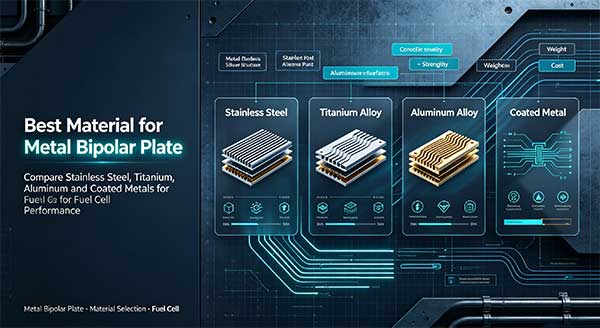
Core Comparison Table
| Material | Conductivity | Corrosion Resistance | Weight | Cost | Main Limitation |
|---|---|---|---|---|---|
| Stainless Steel | Good | Poor (coating needed) | Medium | Low | Corrosion without coating |
| Titanium Alloy | Medium | Excellent | Light | High | High manufacturing cost |
| Aluminum Alloy | Very Good | Poor | Ultra-light | Medium | Easy corrosion |
| Copper Alloy | Excellent | Poor | Heavy | Medium | Corrosion & weight |
How to Select the Best Material
- Target working life: Long-life stacks → titanium or coated stainless steel. Short-cycle portable products → coated aluminum.
- Power density requirement: High current density stacks prioritize high conductivity (copper, coated stainless steel).
- Mass production budget: Large-scale automotive projects normally select coated thin stainless steel, balancing performance and cost.
- Manufacturing feasibility: Thin metal foils (0.05–0.2mm) can be processed by chemical etching or laser cutting for flow channel patterns.
Summary
For mass commercial fuel cell applications, coated thin stainless steel is the best overall material for metal bipolar plates. Titanium alloy is the premium choice for extreme environment and long service life requirements. Aluminum and copper are only suitable for specific customized prototypes or low-volume special scenarios.