
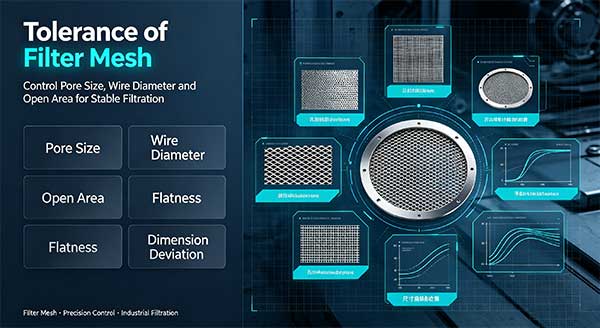
etched filter mesh tolerance
Filter mesh tolerance defines the permissible deviation of key parameters for finished filter screens, covering aperture, hole position, overall outer dimension, flatness and thickness. Different manufacturing technologies deliver different tolerance capabilities. This is a critical specification for automotive oil filters, medical filtration, semiconductor purification and hydraulic systems.
Main Tolerance Items for Filter Mesh
- Aperture Tolerance Aperture tolerance refers to the allowable variation of hole size across the mesh surface.
- Photo-etched filter mesh: ±0.003 ~ ±0.015 mm, excellent hole consistency, ideal for precision filtration.
- Woven wire mesh: ±0.02 mm or higher. Aperture fluctuates due to weaving tension; larger deviation for coarse mesh.
- Hole Position Tolerance It controls the positional accuracy of each micropore in the hole array. Photo chemical etching achieves precise hole location, which is essential for uniform flow distribution. Woven mesh has no fixed hole position tolerance because its holes are formed by interlaced wires.
- Outer Dimension Tolerance The allowable error of the mesh outline, discs, rectangular sheets and mounting cutouts.
- Small mesh discs: ±0.02 ~ ±0.05 mm
- Large filter panels: ±0.05 ~ ±0.10 mm Tighter tolerance will increase inspection cost and production difficulty.
- Flatness Tolerance Flatness is highly important for assembly. Thin metal filter mesh is easy to warp. Automotive-grade filter mesh usually requires strict flatness control to avoid assembly gaps and bypass of unfiltered particles.
- Material Thickness Tolerance Depends on original metal foil stock. Stainless steel foil itself has thickness deviation, which will slightly affect aperture after etching.
Key Factors Affecting Filter Mesh Tolerance
- Manufacturing Process Photo etching is a non-thermal subtractive process, delivering the best aperture and hole position tolerance for thin microporous mesh. Laser cutting is suitable for cutting outer profiles but cannot guarantee consistent tolerance for dense micro holes. Woven mesh has limited aperture precision.
- Raw Material Quality High-quality cold-rolled stainless steel foil with stable thickness minimizes tolerance fluctuation. Surface scratches or uneven material will impact final mesh performance.
- Feature Size & Porosity Smaller micropores require stricter process control. High porosity mesh is more prone to deformation during production, which affects flatness tolerance.
- Post-processing Ultrasonic cleaning, passivation, flattening and stamping can introduce minor shape changes. Precision filter mesh requires controlled post-processing steps.
- Inspection Standard Sampling inspection or 100% full inspection directly influences the acceptable tolerance range. OEM automotive and medical projects normally adopt full vision inspection.
Tolerance Comparison: Etched Mesh vs Woven Mesh
| Item | Photo Etched Filter Mesh | Woven Wire Mesh |
|---|---|---|
| Aperture Tolerance | Ultra tight, uniform holes | Relatively large fluctuation |
| Hole Position Tolerance | Controllable | Not applicable |
| Flatness | Controllable with flattening | Depends on weaving and leveling |
| Best Use | Precision micro filtration | General coarse filtration |
Design Tips for Filter Mesh Tolerance
- Mark critical tolerance items clearly on 2D drawings, separate critical and non-critical dimensions.
- Avoid over-specifying unnecessary ultra-tight tolerance, which will raise quotation.
- For thin filter mesh, add flatness requirement in your technical specification.
- Confirm the achievable tolerance with the manufacturer before drawing finalization.
- Specify inspection method: vision measuring machine or microscope for aperture checking.
Inspection Methods
- Aperture: Optical microscope, vision measuring system
- Outer dimension: Digital caliper, micrometer
- Flatness: Flat plate and feeler gauge, vision inspection
Applications
Automotive oil filter mesh, medical device filter screens, fuel cell filter components, semiconductor gas purification, hydraulic filter mesh, coffee filter mesh.
Conclusion
Tolerance of filter mesh varies greatly by production method. If stable, tight aperture and position tolerance is required for precision filtration, photo etched metal mesh is the preferred option. For general coarse filtration, woven mesh is cost-effective with relaxed tolerance requirements. Always communicate tolerance requirements upfront to avoid quality disputes.