

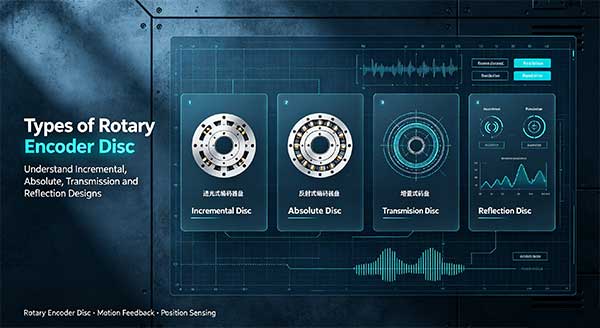
optical encoder disc
Rotary encoder disc (also known as code wheel) is the core sensing component of rotary encoders. It converts mechanical rotation into electrical signals for position, speed and angle measurement. Encoder discs are categorized by working principle, which determines material selection, manufacturing method, resolution and environmental adaptability.
1. Optical Encoder Disc
Optical code discs are the most widely used type in precision measurement. They work based on light transmission or reflection. The disc features precisely patterned slits: when rotating, light passes through or is blocked to generate pulse signals.
- Sub-types: Transmissive optical disc, reflective optical disc
- Common materials: Glass, metal (stainless steel via photo etching), plastic/polyester film
- Advantages: High resolution, excellent angle accuracy, stable signal, low noise
- Limitations: Sensitive to dust, vibration and contamination; glass versions are fragile
- Applications: Servo motors, robotics, medical equipment, precision inspection instruments, automation positioning
2. Magnetic Encoder Disc
Magnetic encoder discs carry magnetic pole tracks around the surface. Magnetic sensors detect magnetic field changes during rotation to calculate rotation angle and speed.
- Sub-types: Multi-pole magnetic ring, magnetic code disc
- Common materials: Rubber-bonded magnet, plastic with magnetic coating, metal base
- Advantages: Dust-proof, shock-resistant, robust in harsh environments, low cost for mass production
- Limitations: Lower resolution compared with optical discs; susceptible to external magnetic interference
- Applications: Automotive motors, heavy machinery, elevators, hydraulic actuators, outdoor equipment
3. Capacitive Encoder Disc
Capacitive code discs use changes in capacitance between electrode patterns on the disc and fixed sensing plates to capture rotary motion.
- Material: Printed circuit board (PCB), thin metal patterned substrate
- Advantages: Compact structure, good vibration resistance, low power consumption
- Limitations: Strict requirement for humidity and electromagnetic shielding
- Applications: Small handheld devices, consumer electronics, compact servo modules
4. Contact (Brush Type) Encoder Disc
This is the traditional mechanical type. Brushes slide over conductive and insulated segments on the disc to switch electrical circuits.
- Material: Bakelite or plastic substrate with copper conductive tracks
- Advantages: Simple structure, low cost
- Limitations: Wear caused by friction, limited service life, low rotation speed limit
- Applications: Old-style low-precision potentiometer-style rotary sensors, rarely used in modern high-precision industrial systems
Material Classification of Optical Encoder Disc
- Glass code disc: Ultra-high resolution, stable thermal performance, brittle, higher price. For high-end precision instruments.
- Metal (etched stainless steel) code disc: Thin, impact-resistant, flexible custom patterns, good for mid-to-high resolution. Produced by photo chemical etching.
- Plastic / Film code disc: Light weight, low cost, suitable for mass consumer products; less stable under temperature variation.
Selection Guide for Rotary Encoder Disc
- High precision & high resolution: Choose glass or photo-etched metal optical encoder disc.
- Dirty, vibrating, dusty industrial environment: Magnetic encoder disc is preferred.
- Compact size and low power requirement: Capacitive encoder disc.
- Low budget, low speed and low precision: Contact brush type (not recommended for new high-performance projects).
Conclusion
Optical rotary encoder discs dominate high-precision automation markets, while magnetic discs are favored for rugged industrial and automotive environments. Metal etched optical discs provide a balanced solution between precision, cost and mechanical toughness, and they can be customized with different slit patterns and outer dimensions. When selecting encoder disc type, match the working environment, required resolution and budget at the design stage.
