
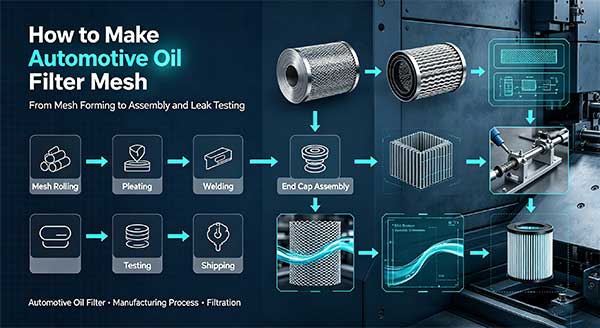
photo etched oil filter mesh
Automotive oil filter mesh is a precision metal component that traps solid particles, metal debris and sludge in engine oil to protect moving engine parts. There are two dominant manufacturing routes: woven wire mesh and photo chemical etching. The photo etching method is widely adopted for high-precision automotive applications that demand consistent micropores.
1. Material Selection
The most common raw material is 304 stainless steel foil. For high-temperature or corrosive oil environments, 316L stainless steel is selected. Material thickness normally ranges from 0.03 mm to 0.15 mm. The metal foil must be clean, free of scratches, pinholes and surface contamination to guarantee uniform filtering performance.
2. Two Main Manufacturing Processes
Option A: Photo Chemical Etching (For Precision Oil Filter Mesh)
- CAD Pattern Design Engineers draw the hole array, outer contour, positioning notches and dimensional tolerances according to customer drawings. The hole size, hole spacing and porosity are calculated to meet target oil flow rate and filtration efficiency.
- Pre-treatment of Metal Foil The stainless steel foil is cleaned by ultrasonic washing to remove grease, dust and oxidation. A dry photoresist film is laminated onto both sides of the metal sheet.
- Exposure & Development The film is exposed under UV light with a precision photomask. The exposed resist becomes hardened, while unexposed areas are washed away during development, revealing the metal areas to be etched.
- Chemical Etching The sheet goes through an etching bath. The exposed metal is dissolved by chemical solution from top and bottom simultaneously, forming uniform micropores and outer shape.
- Stripping Remaining photoresist is stripped off completely after etching.
- Post-processing Parts undergo deburring, passivation, ultrasonic cleaning and drying. Flatness correction is carried out to meet automotive flatness requirements.
- Quality Inspection Inspect pore dimension, hole position, outer diameter, flatness and surface condition. Random sampling or full inspection is available for automotive OEM orders.
- Packing Qualified oil filter mesh pieces are packed in clean anti-static packaging.
Option B: Woven Wire Mesh (For General Coarse Filtration)
- Select stainless steel wire of specified diameter.
- Weave wires on looms to form continuous mesh rolls.
- Slit the mesh roll into required width.
- Punch or laser cut blanks into final disc shape.
- Clean and inspect the finished mesh.
- Pack for delivery.
Comparison of Two Processes
- Photo-etched mesh: Consistent pore size, thin flat profile, customizable complex patterns, suitable for high precision automotive oil filtration. Higher cost.
- Woven mesh: Low cost, simple production. Pore uniformity is limited, not ideal for ultra-fine precision filtration.
Key Quality Control Points
- No burrs on hole edges
- Consistent aperture across the whole mesh surface
- Strict flatness control to avoid assembly gaps
- Material certification and batch traceability for automotive grade
- No residual chemical contaminants after cleaning
Applications
Engine oil pumps, automatic transmission filters, motorcycle oil filters, hydraulic lubrication systems for commercial vehicles.
Conclusion
Photo chemical etching is the preferred process for high-performance automotive oil filter mesh because of its stable micron-level holes and reliable repeatability for mass production. Woven mesh remains a cost-effective solution for less demanding coarse filtration scenarios. Choosing the right manufacturing method depends on your filtration accuracy requirement and budget.