
custom etched oil filter mesh
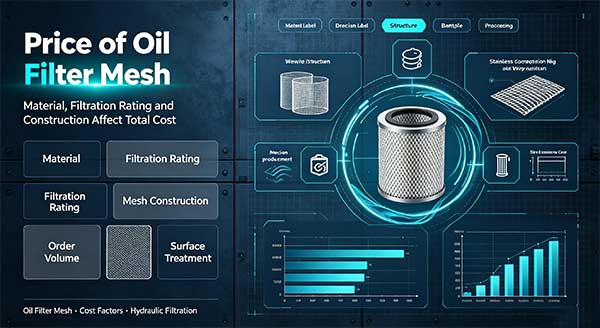
Oil filter mesh price varies greatly and is not a fixed rate. It depends on raw material, filtration micron rating, fabrication technology, dimensional tolerance, mesh shape, physical size, batch quantity, surface finishing and testing requirements. Automotive and hydraulic oil filter mesh can be produced by woven wire or photo chemical etching, and the two processes show obvious price gaps.
Key Factors Affecting Oil Filter Mesh Price
- Raw Material Grade 304 stainless steel is the most widely used and cost-effective material for oil filter mesh. 316L stainless steel, copper alloy and nickel alloy are selected for corrosive, high-temperature engine oil environments and cost more. Thinner foil materials used for etched micro mesh also push up unit cost.
- Micron Rating & Hole Consistency Smaller filtration micron means higher production cost. Standard woven mesh for coarse oil filtration is economical. For automotive engine oil filtration requiring precise, uniform tiny holes, photo-etched mesh is preferred. Consistent hole geometry and tight pore tolerance will increase manufacturing and inspection workload.
- Manufacturing Process
- Woven wire mesh: Low cost for standard coarse filtration, simple round or rectangular blanks. Limited for ultra-fine, high-precision hole arrays.
- Photo chemical etching: Best for thin metal oil filter mesh with precise, uniform micropores. Etched mesh maintains stable flow rate and prevents particle bypass, widely adopted in automotive engine oil systems. Higher cost than common woven mesh.
- Laser cutting: Suitable for large perforated plates, not cost-effective for dense micro holes.
- Dimensional & Flatness Tolerance Automotive-grade oil filter mesh requires strict flatness, outer diameter and hole position tolerance. Tighter tolerance needs full visual and dimensional inspection, adding quality control expense. For OEM automotive projects, material certification and batch traceability further raise the cost.
- Shape & Structure Complexity Simple flat disc oil filter mesh has lower processing cost. Multi-layer composite mesh, stamped forming, welded frames, folded edges and special mounting cutouts add extra processing steps and costs.
- Order Volume & MOQ Prototyping and small batch orders carry higher one-time tooling and setup charges, resulting in higher unit price. Mass production for automotive OEM can greatly reduce per-piece cost.
- Post-processing & Packaging Ultrasonic cleaning, deburring, passivation, oil removal, RoHS compliance and clean industrial packaging all bring extra costs.
General Price Reference
- Standard woven stainless steel oil filter mesh sheet: $1.8–5 per square meter
- Simple etched oil filter disc, small batch: $0.6–3 per piece
- Automotive-grade precision etched oil filter mesh with strict tolerance: $3–12 per piece
Note: All prices are reference only. Final quotation relies on your drawings, material specs and order quantity.
Information Needed for Exact Quotation
- 2D technical drawings or sample photos
- Material type and metal thickness
- Micron rating, hole pattern and porosity
- Outer dimension, flatness and tolerance requirements
- Order quantity (prototype / mass OEM production)
- Post-treatment, test and certification requirements
Main Applications
Automotive engine oil filtration, motorcycle oil pump filter, hydraulic station oil filtration, transmission fluid filtration, heavy machinery lubrication systems.
Conclusion
When comparing oil filter mesh price, do not only focus on unit price. The mesh’s hole consistency, material corrosion resistance and flatness directly affect engine protection. A reliable custom manufacturer reduces filter failure risk and lowers your after-sales rejection rate.