

custom microporous filter screen
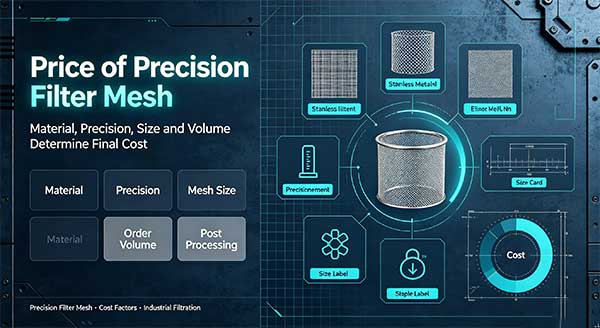
The price of precision filter mesh is not fixed. It varies widely based on raw material, pore specification, manufacturing technology, dimensional tolerance, part size, order volume, post-processing and testing requirements. For industrial custom precision filter mesh, photo-etched microporous mesh usually costs more than standard woven wire mesh due to ultra-fine hole accuracy and tight tolerances.
Main Factors Affecting Precision Filter Mesh Price
- Raw Material Selection Material is one of the biggest cost contributors. 304 stainless steel is the most common cost-effective option. 316L stainless steel, copper alloy, nickel, Hastelloy and other special alloys carry higher material costs. Thinner metal foils (0.03mm, 0.05mm, 0.1mm) also raise production difficulty and unit price.
- Pore Size & Porosity The smaller the pore size, the higher the cost. Micropores below 50μm require advanced photochemical etching technology. High porosity increases etching time, while low porosity needs more raw material. Uniformity of hole pattern also impacts manufacturing complexity and inspection workload.
- Manufacturing Process
- Woven mesh: Low cost for standard coarse mesh, limited for ultra-fine precise custom shapes.
- Photo chemical etching: Ideal for complex pattern, consistent micro holes and thin metal sheets. Higher cost than woven mesh, widely used in medical, automotive and sensor filtration.
- Laser cutting: Suitable for larger perforated panels, less economical for dense micro pores.
- Tolerance & Quality Requirements Tighter dimensional and positional tolerance increases inspection cost. For applications in automotive, medical and semiconductor industries, extra quality control, full inspection and certification will push up the price.
- Part Size & Shape Complexity Simple rectangular or round mesh discs have lower tooling and processing fees. Irregular outlines, folded edges, frames, multi-layer assembly and special forming will add extra processing charges.
- Order Quantity & MOQ Unit price drops significantly with higher batch volume. Prototyping and small-batch orders bear higher setup and one-time tooling cost. Mass production reduces per-unit cost greatly.
- Post-treatment & Packaging Surface treatments such as passivation, polishing, deburring, ultrasonic cleaning, oil removal and custom clean packaging add extra cost. Special requirements like RoHS certification or cleanroom packaging also affect final pricing.
General Price Reference
- Standard woven stainless steel filter mesh: $2–6 per square meter
- Etched precision microporous mesh (simple disc, medium batch): $1–8 per piece
- Ultra-fine thin etched mesh with strict tolerance (medical/semiconductor grade): $10–30+ per piece
Note: All figures are for reference only. Final quotation depends on your drawings and technical specifications.
How To Get Accurate Quotation
To receive an accurate price for precision filter mesh, prepare the following information:
- 2D/3D drawings or sample photos
- Material grade and thickness
- Pore size, hole pattern and porosity
- Outer dimension and tolerance requirement
- Order quantity (prototype / mass production)
- Post-processing, testing and certification needs
Applications
Precision filter mesh serves automotive oil filtration, medical devices, coffee filtration, semiconductor sensors, fuel cell systems, chemical purification, aerosol detectors and hydraulic equipment.
Conclusion
When evaluating the price of precision filter mesh, avoid judging only by unit price. It is critical to balance manufacturing capability, hole consistency, material stability and after-sales support. A reliable manufacturer can provide stable performance and reduce rejection rate for your filtration system.
