
precision metal parts
Chemical etching is a highly reliable subtractive manufacturing technique for producing thin metal components widely adopted in the energy storage industry. The process uses controlled chemical reaction to remove unwanted metal material, requiring no hard stamping or thermal cutting, so there is no mechanical stress, burrs or heat-affected zones on finished parts.
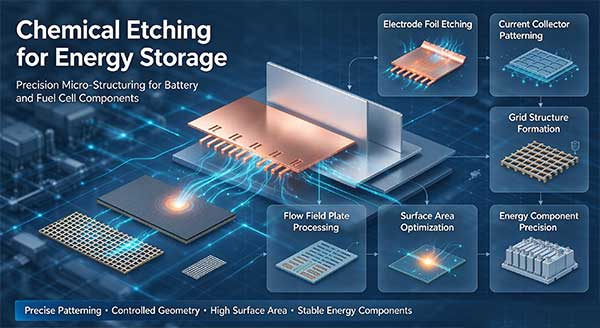
For energy storage applications, chemical etching can produce many critical components, including battery current collectors, flow field plates, metal shims, conductive spacers, micro filter screens and connection tabs. These etched parts need uniform thickness, precise micro holes and flat surfaces to guarantee stable electrical conductivity, reliable sealing and long service life of energy storage modules.
Common raw materials for energy storage chemical etching include stainless steel, nickel, copper, aluminum alloy and titanium. Engineers select materials according to conductivity, corrosion resistance, tensile strength and battery chemical environment requirements.
A key benefit of chemical etching is its flexibility for complex custom geometries. It supports rapid prototyping and mass production with low tooling cost. Even ultra-thin foils can be processed while maintaining tight tolerances, which is difficult to achieve with traditional machining methods.
Typical use cases cover lithium-ion battery packs, energy storage stacks, fuel cell energy storage systems and supercapacitor assemblies. Chemical etching meets strict dimension and surface quality standards required by modern energy storage equipment.