
chemical etched shims
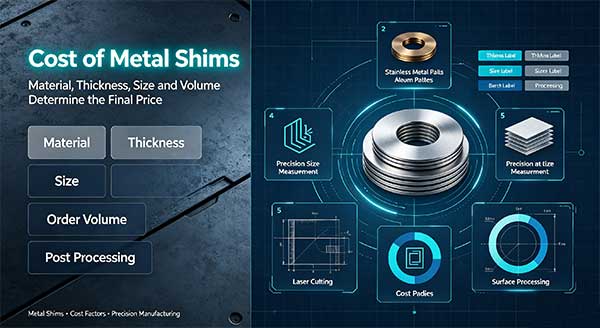
Metal shims are thin spacer components used to adjust clearances, compensate for assembly tolerances and level mechanical parts. The cost of metal shims is not fixed and fluctuates significantly, mainly determined by raw material, thickness, fabrication method, dimensional tolerance, geometry, batch size, post-processing and inspection requirements. Stainless steel, copper, brass and alloy shims are widely used in automation, motors, new energy and precision machinery.
Main Factors Affecting Metal Shim Cost
- Raw Material Grade Material is one of the primary cost drivers. 304 stainless steel is the most common cost-effective option. 316L stainless steel, copper, brass, nickel and special alloys carry higher raw material costs. Ultra-thin foil below 0.1mm is more expensive than standard sheet stock.
- Material Thickness Ultra-thin shims (0.02 mm, 0.03 mm, 0.05 mm) demand premium foil and tighter process control, raising unit price. Thicker shims over 0.5mm are easier to process with lower per-unit processing cost.
- Manufacturing Technology
- Stamping: Lowest unit price for simple round/rectangular shims in mass volume. High upfront mold cost, not economical for frequent design changes or small runs.
- Laser cutting: Flexible for prototype and low-volume custom shims. No hard mold required. Higher unit cost for ultra-thin foils due to thermal deformation risk.
- Chemical etching: Ideal for ultra-thin, complex-profile burr-free precision shims. No thermal distortion. Low tooling cost for design revisions, competitive price for medium and mass production of thin shims.
- Tolerance & Flatness Requirements Tighter dimensional and flatness tolerance increases production difficulty and inspection expense. Precision-grade shims for servo or fuel cell assemblies often require 100% vision inspection, which pushes up total cost.
- Shape & Feature Complexity Simple solid flat discs or rectangular strips have lower processing fees. Irregular outlines, multiple cutouts, U-slotted shims and multi-layer peelable shims add extra machining steps and cost.
- Order Quantity & MOQ Prototyping and small batch orders bear higher one-time setup or photo tooling charges, leading to higher unit price. Mass production greatly reduces per-piece cost.
- Post-processing & Quality Certification Deburring, passivation, ultrasonic cleaning, flattening, anti-rust treatment and custom packaging add cost. Material certificates, batch traceability and RoHS compliance also increase overall pricing.
General Price Reference
All figures are for reference only, based on stainless steel custom shims.
- Simple stamped stainless steel shim, mass production: $0.02–$0.10 per piece
- Laser cut custom shim, prototype / small batch: $0.10–$0.60 per piece
- Chemical etched ultra-thin precision shim (0.03~0.1mm, tight tolerance): $0.20–$1.20 per piece
- Special alloy or multi-layer peelable shim: $1.50+ per piece
Required Information for Accurate Quotation
- 2D engineering drawings or sample photos
- Material type and shim thickness
- Outer dimensions, features and tolerance requirements
- Order quantity (prototype or mass production)
- Post-treatment, inspection and certification needs
Applications
Mechanical equipment assembly, motor gap adjustment, fuel cell stacks, automotive assemblies, automation fixtures, bearing preload adjustment, aerospace prototypes.
Conclusion
When evaluating the cost of metal shims, do not only compare unit price. The edge quality, flatness and thickness consistency directly affect assembly accuracy. For ultra-thin precision shims with complex contours, chemical etching often delivers better overall value by eliminating burrs and thermal deformation. Confirm manufacturability and tolerance feasibility before finalizing drawings.