
custom micro mesh
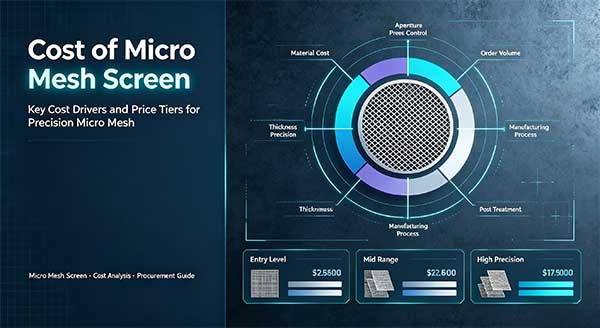
The cost of micro mesh screen varies drastically, mainly determined by raw material, pore size, manufacturing technology, dimensional tolerance, part size, thickness, order quantity, surface treatment and quality inspection standards. Simple woven micro mesh is affordable for general filtration, while ultra-fine photo-etched micro mesh with strict micron-level tolerances for medical, automotive and semiconductor use carries a much higher unit price.
Main Factors Affecting Micro Mesh Screen Cost
1. Material Selection
304 stainless steel is the most widely used economical option for industrial micro mesh. 316L stainless steel offers better corrosion resistance for chemical, medical and high-temperature environments, with raw material cost roughly 30–40% higher than 304. Copper, nickel, brass and specialty alloy mesh are more expensive and reserved for special conductive or corrosion-resistant applications.
2. Pore Size & Open Area
Smaller micropores increase production difficulty and scrap rate. Pores below 0.1 mm require high-precision processing. Consistent hole geometry and uniform aperture tolerance push up manufacturing costs. Higher open area design also raises technical requirements and price.
3. Manufacturing Process
- Woven micro mesh: Low cost for large orders, suitable for regular micron filtration. Limitations include slight wire offset and inconsistent aperture.
- Photo chemical etched micro mesh: Best for ultra-thin substrates and highly uniform micro holes. Tooling cost is low for samples, but unit price is higher than woven mesh for mass production.
- Laser perforated mesh: Flexible for small-batch custom prototypes, but expensive for mass production and limited on tiny micro holes.
- Sintered multi-layer mesh: Premium grade with gradient filtration performance, highest material and processing cost.
4. Thickness, Size & Tolerance
Ultra-thin sheets (0.02–0.1 mm) are prone to deformation during processing, leading to higher reject rates. Larger mesh panels also increase production risk. Tight tolerance requirements for flatness, hole position and dimensional accuracy require 100% AOI inspection and add extra cost.
5. Order Quantity & MOQ
Unit price drops significantly with larger batch volumes. Sample orders (1–10 pcs) include one-time setup, film and testing fees. Bulk production over 1000 pieces can reduce per-piece cost greatly. Standard in-stock mesh is cheaper than fully custom parts.
6. Post-processing & Certifications
Passivation, polishing, deburring, forming, welding, laser marking, FDA, RoHS or ISO certifications add extra labor and inspection expenses.
Reference Price Range (Metal Micro Mesh Screen)
- Standard woven 304 micro mesh (large bulk): $2.5–$8 / sq.m
- Regular photo-etched micro mesh, 0.1–0.3mm pores: $8–$30 / sq.m
- Ultra-fine etched micro mesh (<0.05mm pores, tight tolerance): $30–$120 / sq.m
- Sintered multi-layer micro mesh: $80–$200+ / sq.m
- Small custom cut discs / shaped micro mesh components: $0.5–$15 / pc, depends on dimension and precision
Cost Saving Tips
- Select woven mesh if ultra-consistent aperture is not mandatory.
- Use standard pore sizes and common material (304 stainless steel) whenever possible.
- Relax tolerance specs to the minimum requirement your system actually needs.
- Combine multiple part revisions into one batch to reduce repeated setup charges.
- Confirm MOQ and lead time in advance to unlock volume discounts.
Typical Applications
Micro mesh screens are widely applied in automotive oil filtration, coffee filters, fuel cell components, medical equipment, sensor protection, semiconductor filtration, hydraulic systems and electronic EMI shielding.
Conclusion
There is no fixed price tag for micro mesh screen. The biggest cost driver is pore precision and manufacturing method. Photo-etched micro mesh delivers superior hole uniformity for precision filtration, while woven mesh remains the cost-effective option for general industrial filtration.