

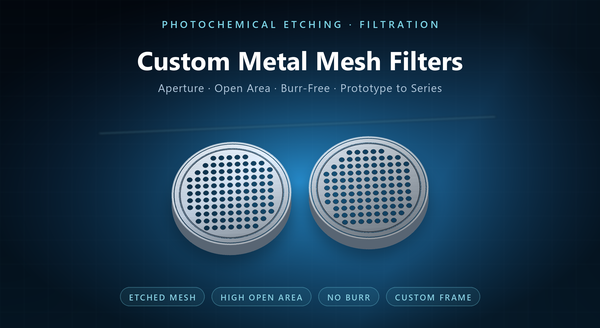
metal filter screens
Custom metal mesh filters are flat or formed screens with a pattern of precise apertures cut into metal sheet rather than woven from wire. Etching produces that pattern from a digital file, so hole size, spacing and open area can be tuned to a flow and filtration target without a die, which makes the format practical for prototypes, low-volume programs and designs that are still changing. The difficulty is rarely the etching itself. It is the specification, because an etched filter is a set of coupled decisions and three numbers carry most of them. This guide works through those numbers, the comparison with woven cloth, and the order details that decide performance.
1. Aperture, Open Area and Thickness: Three Coupled Parameters
Aperture is the hole dimension the etchant defines, and buyers ask about it first because it sets what passes and what is retained. Open area is the share of the sheet left open, and it sets flow and pressure drop. Thickness is the sheet gauge, and it sets stiffness, strength and service life. The three interact, and that interaction is where most specification errors start.
Enlarging apertures is the obvious way to raise open area, but it also changes the ratio of hole size to ligament width. A pattern of wide holes and thin ligaments is weak in handling and can distort during rinsing. Holding open area while shrinking apertures means more holes and narrower ligaments, which pushes the process toward its practical limit. Adding thickness restores stiffness but lowers open area for the same pattern and lengthens the etch.
In woven cloth these three arrive as a package chosen from a catalogue. In an etched filter they are separate variables on a drawing, so the buyer states the trade-off instead of accepting a standard weave. A useful habit is to write the aperture, the minimum open area and the thickness as three requirements, then agree which one may move.
2. Etched Mesh Compared with Woven Wire Cloth
Woven wire cloth is made by interlacing wire, so the aperture forms at the crossings and varies slightly across the roll. Cut it and the edge can unravel unless the wire is welded or the edge is finished. Etched mesh is cut from solid sheet, so the aperture is exactly what the artwork says, the surface is flat, and a cut edge cannot unravel because there is no weave to open.
That difference shows up in service. A flat, burr-free surface is easier to clean and resists clogging better than a woven cloth whose wire crowns trap material. Uniform apertures make flow predictable and let a specification be written as a number rather than a range. Because the pattern is data, one sheet can carry mixed aperture sizes, a logo, mounting tabs and a frame in the same etch step.
Woven cloth still wins on cost per square metre at volume, and its three-dimensional structure can be an advantage where depth is wanted. The honest comparison is that etching buys aperture control, flatness and tooling-free change, paid for in material and etch time rather than in a die.
3. Designing Aperture for Flow and Pressure Drop
Aperture decides what the filter retains; open area decides how easily the fluid gets through. Pressure drop rises sharply as open area falls, and the effect compounds when the fluid is viscous or the flow is high. This is why a filter can meet its aperture callout and still miss the flow target, and why flow belongs in the conversation before the drawing is frozen.
The flow path matters as well. An etched aperture is a straight-walled or slightly tapered hole through the sheet, so the fluid passes a short distance compared with the tortuous path through a weave. That usually favours etched screens in low-pressure duties, but it also means the pattern offers less depth for holding contaminant, so the duty has to be matched to the design rather than assumed.
Mechanical support belongs here too. A large open span deflects under pressure, and deflection changes both the flow gap and the flatness the filter needs to seal. A frame, a heavier ligament pattern or a support layer can hold the span, at the cost of open area, which is why the three parameters cannot be settled one at a time.
4. Matching Material to the Fluid and the Environment
Material choice follows the medium, not the catalogue. Stainless steel covers a wide range of aqueous and mildly aggressive duties and is the usual starting point. Copper and brass suit media where conductivity or a specific surface chemistry helps. Aluminum serves weight and cost where corrosion duty is mild. Nickel alloys are specified when the fluid, the temperature or both would attack the cheaper options.
Corrosion is a property of the system rather than of the metal alone, so the fluid, its concentration, the temperature and the presence of air all belong in the enquiry. A grade that performs in one duty can fail in another at a higher temperature or with dissolved oxygen present.
The process side matters too: not every alloy etches with the same ease or the same edge quality, so a material that is ideal for the duty may need a different pattern or a different supplier route.
5. Frames, Mounting Tabs and Multi-Layer Builds
Most etched filters ship with a frame, and the frame is etched in the same step as the mesh. That single fact removes a second operation, a bonding step and a tolerance stack. The frame stiffens the panel, gives the filter a handling edge, and can carry holes for screws, gaskets or robot pick-up without extra cost.
Mounting tabs are the temporary bridges that hold the mesh in the frame until assembly. Their width and position decide whether the filter survives rinsing and shipping and whether it breaks out cleanly. Tabs belong on non-critical edges, away from sealing lands, because a tab removed from a sealing face can leave a mark that no inspection will catch. Handling holes are worth adding at the same time, since they cost nothing once the pattern exists.
Where one layer cannot meet both the flow and the retention target, layers can be combined into a multi-layer pack, with each layer carrying its own aperture pattern. A pack is specified as an assembly, with the layer order and frame called out, because the stack behaves differently from any single sheet.
6. Cost Drivers and the Prototype Stage
An etched filter has no hard tooling, so the cost is built from artwork, material, etch time, finishing and inspection rather than from a die. That changes the economics. Small quantities are viable because the setup is a file, and a design change costs a new file rather than a tool, which is why prototypes and low-volume programs fit so well.
The drivers that move price most are open area, thickness, tolerance, part size and quantity. More open area means more metal removed and a longer etch. Thicker sheet etches more slowly and needs wider ligaments. Tighter aperture tolerance adds inspection and may add process steps. Large panels use material efficiently only when the parts nest well, so the drawing and the panel layout are a single cost decision.
At volume, woven cloth is usually cheaper per square metre. The case for etching rests on aperture control, flatness, mixed patterns and no tooling, not on unit price alone.
7. Inspection: Aperture, Open Area and Flatness
Inspection of an etched filter checks the pattern, not just the outline. Aperture is measured optically at several points across the panel, and the report should give the range rather than a single reading, because a two-sided etch can vary across the panel. Open area is derived from the measured aperture and pitch, or measured directly by optical scanning, and the two methods should agree.
Flatness matters because the filter usually has to seal. A panel that bows will leak at the gasket line no matter how accurate the apertures are. Flatness is checked on a surface plate or by profile, and the acceptable limit belongs on the drawing with the sealing face identified.
Burr is checked as well. Etching leaves no rolled burr of the kind a punch produces, but handling, shearing of the frame or a secondary trim can still damage an edge. A first article should record aperture, open area, flatness and edge condition, and the sample should be produced on the same line as production.
8. Order Notes and Common Mistakes
An order should carry the aperture and its tolerance, the open area, the sheet thickness, the material, the frame and tab requirement, the flatness limit and the packing method. A mesh count borrowed from woven cloth is not a substitute, because a mesh number describes a weave, not an etched hole. Writing the target function alongside the dimensions lets the supplier propose a pattern that meets both.
The common mistakes are predictable. A nominal aperture with no tolerance leaves the accept or reject decision to the inspector. Open area is quoted without the ligament width that makes it manufacturable. A design assumes etched performance equals woven performance in depth or dirt holding. The flow direction is left unstated, so the frame ends up on the wrong face. A frame or tab change arrives after the artwork is released, when it is no longer free.
Each of these is cheaper to settle before the file is released. The parameters are few, but they are coupled, and the drawing is where the coupling has to be resolved.
