
Description
Argument
Products Description
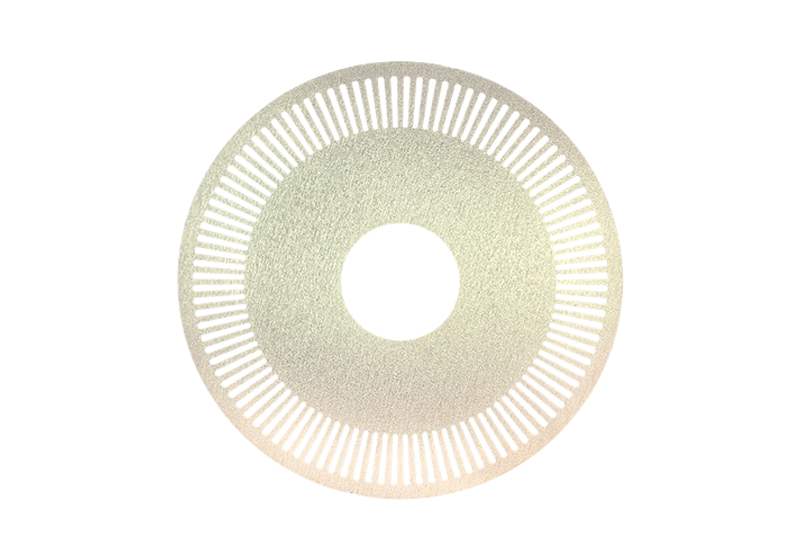
Core Advantages of Photochemical Etching for Metal Encoder Discs
Metal encoder discs, also known as code wheels or encoder gratings, are the core functional components of rotary and linear encoders, responsible for optical signal conversion and position feedback in motion control systems. Their precision directly determines the positioning accuracy and control stability of the entire equipment. Traditional manufacturing methods such as stamping, laser cutting and CNC milling struggle to meet the strict requirements of ultra-thin thickness, high-resolution grating lines and burr-free edges. Photochemical etching (PCM), as a stress-free cold subtractive manufacturing process, has become the mainstream production solution for high-end metal encoder discs worldwide.
1. Stress-Free Cold Processing, Preserving Full Substrate Integrity
Photochemical etching is a normal-temperature chemical reaction process that removes metal through uniform corrosion of etchant, without mechanical extrusion force from stamping or high-temperature heat-affected zones (HAZ) from laser processing. It does not cause lattice deformation, residual internal stress or material property changes inside the metal substrate.
Encoder discs usually adopt ultra-thin substrates with a thickness of 0.02mm to 1.0mm. Stamping process will cause warpage and arching of thin plates after demolding, resulting in poor coaxiality after installation and signal jitter during rotation; laser processing will cause local thermal expansion and contraction, leading to edge melting and grating line distortion. The etching process can control the overall flatness of the disc within ≤0.008mm, and the deformation of 0.05mm ultra-thin stainless steel foil after double-sided etching is less than 0.005mm. The stress-free substrate also ensures that the disc will not deform under long-term high-speed rotation and vibration conditions, maintaining stable signal output throughout the service life.
2. Micron-Level Precision & Uniform Grating Line Consistency
The dimensional tolerance of precision etching can stably reach ±0.005mm to ±0.01mm, and the critical grating line width and spacing accuracy can be controlled at ±5μm. It is the only process that can achieve consistent dimensions for thousands of grating lines on a single disc in mass production.
For incremental encoder discs, the line width uniformity directly determines the pulse signal duty cycle and position accuracy. The stamping process has a tolerance of generally ±0.08mm, and mold wear will cause gradual deviation of line width in mass production; laser cutting has rough inner walls of slits and large deviation of single line width. The etching process adopts zoned spray gradient etching technology, with high verticality of grating side walls and uniform depth of grooves. The width error of thousands of grating lines on a single disc does not exceed 3 microns, which ensures the consistency of optical signal on-off and supports high-resolution requirements of more than 5000 PPR (pulses per revolution). Complex coding patterns such as serpentine tracks, absolute Gray code tracks and multi-channel composite code tracks optimized by optical simulation can be reproduced without loss.
3. Burr-Free Smooth Edges for Optimized Optical Performance
Stamping and CNC machining will inevitably produce metal burrs, flanging and tool marks; laser cutting will have molten slag and oxidized carbon deposits at the incision. Tiny burrs will cause light diffuse reflection, block the optical path, and lead to signal distortion, missed codes and increased bit error rate. Burr grinding will not only increase process costs, but also easily produce metal debris that pollutes the optical system.
Etching relies on the uniform corrosion of chemical solution to peel off metal, with smooth and burr-free forming edges, no sharp edges and corners, and controllable surface roughness Ra. The smooth and vertical grating edge makes the optical signal switch sharply without trailing edge, which greatly improves the signal-to-noise ratio (SNR) of the encoder output, reduces the difficulty of subsequent circuit shaping, and avoids signal misjudgment caused by burr light leakage. For reflective encoder discs, the uniform matte base formed by etching provides an ideal light reflection interface.
4. No Hard Tooling, Fast Prototyping & Flexible Customization
A set of stamping die for encoder discs costs thousands to tens of thousands of dollars. Any adjustment of grating line number, code track layout, aperture size and outer shape requires re-machining the die, and the R&D cycle is extended by 20-40 days. Etching uses digital photomasks instead of hard steel dies. The production cost of photomasks is less than 1/50 of that of dies. Drawing modification only needs to re-output the photomask film, and samples can be completed within 24-48 hours.
From 1-10 pieces of laboratory prototype samples to millions of pieces of mass production for industrial automation brands, the etching process covers the full capacity flexibility without minimum order threshold. Multiple models of encoder discs can be typeset and etched in the same batch, and the model switching time is compressed to within 2 hours, which adapts to the simultaneous R&D and iteration of encoders with multiple powers and specifications, and reduces the overall R&D investment by more than 60%.
5. Broad Material Compatibility for Diverse Environments
Etching can stably process 304/316L stainless steel, beryllium copper, phosphor bronze, nickel alloy, titanium alloy, Hastelloy and other common metal substrates for encoders. Special etchant systems are configured for different metals: gradient ferric chloride corrosive liquid for stainless steel, low-temperature plasma-assisted etching system for titanium alloy, and corrosion inhibitor formula for ultra-thin copper foil, without damaging the original conductivity, corrosion resistance and mechanical properties of the substrate.
It perfectly adapts to two mainstream routes in the industry: stainless steel encoder discs are used for general industrial automation and civilian equipment, with outstanding cost advantages; beryllium copper and nickel alloy discs are used for high-end precision instruments and aerospace scenarios, with higher elasticity and fatigue resistance; titanium alloy discs are suitable for high-corrosion and high-temperature extreme environments. Compared with glass and plastic code discs, etched metal discs have 3-5 times higher impact resistance and wider operating temperature range.
6. Stable Mass Production & Cost-Effective Manufacturing
The whole etching process is a standardized closed-loop: material cutting → surface degreasing pretreatment → dry film coating and drying → UV exposure and development → double-sided precision etching → film stripping and passivation → clean cleaning → full dimensional inspection. The automated assembly line in constant temperature clean workshop has less manual intervention, and the comprehensive yield of single piece is stable above 98.5%.
In mass production, the cost of photomask and chemical liquid consumption is diluted. For orders of more than 100,000 pieces, the single-piece processing cost of etching is lower than that of stamping and laser cutting. There is no need for mold repair and post-processing deburring processes, and the overall processing cost is reduced by 18%-25%. The stress-free forming reduces welding and assembly rework, and the hidden scrap cost is greatly reduced.
Tags: absolute encoder disc chemical etching encoder wheel custom encoder disc etching incremental encoder disc metal encoder disc etching optical encoder disc manufacturing photo etched encoder disc precision stainless steel encoder disk thin metal encoder disc
Technical parameter
Precision Photo Etched Encoder Discs

Core Functions of Etched Metal Encoder Discs
As the core sensing component of the motion control closed-loop system, the etched metal encoder disc is installed between the light-emitting element and the photosensitive element of the encoder, and integrates five core functions: position and speed detection, optical signal modulation, direction identification, zero reference positioning, and long-term stable operation support. The reliable realization of each function highly depends on the high-precision grating and flat substrate brought by etching.
1. High-Precision Position & Speed Detection
This is the most core function of the encoder disc. When the motor drives the code disc to rotate, the evenly distributed grating slits periodically pass through the optical path, so that the photosensitive element receives periodic light and dark changes and converts them into electrical pulse signals. The control system calculates the current rotation angle, position and real-time speed of the motor by counting the number of pulses and pulse frequency.
The high-precision grating of the etched disc ensures that each pulse corresponds to an accurate angle value, and the position detection accuracy can reach micron or even sub-micron level. The higher the number of grating lines, the higher the resolution, which can meet the high-precision positioning requirements of CNC machine tools, semiconductor equipment and surgical robots.
2. Optical Signal Modulation & Stable Pulse Output
The regular grating structure modulates the continuous incident light into periodic square-wave optical signals, which are converted into standard electrical pulse signals after being received by photoelectric components. The uniform line width and spacing of the etched disc ensure that the duty cycle of the output pulse signal is stable at 50%±2%, with good waveform symmetry and no distortion.
Stable pulse signals can reduce the pressure of subsequent signal conditioning circuits, improve the anti-interference ability of the system, and avoid control errors caused by irregular waveforms. For high-resolution encoders, the signal quality directly determines the subdivision accuracy of the system.
3. Rotation Direction Identification & Zero Reference Positioning
Dual-channel (A/B phase) etched encoder discs output two pulse signals with a 90° electrical angle phase difference. The control system judges the forward and reverse rotation direction of the motor by comparing the phase sequence of the two signals, so as to realize bidirectional position control.
In addition, the independently designed zero-index (Z phase) grating line outputs a zero pulse every time the disc rotates one circle, providing an absolute zero reference for the system, which is used for position calibration and origin return after power-on. The etching process ensures the accurate position of the zero line, and the zero pulse position is accurate and reliable.
4. Closed-Loop Feedback Reference for Motion Control Systems
In the servo control system, the encoder disc provides real-time position and speed feedback signals to form a closed-loop control with the drive system, so as to accurately control the movement trajectory, positioning accuracy and speed stability of the equipment. It is the “eye” of the motion system.
The etched metal disc has high structural stability and signal consistency, which can provide long-term stable feedback signals, ensure the repeated positioning accuracy of the equipment, and meet the high-precision control requirements of automation production lines, robots and numerical control equipment.
5. Long-Term Reliable Operation Under Harsh Conditions
The metal etched disc has strong mechanical properties and environmental adaptability. It can work stably for a long time in harsh industrial environments such as high speed, high vibration, wide temperature range and oil dust, and is not easy to be damaged. It provides reliable position detection guarantee for equipment in heavy industry, outdoor vehicles, aerospace and other scenarios.
Compared with fragile glass discs and aging-prone plastic discs, metal etched discs have a service life of more than 3-5 times, which reduces the failure rate and maintenance cost of the equipment, and improves the overall reliability of the system.
Main Application Fields of Etched Metal Encoder Discs
With the rapid development of global industrial automation, intelligent manufacturing and new energy industries, the demand for high-precision encoders continues to grow, and etched metal encoder discs are widely used in all walks of life with their comprehensive advantages of high precision, durability and cost-effectiveness.
1. Industrial Automation & Servo Motor Systems
This is the largest application field of encoder discs. Various AC/DC servo motors, stepper motors and brushless motors are equipped with photoelectric encoders, which are used for speed regulation and position control of automated production lines, conveyor belts, packaging machinery, printing machinery and textile equipment. Etched stainless steel encoder discs have high cost performance and stable quality, and are the standard configuration of industrial grade encoders.
2. CNC Machine Tools & Industrial Robotics
CNC machine tools require high-precision spindle encoders and feed shaft encoders to ensure machining accuracy and surface finish; each joint of industrial robots is equipped with encoders to achieve precise motion control and trajectory planning. Etched high-line-count encoder discs have high resolution and strong vibration resistance, which can meet the requirements of high precision and long-term stable operation of equipment.
3. Aerospace & Defense Equipment
Aircraft flight control actuators, radar antenna servo systems, missile guidance systems and satellite attitude control equipment all require ultra-high reliability encoders. Etched encoder discs made of titanium alloy and high-temperature alloy have the characteristics of light weight, wide temperature resistance, impact resistance and radiation resistance, which can adapt to the extreme working environment of aerospace and meet strict military grade quality requirements.
4. Medical Devices & Precision Instruments
Surgical robots, CT scanners, MRI equipment, automatic biochemical analyzers and laboratory precision instruments require encoders with high precision, high cleanliness and stable performance. Etched medical-grade stainless steel encoder discs have burr-free and clean surfaces, can withstand disinfection treatment, and will not produce pollutants, which fully meets the strict requirements of the medical industry.
5. Automotive Electronics & New Energy Vehicles
Automotive steering assist systems, brake systems, throttle position sensors, and drive motors of new energy vehicles all use encoders. Etched metal encoder discs have strong vibration resistance and wide temperature adaptability, can adapt to the complex environment of vehicle driving, and provide reliable position and speed detection for vehicle electronic control systems.
6. Elevators, Logistics & Intelligent Warehousing
Elevator traction machine encoders, AGV trolley drive encoders, logistics sorting equipment and three-dimensional warehouse access equipment are widely used with encoder discs. Etched products have long service life and low cost, can meet the requirements of long-term continuous operation of equipment, and help the stable operation of intelligent logistics and warehousing systems.
With the continuous upgrading of global industrial intelligence and precision manufacturing, the demand for high-precision, high-reliability and cost-effective encoder discs is growing rapidly. Photochemical etching, with its unique advantages of stress-free forming, micron-level precision, burr-free quality, flexible customization and high cost performance, has become the preferred manufacturing process for high-end metal encoder discs, gradually replacing traditional stamping and laser cutting processes.
Etched metal encoder discs, with their stable product characteristics and complete core functions, support the continuous progress of motion control technology in various industries, and have broad market growth space in the fields of industrial automation, robotics, new energy, aerospace and medical equipment.