
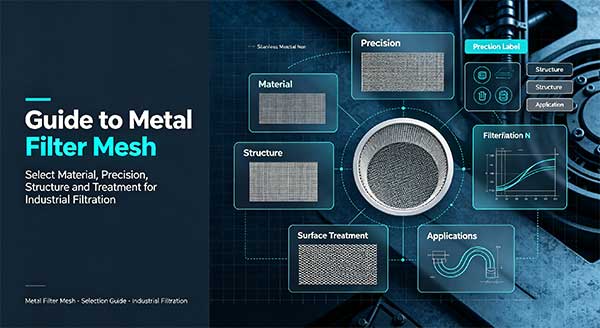
microporous metal filter mesh
Metal filter mesh is a durable filtration component fabricated from metal foils or wires. It separates solid particles from liquids or gases, widely used in automotive, food & beverage, medical, fuel cell, chemical and precision instrument industries. Compared with plastic filter media, metal filter mesh features high temperature resistance, mechanical strength, cleanability and long service life.
1. Main Types of Metal Filter Mesh
1.1 Woven Wire Mesh
Formed by interweaving metal wires into regular mesh openings.
- Features: Low cost, large filtration area, flexible specification range.
- Limitation: Minimum aperture limited by wire diameter; poor precision for ultra-fine and complex patterns.
- Common use: Coarse to medium filtration, industrial liquid filtration.
1.2 Photo Etched (Chemical Etching) Mesh
Fabricated by selectively removing metal from thin metal foil through photochemical machining.
- Features: Highly consistent hole size, precise aperture, complex custom patterns, ultra-thin substrate (0.01mm+).
- Limitation: Higher setup cost for small batch prototyping.
- Common use: Microporous filters, coffee filters, automotive oil filter mesh, fuel cell components.
1.3 Perforated Laser Cut Mesh
Laser cutting creates holes directly on metal sheets.
- Features: Fast turnaround, flexible custom shapes, suitable for medium precision holes.
- Limitation: Tiny micro-holes have higher burr risk; not ideal for ultra-fine dense apertures.
- Common use: Industrial sieve plates, ventilation panels, coarse filtration.
1.4 Sintered Metal Mesh
Multiple layers of woven metal mesh stacked and sintered together.
- Features: High pressure resistance, depth filtration structure, good backwash performance.
- Limitation: Higher cost, thicker structure.
- Common use: High-pressure chemical filtration, gas purification.
2. Common Materials
- Stainless Steel (304 / 316L): Most popular option. Good corrosion resistance, heat resistant, food-safe. Suitable for coffee filters, oil filters, general industrial filtration.
- Brass / Phosphor Bronze: Good conductivity, wear resistance, suitable for special gas and electronic filtration.
- Titanium: Excellent corrosion resistance for strong acid and high-temperature environments, high cost.
- Nickel Alloy: Used in extreme chemical and high-temperature working conditions.
3. Key Technical Parameters
- Aperture size: Determines filtration accuracy.
- Open area: Ratio of total hole area to the whole mesh area, affects flow rate and pressure drop.
- Material thickness: Thinner mesh brings higher flow rate but lower mechanical strength.
- Tolerance: Critical for etched mesh; tight tolerance guarantees uniform filtration performance.
- Flatness: Important for sealing and assembly.
4. Core Selection Principles
- Confirm filtration requirement: Define target particle size to decide aperture.
- Check working environment: Temperature, liquid/gas medium, acidity to select proper metal material.
- Flow and pressure drop: Higher open area brings better flow, lower pressure loss.
- Mechanical demand: Pressure load, vibration, assembly method decide material thickness and reinforcement design.
- Batch quantity: Choose manufacturing process accordingly. Small complex prototypes often use chemical etching or laser cutting; large simple orders use woven mesh.
5. Typical Applications
- Automotive: Engine oil filter mesh, fuel filter, hydraulic filter
- Food & beverage: Stainless steel coffee filter mesh, beverage filtration
- Medical: Medical-grade microporous purification filter mesh
- New energy: Fuel cell fluid filtration
- Chemical industry: Liquid and gas impurity separation
6. Maintenance Tips
Metal filter mesh can be cleaned and reused. Ultrasonic cleaning is commonly adopted to remove trapped particles. Avoid strong mechanical scraping which may deform the mesh or damage hole edges.
Summary
For most precision custom projects requiring consistent micro apertures, chemically etched metal filter mesh is the top choice. Woven mesh is ideal for low-cost medium filtration. Sintered mesh fits high-pressure heavy-duty filtration. Provide drawings, aperture requirement, material and working condition to manufacturers for accurate quotation.