
custom coffee filter mesh
Coffee filter mesh is a reusable metal filter used for pour-over coffee, espresso and cold brew. Stainless steel is the dominant raw material for food-grade coffee filters. There are two mainstream manufacturing methods: woven wire mesh and photo chemical etching (chemical etching). Laser cutting is also used for small-batch custom samples.
1. Material Selection
Food-grade stainless steel foil or stainless steel wire is the primary choice, usually 304 or 316L stainless steel.
- 304 stainless steel: Most common, food safe, good corrosion resistance, cost-effective.
- 316L stainless steel: Higher corrosion resistance, suitable for acidic coffee liquid and long-term repeated use. Material thickness selection: 0.05mm to 0.2mm thin foil for etched coffee filters.
2. Two Main Manufacturing Routes
Route A: Photo Chemical Etching (Most popular for precision custom coffee filter mesh)
- CAD Drawing Preparation: Design mesh pattern, aperture, open area and outer contour. The hole size controls coffee flow rate and extraction effect.
- Cleaning & Degreasing: Clean stainless steel foil surface to remove oil, dust and contaminants, ensure photoresist adhesion.
- Photoresist Coating: Apply light-sensitive photoresist film on both sides of the metal sheet.
- Exposure & Development: Align photomask, expose under UV light, then wash away unexposed photoresist to reveal the mesh pattern.
- Chemical Etching: Immerse the sheet into etching solution. Exposed metal areas are chemically dissolved to form uniform micropores.
- Stripping: Remove the remaining photoresist protective film.
- Post-treatment: Deburring, passivation, ultrasonic cleaning to remove etching residue.
- Quality Inspection: Check aperture tolerance, flatness, hole consistency, surface finish, then cut into final filter shape.
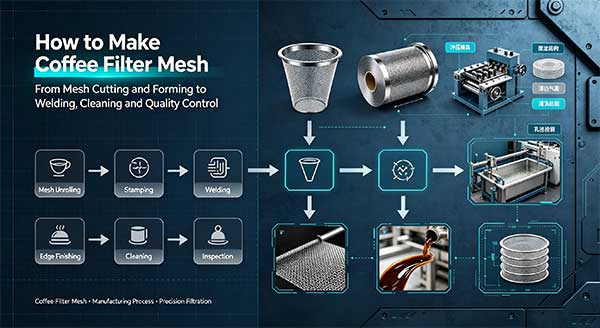
Route B: Woven Wire Mesh
- Select fine stainless steel wire of specified diameter.
- Weave wires on loom to form continuous mesh roll with target aperture.
- Slit the mesh roll into required width.
- Stamping or laser cutting to punch out round or custom filter outlines.
- Edge finishing, cleaning and inspection.
Limitation: Woven mesh holes are less uniform than etched mesh, and minimum aperture is limited by wire diameter.
Route C: Laser Cutting (For small prototype batches)
Directly cut micro holes and outer shape on stainless steel thin sheet by fiber laser.
- Advantage: Fast setup, no tooling cost for samples.
- Disadvantage: Tiny holes may have burrs; lower consistency for dense micro-hole arrays.
3. Post-processing & Surface Finishing
- Deburring: Remove sharp edges to avoid hand cuts and metal powder residue.
- Passivation: Improve anti-corrosion performance.
- Ultrasonic cleaning: Remove all oil and metal debris to meet food contact requirements.
- Polishing: Matte or bright surface options for better touch and appearance.
4. Quality Control Checks
- Aperture size and tolerance
- Open area consistency
- Surface cleanliness (food grade requirement)
- Flatness and edge condition
- Pressure / flow test for extraction performance
5. Summary
For high-end reusable coffee filters with consistent and precise micropores, photo chemical etching is the preferred manufacturing process. Woven mesh is widely adopted for low-cost mass standard filters. Laser cutting works best for custom small-volume prototypes. Send your mesh pattern and dimension drawings to manufacturers for sample development.