
metal chemical etching
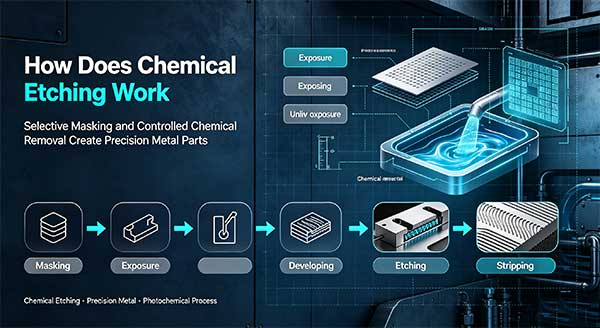
Chemical etching, also known as photo chemical machining (PCM), is a subtractive manufacturing process that creates precision patterns on thin metal sheets without mechanical cutting force. It relies on photoresist and corrosive chemical solutions to dissolve unwanted metal material. This non-contact method avoids burrs, thermal deformation and mechanical stress, making it widely used for microporous filter mesh, rotary encoder discs, thin shims and custom metal components.
Step 1: CAD Pattern Design & Photomask Making
Engineers design the required part outline, holes, slits and tolerance features using CAD software. The digital drawing is then output to produce a precision photomask film. The mask contains opaque and transparent areas to control where the metal will be etched away.
Step 2: Metal Foil Preparation
Raw thin metal foil (stainless steel, copper, nickel, alloy) is thoroughly cleaned via ultrasonic washing. Grease, oxidation and surface contaminants must be fully removed to ensure the photoresist adheres evenly.
Step 3: Lamination of Photoresist
Dry film photoresist is laminated onto both sides of the clean metal sheet under controlled heat and pressure. This light-sensitive film will protect the metal areas that need to remain intact.
Step 4: UV Exposure
The photomask is aligned tightly on top of the photoresist-covered metal. Ultraviolet light passes through the transparent regions of the mask, curing and hardening the exposed photoresist. Areas covered by the opaque mask stay unhardened.
Step 5: Development
The sheet goes through a developer solution. Unhardened photoresist is washed away, exposing the bare metal regions that will be etched. The hardened resist remains to protect the required part geometry.
Step 6: Chemical Etching
The workpiece is sprayed with heated etching chemical on both sides. The exposed metal reacts with the etchant and dissolves gradually. The protected areas covered by photoresist remain unchanged. The etching time is precisely controlled to achieve the target thickness, aperture and dimension.
Step 7: Stripping
After etching reaches the target depth, the remaining hardened photoresist is stripped off using stripping solution, revealing the finished metal part pattern.
Step 8: Post-processing & Quality Inspection
Parts go through deburring, passivation, ultrasonic cleaning and drying. Vision inspection or microscope inspection is performed to verify aperture, dimension, flatness and surface quality. Qualified products are packed.
Core Advantages of Chemical Etching
- No mechanical contact or heat input, zero burrs and no thermal distortion.
- Can produce ultra-fine, uniform micropores on ultra-thin metal foil down to 0.03mm.
- Complex 2D patterns, multi-hole arrays can be manufactured in one process.
- Consistent repeatability for prototyping and mass production.
- Low tooling cost; pattern changes only require new photomask without expensive hard dies.
Limitations
- Mainly suitable for thin metal foils, generally below 1.5mm thickness.
- Material removal rate is slower than laser cutting for large blank removal.
- Material selection is limited to metals that can react with etching chemicals.
Typical Applications
Precision filter mesh, optical rotary encoder discs, thin metal shims, fuel cell bipolar plates, medical micro components, EMI shielding parts, custom metal grids.
Conclusion
Chemical etching is a precision subtractive manufacturing process using light-sensitive resist and corrosive etchant. It excels at thin metal parts with dense micro holes and intricate geometries where laser cutting or stamping may introduce burrs or heat deformation. It is an ideal solution for high-precision custom metal components from prototype to mass production.