

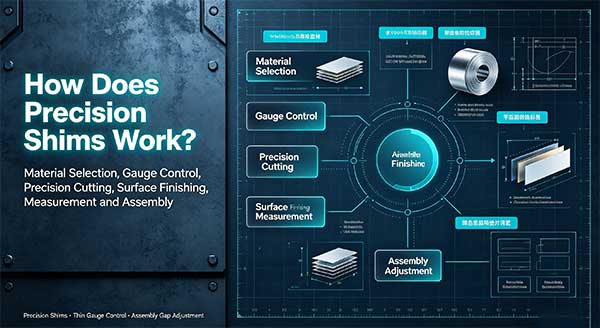
how does precision shims
Precision shims are thin, flat pieces of metal or non-metal material designed to control spacing, compensate for tolerance errors and fine-tune assembly clearances in mechanical systems.
At its core, precision shims work by inserting a controlled thin layer between two mating components. When parts are assembled, manufacturing tolerances, thermal expansion or component wear often create unwanted gaps. By placing precision shims of specified thickness into the joint, engineers can accurately set preload, adjust height, maintain parallelism and correct misalignment without machining the original parts.
Precision shims are manufactured to tight thickness tolerances. They can be single solid sheets or laminated shims that allow peeling off thin layers for incremental adjustment. Different materials are selected according to working environment: stainless steel, brass, copper, aluminum and plastic are common options.
Key Functions of Precision Shims
- Gap filling: Eliminate clearance between assembled parts.
- Position adjustment: Fine-tune height, offset and parallelism.
- Preload control: Set proper pressure for bearings, gears and spindle assemblies.
- Vibration & thermal compensation: Absorb minor dimensional changes caused by temperature fluctuation.
- Wear compensation: Restore original alignment after component abrasion.
Common Types
- Solid precision shims: Fixed thickness, high rigidity for static positioning.
- Laminated shims: Multi-layer peelable structure for micro adjustment.
- Slotted shims: Easy installation without fully disassembling equipment.
- Custom etched shims: Complex outer profiles produced via photo etching for high-volume precision assemblies.
Typical Applications
Precision shims are widely used in automotive, aerospace, pump & valve, motor, optical instrument and automation equipment. They help manufacturers reduce assembly time, lower rework cost and guarantee consistent equipment performance.
Advantages
- Fast on-site adjustment, no secondary machining required
- High dimensional accuracy, ultra-thin options available
- Custom shapes and sizes support unique assembly requirements
- Cost-effective solution for tolerance stacking issues
