
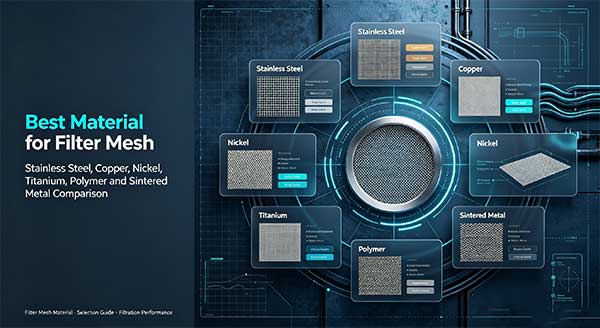
How to Select Filter Mesh Material
Selecting the best material for filter mesh depends on working environment, filtration accuracy, corrosion requirement, operating temperature and budget. Different metal materials deliver distinct performance for woven mesh, etched microporous mesh and laser cut filter panels.
1. Stainless Steel (304 / 316L) – Most Popular Option
Stainless steel is the top choice for general and medium-demanding filtration.
- 304 stainless steel: Good rust resistance, excellent mechanical strength, cost-effective. Widely used for water filtration, coffee filter mesh, air filters and oil filter screens. Not ideal for strong chloride environments.
- 316L stainless steel: Superior corrosion resistance against saltwater, acids and alkaline liquids. Suitable for chemical processing, seawater filtration and marine equipment.
- Pros: High tensile strength, reusable, easy cleaning, stable pore geometry.
- Cons: Higher cost than carbon steel; limited resistance to concentrated strong acids.
2. Copper & Brass Filter Mesh
Copper and brass mesh feature outstanding thermal conductivity and natural antimicrobial properties.
- Pros: Good ductility, easy forming, excellent heat transfer.
- Cons: Easily oxidized and tarnish in humid or acidic conditions.
- Typical uses: Gas filtration, electromagnetic shielding, heat dissipation, special fluid separation.
3. Nickel Filter Mesh
Pure nickel mesh performs well under high temperature and alkaline media.
- Pros: Great alkali corrosion resistance, stable at elevated temperatures.
- Cons: Premium price.
- Typical uses: Chemical electrolysis, battery industry, high-temperature gas filtration.
4. Titanium Filter Mesh
Titanium is the premium material for harsh corrosive working conditions.
- Pros: Outstanding acid & salt corrosion resistance, lightweight, high temperature endurance.
- Cons: Very expensive, harder to machine.
- Typical uses: Chemical industry, pharmaceutical filtration, seawater treatment.
5. Carbon Steel Filter Mesh
Low-cost material for dry, non-corrosive environments.
- Pros: Low price, high hardness.
- Cons: Prone to rust, requires coating or oil protection.
- Typical uses: Dry air screening, particle separation in non-corrosive dust filtration.
Material Selection Guide
- Corrosive fluid (acid / saltwater): Choose 316L stainless steel or titanium.
- High temperature filtration: Nickel or titanium.
- General oil, air and water filtration: 304 stainless steel.
- EMI shielding & heat transfer: Copper / brass.
- Low-budget dry dust filtering: Carbon steel.
Application Scenarios
- Automotive: 304 / 316L stainless steel oil filter mesh
- Food & beverage / coffee filters: Food-grade 304 stainless steel
- Chemical industry: 316L, nickel or titanium microporous filter screens
- Electronics shielding: Copper mesh