
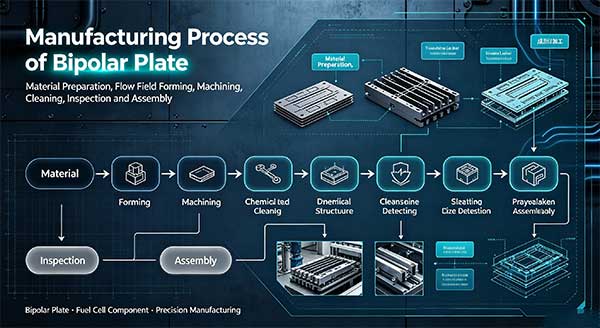
manufacturing-process-of-bipolar-plate
Bipolar plate is one of the core components of proton exchange membrane fuel cells. It distributes fuel and oxidant, conducts electricity, removes heat and drains water. Metal bipolar plates are widely adopted for their thin thickness, high conductivity and mass production potential.
1. Material Selection & Raw Material Preparation
Common substrate materials include stainless steel, titanium alloy, aluminum alloy and copper alloy. Raw metal foil is usually 0.1–0.5 mm thick.
- Slit the coil to required blank size.
- Degrease and clean the metal surface to remove oil, oxide and contaminants. Surface cleanliness directly affects coating adhesion and corrosion resistance.
2. Micro Flow Channel Forming
Two mainstream forming methods for metal bipolar plates:
Stamping
Using precision moulds to press micro flow channels on thin metal foil. High speed, suitable for mass production.
Photo Chemical Etching (Photo Etching)
No hard mould required. Etch intricate flow field patterns on thin metal sheets. Great for complex channel designs, low cost for prototype and small batch.
3. Trimming & Hole Machining
Cut outer profile and machine mounting holes, manifold ports for gas, coolant and drainage. Methods: laser cutting, photo etching or CNC punching. Strict dimensional tolerance and burr control are required, as burrs may pierce the membrane electrode assembly.
4. Surface Treatment & Coating
Base metal easily corroded in fuel cell acidic environment, leading to increased contact resistance.
- Surface activation: pickling and plasma cleaning.
- Conductive anti-corrosion coating: gold, titanium nitride, carbon composite coating or other conductive layers.
- Post-coating curing and inspection. Coating uniformity is critical to guarantee long-term fuel cell performance.
5. Stack Assembly (Two Half Plates Bonding)
Most metal bipolar plates consist of two formed single plates welded or bonded together.
- Align anode plate and cathode plate.
- Welding / laser welding / diffusion bonding to seal the cooling cavity between two layers.
- Leak test: check gas and coolant leakage.
6. Final Inspection & Testing
- Dimensional inspection: profile, channel depth, flatness, hole position tolerance.
- Contact resistance test.
- Corrosion resistance test.
- Leakage detection.
- Visual inspection for scratches, coating defects and surface damage. Qualified parts are packed for fuel cell stack assembly.
7. Main Applications
Hydrogen fuel cell vehicles, stationary power generation, portable fuel cell power supply, aerospace fuel cell systems.
Advantages of Metal Bipolar Plate
- Ultra-thin substrate reduces stack weight and volume.
- Excellent electrical and thermal conductivity.
- Mature manufacturing route for mass production.
Limitations
- Requires high-performance anti-corrosion conductive coating.
- Thin material is prone to deformation during forming.
- High precision requirement for flow channel geometry.