
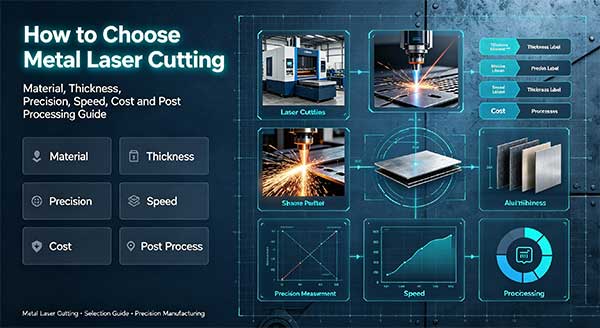
How to Choose Metal Laser Cutting
Metal laser cutting is a non-contact thermal cutting process widely used for custom metal components. Knowing how to select this manufacturing method helps you balance precision, cost and delivery time for your project.
1. Check Material Compatibility
Laser cutting works well on most common metals, but each material has different cutting performance.
- Stainless steel: Excellent for thin & medium sheets, clean cut edges, widely used for filter mesh, shims and enclosures.
- Carbon steel: Easy to cut, low cost, good for structural parts.
- Aluminum: High reflectivity, needs higher laser power; risk of burr on thick material.
- Copper & brass: Highly reflective, harder to cut. Ultra-fine micro features are not recommended for standard laser cutting.
2. Evaluate Material Thickness
Fiber laser is the mainstream for metal. The thinner the metal sheet, the higher precision you can achieve.
- Thin foil (0.02–0.3mm): Laser cutting can handle simple outlines; for tiny micro holes, photo chemical etching usually delivers better consistency.
- Medium sheet (0.3–6mm): Ideal range for fiber laser cutting, stable accuracy and fast speed.
- Thick plate (>6mm): Cutting speed slows down, edge taper increases, tolerance becomes looser.
3. Confirm Required Tolerance & Feature Size
Define your dimensional tolerance and minimum feature size before selecting laser cutting.
- Typical tolerance: ±0.03 ~ ±0.1mm, varies with sheet thickness and part dimension.
- Minimum hole: Normally the hole diameter should be at least equal to material thickness.
- If you need ultra-small uniform apertures below 0.1mm, photo etching is often a better option than laser cutting.
4. Assess Part Geometry
Laser cutting excels at complex 2D profiles, curved outlines and cutouts. ✅ Suitable: Custom outlines, perforated panels, simple cutouts, sheet metal prototypes. ❌ Not ideal: Extremely tiny dense micro holes, parts requiring zero edge burr without secondary polishing.
5. Surface Finish & Post-processing Needs
Laser cut edges may have minor burrs or oxidation.
- Mild oxidation on carbon steel can be removed by deburring.
- Stainless steel parts can choose pickling or passivation for clean surface.
- For high-precision assembly parts, deburring is usually required after laser cutting.
6. Production Volume & Lead Time
- Prototypes & small batches: Laser cutting is perfect, no expensive tooling cost, short lead time.
- Mass high-volume production with many micro holes: Photo etching often has lower unit cost and more consistent quality.
7. Supplier Selection Tips
- Verify their laser machine power and inspection capability.
- Ask for sample cutting before mass order.
- Clarify tolerance, burr control and inspection standards on drawings.
Common Applications
Sheet metal prototypes, shielding parts, perforated panels, metal shims, enclosures, industrial filter frames.