
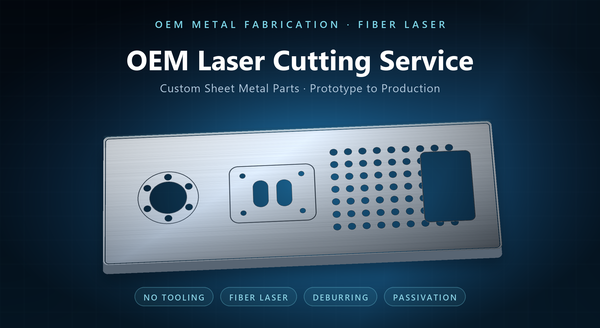
sheet metal laser cutting
An OEM laser cutting service turns a flat CAD file into production metal parts without a dedicated die, so custom programs start at prototype quantities instead of waiting for tooling. Laser cutting covers brackets, busbars, shields, covers and frame components in stainless steel, aluminum, copper and titanium. Compared with stamping and photo etching, it sits in the middle on unit cost and near the top on speed and design freedom.
The total cost of an OEM laser cutting service covers sheet material, nesting yield, cut length, sheet thickness, programming and setup, deburring, inspection, packaging and freight. Material usually dominates, and how well parts nest on the sheet decides how much metal is bought and wasted. Cut length and thickness set machine time, so a part with many small holes costs more than its outline suggests. Laser cutting carries no die cost, which is why it wins for prototypes and low volumes; above a certain annual quantity, a stamping die can be cheaper per part.
Tolerance class and edge quality are the next cost drivers. Holding a tight tolerance or a burr-free edge needs slower cutting, extra finishing or a different process. Laser cutting leaves a small heat-affected zone and a dross edge on some materials, so parts that will be coated or welded may need deburring or edge preparation. Order quantity spreads programming and setup across more parts, and repeat orders in the same material and thickness avoid re-nesting and re-programming.
We run OEM laser cutting programs from first article to series production, cutting stainless steel, aluminum, copper, brass and titanium sheet in custom thicknesses and batch sizes. Prototype samples, pilot runs and volume orders follow the same programming and inspection route. Every batch is checked for dimensions, edge condition and flatness before packing, and material certificates are available on request.
The lowest OEM laser cutting service quote rarely reflects the lowest total cost. A supplier that over-nests parts to save material can ship distorted or short parts, and poor edge quality shows up later at coating or assembly. Compare material traceability, inspection reports, tolerance capability and delivery reliability alongside price.