
precision laser cutting service
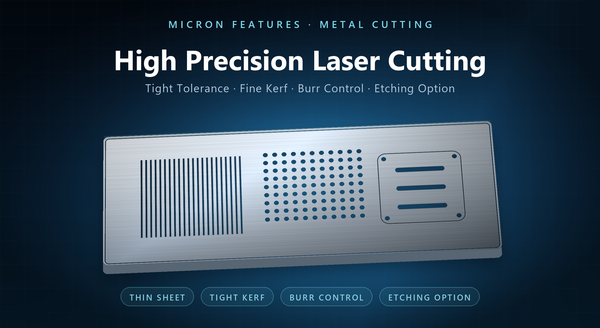
High precision laser cutting is the right process when a thin metal part needs tight tolerances and fine features without a stamping die. It cuts stainless steel, aluminum, copper, nickel alloys and foil from a CAD file, so a revision costs a new program, not a new tool. Requests described as micron laser cutting split in two: parts the laser can hold, and features that belong to photo etching.
The cost of a high precision laser cutting job covers sheet material, nesting yield, cut length, thickness, programming, fixturing for thin stock, inspection, packaging and freight. Precision raises cost because slower cutting and stress control protect the part from distortion, and thin sheet needs support to avoid vibration marks. There is no die cost, so prototypes and small series avoid the tooling write-off that stamping carries. Volume orders spread programming and setup across more parts.
What the laser can hold depends on thickness, material and feature size. Kerf width, heat-affected zone and burr set the practical floor, and those limits tighten as the sheet gets thinner. Below that floor, micron features are produced by photo chemical etching, which removes material chemically with no heat input and no burr. The two processes are complementary: laser for outlines, slots and thicker sections, etching for fine flow fields, screens and grids.
We cut thin gauge stainless steel, aluminum, copper, brass and nickel alloy parts from prototype to series production, and run photo etching in the same plant for features below laser capability. First articles are checked for dimensions, burr, flatness and edge condition, with material certificates available. Keeping both processes under one roof avoids a second supplier qualification.
A supplier that promises micron laser cutting without test data is describing a wish, not a capability. Ask for a first article report, kerf and burr measurements, and a clear statement of which process will make each feature. Comparing price alone hides the cost of a part that fails at assembly or coating.