
automotive filter mesh supplier
Automotive oil filter mesh precision laser cutting turns woven wire cloth into the support screens, end-cap discs and suction strainers that sit inside an oil filter, and it does so without a blanking die. The mesh is the functional element: its aperture decides what the filter retains, and its open area sets the pressure drop the pump has to overcome. Cutting that cloth to the right outline, with an edge that does not shed wire into the oil circuit, is a different problem from cutting sheet metal, and it is where most of the process knowledge sits. This page covers what the part does inside the filter, why laser suits the work, how the cut behaves on a weave, and the tolerances and inspection that decide whether the screen performs.
1. Where the Mesh Sits Inside an Oil Filter
An oil filter is a stack of functions. The media does the filtration, and the mesh around it does the support work. A pleated element needs a screen to hold the pleats open against differential pressure, a centre tube to keep them from collapsing inward, and end-cap discs that bond the pack and seal it to the housing. In a suction strainer the mesh is the only filtration stage, and in a transmission or oil-pan pickup screen it protects the pump from debris large enough to damage it.
Those duties set two requirements that pull against each other: enough open area for flow at cold-start viscosity, and enough stiffness to hold shape when the oil is hot and the differential pressure is highest. A support screen that sags lets the pleats bunch together, which removes effective area and raises pressure drop exactly when the engine needs flow. A disc that does not sit flat leaks unfiltered oil past its seat.
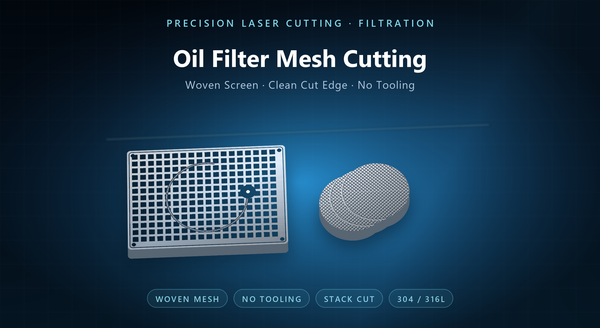
Laser cutting enters at the outline. It converts a roll of cloth into discs, rings, rectangles or the developed shape of a cylindrical screen, from a file rather than a die.
2. Why Laser Cutting Suits Filter Mesh
Filter programs run as families. One platform may need a dozen screens that differ in diameter, pleat count, tab position or the cut-out that clears a housing rib, and each variant may run in quantities that would never pay for a blanking die. Laser cutting fits that pattern because the outline is a program: a new variant costs engineering and machine time, not a tool.
The process also cuts the cloth directly, with no clamping force that would crush the weave and no punch that would pull wires. A blanking die on fine cloth dulls against stainless, can drag wire ends and leaves a burr on every cut wire. Laser removes the tool from the equation entirely and replaces it with a focused beam and a gas jet.
The trade is heat, which the next two sections cover. Everything else about the process follows from the fact that a beam, not a die, defines the shape.
3. Cutting Woven Cloth Is Not Cutting Sheet
Sheet metal is continuous, so a cut runs through solid material. Woven cloth is a lattice: the beam meets a wire, crosses an aperture, meets the next wire, and the cut advances by severing one wire at a time. That difference drives most of the practical rules.
The kerf interacts with the weave. A wire cut across its axis ends cleanly; a wire cut at an angle ends in a wedge, and the outline then shows a saw-tooth of wire ends instead of a smooth line. The height of that tooth scales with wire diameter and mesh pitch, so a coarse, heavy cloth produces a visibly serrated edge while a fine cloth cuts almost like foil.
The cloth also has no rigidity of its own. It lifts under assist gas, it moves as the head travels, and a cut that starts accurately can drift by a pitch over a long path. Tensioning the cloth flat, or cutting it on a sacrificial carrier that holds every wire, is what keeps the outline true. On thin cloth the carrier is often the difference between a part that fits and a part that waves.
4. Edge Quality and Heat Effects
Heat input is small in absolute terms and large relative to a wire a few hundredths of a millimetre across. Three effects matter to a filter screen: discolouration and oxide at the cut edge, a narrow heat-affected zone that can soften work-hardened wire, and dross or a solidified bead where the beam exits.
Function, not appearance, sets the acceptance level. Loose wire ends must not detach and travel into the oil circuit. The edge must not shed particles that a downstream clearance cannot tolerate. The screen must not deform at the edge enough to miss its seat. Discolouration is usually tolerable once cleaned, but oxide on stainless steel is worth removing before the part goes into an engine.
Cleaning is therefore part of the process rather than an afterthought: an edge-condition step, an ultrasonic clean, and passivation where the alloy calls for it. The drawing should state the acceptance level — maximum protruding wire length, no loose wires, no heat discolouration on sealing faces — instead of naming a machine parameter. A supplier can hit a stated edge condition; a supplier cannot guess which cosmetic marks matter.
5. Aperture, Open Area and What Laser Does Not Do
Laser cuts outlines; it does not create a mesh. Aperture and open area come from the cloth that was woven, so a specification starts with the mesh itself: count, wire diameter, alloy and weave type. Laser then decides the outline, the tabs, and any hole cut through the cloth.
This is where filter drawings go wrong. A drawing that names a mesh by count and then calls for a small hole through the cloth is asking the beam to do what the weave cannot support: the edge becomes a ring of severed wires, not a clean bore.
Where a genuine precision aperture is needed — a calibrated orifice, or a fine screen with a defined open area — the part belongs in photo-etched perforated foil, not in woven cloth. Etching forms the aperture; laser trims the outline. For most oil filter support screens the correct answer is woven cloth cut to shape, with the aperture specified by the mesh and confirmed by open-area measurement.
6. Choosing the Cloth for Oil Duty
Oil circuits are mild for stainless steel and aggressive for most other metals. 304 and 316L are the default for support screens, end-cap discs and strainers: they resist oil, water contamination and elevated temperature, and they are woven in fine wire. Brass and copper appear where solderability or a specific galvanic requirement leads. Aluminium suits light-duty and air-side parts but is soft and deforms readily at the cut edge.
Wire diameter and mesh count set flow and strength together. A coarse cloth with heavy wire is stiff and inexpensive but retains less; a fine cloth with thin wire filters better but collapses under differential pressure unless it is backed. That is why an element often carries two layers — a fine filtration cloth over a coarse support screen — cut as a pair and assembled together.
The drawing should name the cloth, not only the finished part: the same outline in a different weave is a different filter, with a different pressure drop and service life.
7. Tolerances, Flatness and Stack Cutting
Tolerance on a laser-cut mesh part is not machined-part tolerance, because the edge is a line drawn through a lattice. The outline can be held to a normal shop tolerance. The position of an individual wire end cannot, and specifying it produces inspection arguments rather than better parts.
Flatness matters more than it appears. A disc that cones or waves will not seal, and a pleated support that bows lets the media shift. Thin cloth distorts from heat and from handling, so the flatness limit should be called out on the seating face, with the measurement method named alongside it.
Stack cutting is how quantity becomes economical: several layers cut at once, held flat by a fixture or a carrier. It also changes the edge on the lower layers and limits how fine an outline can be, so stack height belongs in the process conversation at quoting, not in a note added after the order.
8. Prototype to Volume, Inspection and Order Notes
With no hard tooling, the cost of a new variant is engineering and machine time, which makes prototypes and low-volume variants fast and affordable. The process stays competitive until volume and a frozen design make a die or a photo-etched panel cheaper per part, and that crossover is a commercial question rather than a technical one.
Inspection of an oil filter screen covers the outline, the flatness, the cloth itself, the edge condition and cleanliness. Aperture and open area are properties of the cloth, so they are verified on incoming material and confirmed on the finished part. Edge condition is checked for protruding or detached wires, and cleanliness is checked because a screen carrying cutting debris into an engine is worse than no screen at all.
An order should state the cloth by alloy, count, wire diameter and weave; the outline drawing, with a flat pattern for any formed screen; the edge acceptance level; the flatness limit and how it is measured; the cleaning and passivation requirement; the quantity; and packing that protects the cut edge. The recurring mistakes are a mesh count with no wire diameter, a hole specification the weave cannot hold, a flatness figure with no datum, and an edge condition left to the shop default.