

serpentine flow field
Photochemical machining for hydrogen bipolar plate is asked to produce one of the few features on the plate that is genuinely a design choice rather than a consequence: the flow-field pattern. The plate’s job is to deliver gas evenly, remove the water the reaction makes, and keep the electrical contact — and the pattern is where those three requirements are traded against each other. This page is about that choice and about what etching can honestly deliver.
1. The Field Is the Function
A bipolar plate’s channels are not passages for gas; they are a distribution network with a reaction happening at their walls.
Three things happen in a channel: gas is delivered along its length, water is produced by the reaction and must leave, and the land between channels carries current to the diffusion layer.
A pattern that delivers gas beautifully and traps water is a pattern that floods. A pattern that removes water beautifully and starves the far end is a pattern that dries out. A field is also the part of the plate a customer can see, which makes it the part that is compared in a photograph rather than in a test. The design is a working point between those two failures. A field also has to be manufacturable, and that constraint arrives earlier than most teams expect: the pattern is fixed at the artwork stage, before any of the testing is done.
2. Three Patterns
Three patterns cover most plates, and each has a characteristic behaviour.
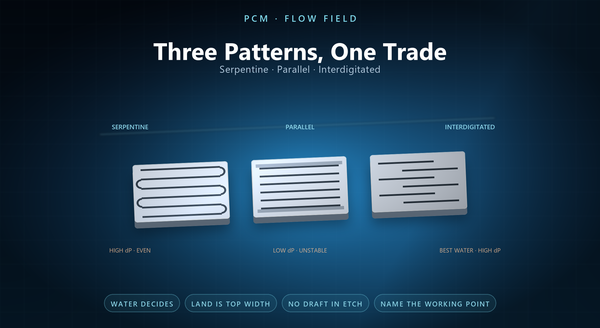
A serpentine is one long channel folded back and forth. It guarantees that the gas travels the whole active area, because there is only one path; it also has the highest pressure drop of the three and the most uneven water distribution along its length.
A parallel field splits the flow into many short channels between two manifolds. It has a low pressure drop and it distributes well, but it is unstable: a channel that floods carries less flow, which makes it flood more.
A serpentine and an interdigitated field are both good at their job and both expensive to run, because both need high pressure. A parallel field that is not flow-stabilised is a field that can oscillate between channels on a slow time scale. An interdigitated field blocks alternate channel ends, A hybrid is also common, with parallel channels near the ports and a serpentine in the active region, because the two regions want different things. so the gas is forced through the diffusion layer to reach the outlet. It is the best of the three at removing water and the worst at pressure drop, and it depends on the diffusion layer’s permeability as much as on the plate.
3. Distribution Against Pressure Drop
The choice is usually framed as distribution against pressure drop, and both are consequences of the same geometry.
More parallel paths mean lower pressure drop and a weaker guarantee that each path gets its share. Fewer, longer paths mean higher pressure drop and a stronger guarantee, at the cost of pump work and of a larger parasitic load on the stack.
Etching contributes to this trade in a specific way: it produces channels with a very uniform cross-section along their length, which makes the pressure drop predictable. A field that is well distributed is also a field whose pressure drop is the same on every plate in the stack, which is a manufacturing statement as much as a design one. A pattern whose pressure drop can be calculated is a pattern that can be designed to the pump rather than tested into it. A pattern with an unpredictable pressure drop is a pattern that is found by experiment, which is expensive on a plate that needs an artwork change each time.
4. Water Is the Real Constraint
Product water is made at the cathode, and where it goes decides whether the plate works.
Three removal paths exist: it can be carried out as vapour with the excess gas, it can be pushed along the channel by the gas velocity, or it can be driven through the diffusion layer into the channel by a pressure difference.
Each of the three patterns favours a different path. A serpentine relies on velocity, which is why it needs a high flow. A parallel field relies on the gas sweeping the channel, which is why it is sensitive to a low flow at low current. A field that is designed for the average current is a field that is wrong at both ends of the operating range. A field that is designed for a low-humidity condition is a field that will flood at high current. An interdigitated field forces the third path, which is why it handles high current well and low current poorly. A field that is designed only for the high-current case is a field that will struggle at start-up, which is when the stack is coldest and wettest.
5. Channel and Land
The channel-to-land ratio is the second geometric variable, and it is a compromise between two physics.
More channel area means more gas access and less contact area; more land area means better electrical contact and less gas access. The ratio is usually set by the diffusion layer’s ability to spread gas sideways under the land.
Etching produces a trapezoidal channel because it is a half-etch, and that matters here: the land at the top of the channel is wider than the land at the bottom, so the contact area the diffusion layer sees is the top width, not the drawn width.
A land that is too narrow under the diffusion layer is a land that the gas can bypass through the layer itself. A land that is drawn at the bottom of the wall and specified as a contact width is a land that is wider in practice than on paper. That is why the drawing should specify the land at the top of the wall, A channel that is wider at the bottom than at the top is a channel that holds water at its edges, which is a subtle flooding source. and why a channel specified by its bottom width and etched to a taper will not give the contact area the designer calculated.
6. What Etching Does Well and Poorly Here
Etching is good at three things in a flow field: uniform depth, a uniform cross-section along a long path, and sharp corners that are drawn rather than tooled.
It is poor at two things. It cannot produce a drafted channel or a truly vertical wall, so the wall is a slope and the land is a trapezoid. And it cannot vary the depth along a channel without a second etch, so a pattern that wants a deeper channel at the inlet is a pattern that needs two operations.
A shallow field is easier to etch and a deep one is better for water, and the depth is where the two meet. A taper that is uniform is a taper that can be compensated in the artwork, and a taper that varies across the plate cannot. Neither is a defect; both have to be in the design rather than discovered after the first build. A field that needs a depth change is worth prototyping before the artwork is frozen, because the second etch is a second registration.
7. The Port-to-Channel Transition
The transition from a manifold port into the field is where a well-designed pattern often fails in practice.
A port is a large opening; a channel is narrow. The transition has to spread the flow across the field width without creating a stagnant corner or a jet that starves one side.
A distribution zone that is designed last is usually a distribution zone that is designed badly. A plenum that is too small creates a jet, and a jet is a local dry-out. Three features are used: a distribution zone with wider channels, A transition that is too abrupt creates a recirculation at the corner, and a recirculation is where water collects. a set of progressively splitting channels, and a small plenum. All three are etched features, and all three are easier to design when the port and the field come from the same artwork.
8. What the Drawing Should Say
A drawing for a hydrogen plate’s flow field should state the pattern type, the channel top width, bottom width and depth with the measurement basis, the land width at the top of the wall, the channel length and the number of paths, the active area, the distribution zone geometry, and the port positions.
It should also state the flow and the current density the pattern is designed for, because the same pattern is a good field at one operating point and a poor one at another.
A field that is copied from a plate of a different size is a field whose pressure drop has been accidentally changed. A field that is specified by pattern name alone is a field that will be built to someone else’s dimensions. The recurring mistakes are a field specified by channel width alone, A drawing that names the operating point is a drawing that lets the pattern be checked rather than admired. a land width measured at the bottom of the wall, a serpentine copied from a smaller plate without rescaling the pressure drop, an interdigitated field applied at low current, and a distribution zone designed after the field.
