

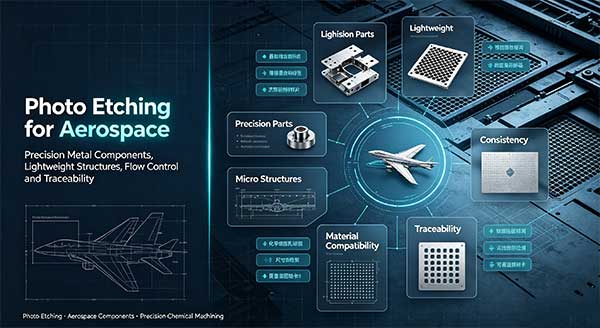
photo etching for aerospace
Photo etching (also known as photochemical machining) is a preferred precision manufacturing process for aerospace applications, ideal for producing intricate thin metal components with complex geometries and strict tolerance requirements.
Aerospace projects demand parts that are lightweight, dimensionally consistent, resistant to high temperature, vibration and corrosion. Unlike stamping or laser cutting, photo etching is a non-contact metal removal method. There is no mechanical stress on raw materials during processing, so metal properties remain unchanged, no burrs or material deformation occur.
Common Aerospace Parts Made by Photo Etching
- Thin metal shims and spacers for engine assembly
- Microporous filter screens for fuel and hydraulic systems
- Encoder discs for aerospace sensing systems
- Heat exchanger foils and cooling meshes
- Lead frames, electrical contact sheets and shielding components
- Custom thin gaskets and fine grid structures
Suitable Materials for Aerospace Photo Etching
Aerospace-grade materials can be processed, including stainless steel, titanium, Inconel, copper alloys, beryllium copper and nickel alloys. These materials meet aerospace standards for high temperature resistance, corrosion resistance and strength-to-weight ratio.
Key Benefits of Aerospace Photo Etching
- Tight tolerances on ultra-thin metal foils, down to 0.02mm material thickness
- Complex patterns, micro holes and fine slots can be fabricated in one step
- No tool wear, low cost for prototype and low-to-medium volume orders
- Stress-free machining, eliminates burrs and part distortion
- Fast lead time for custom aerospace drawings, quick prototype validation
Aerospace Quality Requirements
All photo etched aerospace parts follow strict dimensional inspection, material certification and surface cleanliness standards. Each batch can provide material test reports (MTR) to match aerospace procurement specifications.
Applications
Used in aircraft engines, avionics, hydraulic systems, fuel filtration, satellite components and spacecraft auxiliary assemblies.
