
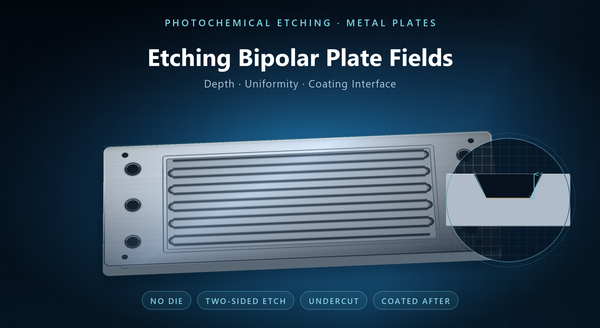
etched bipolar plate flow field
Photochemical etching for a metal bipolar plate forms the flow field by dissolving metal through a photoresist mask instead of pressing it with a die. Chemical etching and photochemical etching name the same route: a phototool carries the pattern, resist transfers it, and chemistry removes what is not protected. The plate leaves the process with channels, ports and its outer profile formed in the same artwork, no tooling to amortise and no mechanical stress in the sheet. That combination is why etching carries most custom and mid-volume plate programs, and why the questions that decide success are about depth, uniformity and what happens at the coating interface rather than about machine speed.
1. What the Etch Does to a Plate
A bipolar plate has three jobs: distribute gas or water across the active area, carry current between cells, and separate the anode and cathode compartments. The flow field does the first, and its geometry — channel width, depth, land width, turn radius — is set by the stack design rather than by the process. The etch also sets the plate’s flatness budget, because it removes more metal from one face than the other.
Etching produces that geometry from a digital file. The plate is coated with photoresist, exposed through a phototool carrying the field, developed, and etched from both faces. Channels appear where the resist was removed, lands remain where it stayed, and the ports and perimeter come out of the same artwork in the same run.
Because there is no die, a flow field revision is a new file. That is the practical reason etching dominates prototyping and custom stacks: the first article and the tenth revision cost the same tooling, which is none. For a stack program that makes the etch a design tool rather than only a manufacturing step: a channel can be tried, measured on a bench and changed in the file.
2. Why Metal, and Why Etched Metal
Graphite plates are corrosion-stable and need no coating, but they are brittle, thick and limited in how fine a channel they can carry. Metal plates are thin, strong and conductive, which lets a stack shrink in height and mass, and it lets the channel pitch tighten.
The price of metal is corrosion. A bare stainless or titanium plate in the humid, acidic environment inside a stack will oxidise, and the oxide raises contact resistance. That is why an etched metal plate is almost always a coated plate, and why the coating discussion belongs in the etching conversation rather than after it.
Etching suits the metal route because it forms the field without touching the sheet mechanically. A stamped plate is thinner at the channel floor and work-hardened at the bends, and both change how the coating behaves. The metal-versus-graphite comparison is usually settled on stack height and mass, and metal wins there; what it costs is the coating.
3. How the Channel Is Formed
Etching is isotropic: the etchant travels sideways as well as down, so a channel is never a rectangular groove. The mask opening sets the top width, the etch time sets the depth, and the undercut sets how much wider the channel becomes below the mask.
That relationship is the design constraint. A deeper channel needs a longer etch, a longer etch widens the channel, and the widening eats the land. Fine pitches therefore favour thin foil, where the same depth is reached before the sideways travel becomes significant.
Two-sided etching is standard, which halves the depth each face has to remove and keeps the channel centred in the sheet. Where a channel is only wanted on one face, the other face is masked, and the plate is etched in a separate step.
Etch depth is controlled by time at a measured rate, which is why the process is specified as a depth with a tolerance rather than as a machine setting. Where a channel must be deep and narrow at once, the process reaches a limit that shows up as a land too thin to survive clamping rather than as an error the supplier can correct.
4. Uniformity Across the Active Area
A plate is mostly active area, so most of its surface is being etched at once. That makes uniformity the central quality question: a channel that is deep at the edge and shallow at the centre changes the pressure drop across the field and the current distribution with it.
Fresh etchant has to reach the centre of a wide field as readily as the edge. Agitation, panel orientation and the loading of the bath all matter, and a supplier who etches large plates has usually built the tank and the fixturing around that problem.
The drawing helps by stating the depth tolerance and the measurement points. A specification that gives one nominal depth and no tolerance will be met by a measurement taken at the most convenient point, which is rarely the centre of a large field. Loading also matters when a run mixes plate sizes, because a large plate changes the metal concentration in the bath for whatever follows it. A supplier who cannot say where the depth was measured has not measured the plate that matters.
5. The Coating Interface
Coating is applied after etching, and it has to cover the channel walls, the lands and the cut edges. Three properties of the etched surface matter to that.
The wall is tapered and slightly rough, not a machined face, so a coating process qualified on flat coupons may behave differently on it. Coverage at the channel floor and at the land edge is where thin spots appear.
The etched surface is chemically clean if it has been passivated, and that is what an adhesion promoter needs. A plate that has sat in a warehouse with handling oils is a plate that will fail an adhesion test.
The edge is the third. Where the plate is cut in the same artwork, the perimeter is an etched edge, and it takes coating the same way the field does. Where the perimeter is laser cut instead, the edge is a different surface and the coater should know. A coating thickness specified on the land may be thin at the channel floor, which is why the requirement belongs on the drawing rather than in a purchase note.
6. Flatness and Stacking
A stack is clamped, and the plates have to seal against gaskets while the whole assembly is compressed. Flatness therefore matters as much as channel depth, and thin metal plates are not naturally flat.
Etching removes metal from both faces unevenly by design, because one face carries the field and the other may carry cooling channels or be masked. That asymmetry, plus the rolling stress in the incoming foil, produces a bow that has to be controlled.
The control levers are the foil’s own flatness, the balance of metal removed from each face, and handling. A plate that is flat when it leaves the tank can still be bowed by the way it is stacked in a crate. Where the design allows it, etching the same depth on both faces balances the stress release and makes flatness easier to hold.
7. Choosing the Metal
Stainless steel is the default: 304 and 316L etch predictably, resist the environment once coated, and are available in the thin gauges a fine pitch needs. It is the cheapest of the practical options and the easiest to source.
Titanium is chosen when the corrosion margin has to be wider, particularly on the oxygen side of an electrolyser or in aggressive fuel cell duty. It etches, but the process window is narrower and the material cost is higher, which changes both the price and the design rules.
Copper and its alloys appear in some cooling plate designs where thermal conductivity dominates, and nickel alloys in high-temperature niches. Each changes the etchant, the resist and the coating route, so the alloy decision is a process decision as much as a material one. The choice is rarely made on price alone: titanium costs more and etches slower, and it is chosen when stack life justifies both.
8. Inspection, Order Notes and Volume
Inspection of an etched plate covers channel depth and width at several points, land width, flatness on the sealing face, port positions and the condition of the surface that will be coated.
An order should state the alloy and foil thickness, the flow field drawing, the depth and its tolerance with measurement points, the land width minimum, the flatness limit and its datum, whether the perimeter and ports are etched or cut, the coating requirement, and the packing that keeps a thin plate flat and free of dents. A first article that records depth at several points and a flatness trace is worth more than a report stating that the plate was checked.
Volume changes the economics but not the physics. Etching has no die, so cost falls with panel utilisation and etch time rather than with amortisation, and a program that ships a few hundred plates a year can stay on the same route as one that ships thousands.