

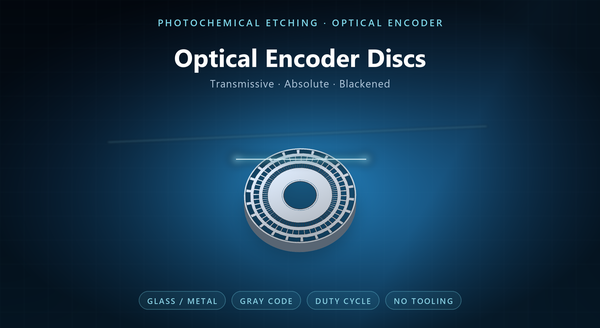
etched encoder disc
Optical encoder disc photochemical etching is one way to make the patterned disc that a rotary encoder reads with light. The disc is a code carrier: a set of concentric tracks whose slots interrupt a beam, and the pattern turns rotation into a train of pulses or a unique position word. Etching matters because it forms that pattern chemically, without a die and without a burr, and because it can hold a narrow slit on a thin disc. This page is about the choice of disc type and code pattern, and where etching sits among glass, metal and moulded alternatives.
1. Two Optical Arrangements
An optical encoder works either by transmission or by reflection, and the disc is built for one or the other.
A transmissive disc has open slots and opaque lands. Light passes through the slots and is blocked by the lands, and a photodetector on the far side sees a square wave. This is the classic arrangement, and it needs a disc that is thin, flat and genuinely opaque.
A reflective disc has reflective and non-reflective areas on one face. The light and the detector sit on the same side, which allows a more compact encoder but puts the burden on the surface finish and the coating rather than on the geometry. A reflective disc is also harder to inspect, because contrast is judged on the surface rather than through the part.
The two arrangements lead to different disc specifications, and a drawing should say which one it is for before anything else is decided. A transmissive disc can be checked by holding it against a light: the slots should read as crisp squares, not as fringes. The choice also decides which face the detector sees, which matters when the disc is fitted by an operator.
2. Glass, Metal or Plastic
Three materials carry the market, and each has a place.
Glass with a chrome pattern is the resolution leader. Photolithography on glass holds the finest features and the best edge, and the glass is optically flat. It is also brittle, it is more expensive, and it is a poor choice where the encoder will see shock or a hot, dirty environment.
Metal, etched or laser-cut, is the rugged option. It survives vibration and temperature, it can be thin and stiff, and it blackens to block light. Etching is the natural process for a metal disc because it makes the pattern without burr and without stress. A glass disc bonded to a metal hub is common in high-resolution encoders, and the bond line is a stress point.
Moulded plastic is the volume option. The pattern is in the tool, so the per-part cost falls with quantity, but the achievable feature size is coarse and the tool is expensive. It is also the only option for a disc with integral features like a hub and a lip moulded in one shot.
Etching sits between glass and plastic: finer than moulding, tougher than glass, and tool-free for custom patterns.
3. Code Patterns
An incremental disc carries two or three tracks: one for the pulse train, one for an index or a quadrature offset. The tracks are evenly slotted, and the encoder interpolates between edges to get resolution. The index track usually carries a single slot per revolution, and its angular position is a specification in itself.
An absolute disc carries several tracks coded so that every angular position has a unique pattern. Binary and Gray code are the common schemes; Gray code is preferred because only one bit changes between adjacent positions, which removes the ambiguity a binary pattern would have at a transition. A Gray-code disc is wider than an incremental one for the same resolution, because it needs more tracks.
A sine/cosine disc is a third type: instead of slots, the track has a continuously varying width that produces a sinusoidal signal, which the encoder interpolates for very high resolution. Absolute discs are read in parallel or serially, and the number of tracks follows the resolution.
Each pattern puts a different demand on the disc. Slot patterns need sharp edges; sine patterns need accurate width modulation, which is a harder thing to etch than a slot.
4. Why Etching Fits the Pattern
Etching forms the pattern from the resist image, so the edge is as sharp as the artwork and the width is set in the file rather than in a tool.
That matters most at the transitions. A duty cycle error — a slit slightly wider or narrower than its neighbour — shifts the interpolation and shows up as position noise. Etching holds the width uniformly across a track because the whole track is imaged at once, rather than cut feature by feature. The same uniformity argument applies to the land width, because lands and slots are imaged from one file.
For a metal disc, etching also delivers the flatness the optical gap needs, because there is no mechanical force to bow the sheet, and the disc can be thin without becoming distorted. Etching also allows a correction: if a track etches slightly wide, the artwork can be compensated on the next revision.
5. Slit Width, Duty Cycle and the Optical Aperture
The encoder’s optics average the light over an aperture, and the disc’s slit is what defines the transition. Two numbers govern the signal.
Slit width sets the mark-to-space ratio. If the mask says fifty-fifty and the etch delivers fifty-five to forty-five, the encoder sees a duty cycle error that no amount of interpolation can remove.
Disc thickness sets how the slit behaves through the thickness. A thin disc gives a clean shadow; a thick one gives a tunnel, and the beam’s divergence then softens the edge.
That is why slit width and thickness are specified together, and why a drawing that gives only a slit width has left half of the optical design open. A thin disc also sits closer to the optics, which changes the beam’s effective aperture, and a thick disc blocks more light at the aperture edge and reduces amplitude.
6. Contrast and the Blackened Face
An optical encoder needs contrast, not just geometry.
A bare metal disc reflects. In a transmissive encoder that reflection is mostly wasted light, but in a reflective encoder it is the signal, and in either case stray reflection can reach the detector and raise the noise floor.
Blackening solves the transmissive case: black oxide or a matte black coating makes the lands absorb rather than reflect, so the detector sees a clean on/off. In the reflective case the requirement is the opposite: the reflective areas must be bright and the rest must be matte, which is usually done with a plated or polished zone against a blackened background. In practice the reflective zone is a band rather than the whole face.
Either way the surface treatment is part of the disc’s optical design, and it belongs in the order rather than in a note after the fact. A blackened disc also hides handling marks, which is a small bonus for a part that is fitted by hand.
7. Where Etched Discs Win, and Where They Do Not
An etched metal disc wins when the encoder has to survive: shock, vibration, temperature cycling, oil mist or washdown. It also wins when the pattern is custom and the quantity is modest, because there is no tool to amortise.
Glass wins when the resolution is beyond what a metal slit can hold, and when the environment is benign. Plastic wins at very high volume with a coarse pattern. A reflective disc is often the only option when the encoder must be short axially.
A hybrid is common: a metal disc with a hub pressed or bonded in, or a metal disc used as a mask in front of a glass disc. Those are assembly decisions that a drawing should show. An etched disc is also the cheapest way to try a new code pattern in a metal encoder before committing to glass.
8. Inspection and Order Notes
Inspection covers slit width and pitch per track, track position and concentricity to the bore, flatness and runout, burr, and the blackening or reflective finish.
The functional check is optical: mount the disc and look at the waveform. Duty cycle, amplitude and phase error are the numbers that decide acceptance.
An order should state the disc type (transmissive or reflective), the material and thickness, the code pattern with track pitches and slit widths, the bore and hub interface, concentricity and flatness limits with datums, the surface treatment, and the packing.
The recurring mistakes are a drawing that does not say transmissive or reflective, a slit width without thickness, a blackening requirement that appears only at inspection, and a hub interface drawn as if the disc were a flat washer. A waveform with unequal marks on one track and not another points at that track’s artwork rather than at the etch, and a disc that passes dimension but fails duty cycle usually has a width problem on one track.
