
oil filter mesh etching
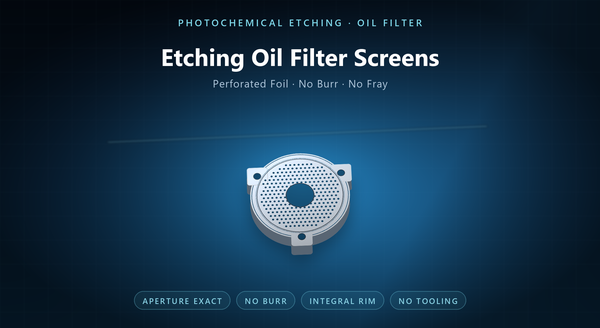
Photochemical etching for oil filter mesh makes the screen itself: a thin metal sheet with a pattern of apertures dissolved through it, rather than a woven cloth trimmed to shape. The distinction matters in an oil circuit, because the screen sits between the oil pump and the bearings, and anything it sheds is a particle the engine has to survive. Etching produces the aperture from a file, leaves no burr and no frayed wire, and can put the frame, the tabs and the bolt holes in the same sheet. This page is about that route and where it beats the alternatives.
1. What the Screen Does in an Oil Filter
An oil filter is a stack of functions, and the mesh does the structural ones. A pleated element needs a support screen that holds the pleats open against differential pressure, a centre tube that keeps them from collapsing inward, and end-cap discs that bond the pack and seal it to the housing.
A support screen also keeps the media from extruding into the centre tube under pressure, a failure a filter can hide until the bypass opens. In a suction strainer the mesh is the only filtration stage, and it protects the pump from debris large enough to damage it. In a transmission or oil-pan pickup it does the same job at a coarser aperture.
Those duties set two requirements that pull apart: enough open area for cold-start flow, and enough stiffness to hold shape when the oil is hot and the differential pressure is highest. The screen is also the part that decides how quickly the filter fills on a cold start. A screen that sags lets the pleats bunch, which removes effective area exactly when the engine needs flow. The screen also has to survive pleating and bonding, where a burr can tear the media it is meant to protect.
2. Why Etching Fits This Screen
Three properties of etching map onto the three things an oil screen needs.
The aperture comes from the artwork, so it is exact and uniform across the panel. A woven cloth varies slightly across the roll, and its aperture changes when the cloth is stretched over a form. Etching also handles a pattern that changes across the panel, which a die cannot do without a stepped tool.
The edge is burr-free. Etching removes metal chemically, so there is no rolled burr and no sheared wire end, and no edge finishing step is needed to make it safe. For a component whose failure mode is shedding a particle into the oil, that is the main reason to choose it.
The part can be one piece. The perforated field, the rim, the mounting tabs and the bolt holes come out of the same etch, which removes a frame, a bonding step and a tolerance stack. Etching also avoids the work-hardening a stamped screen carries, so a thin screen stays flat through assembly.
3. Etched Foil Against Woven Cloth
The comparison is not like for like, and a quotation that does not say which is being bought is not comparable.
Woven cloth is a lattice of wire. It is cheap per square metre, it drapes, and it is the traditional answer for a large simple basket. Its cut edge frays unless it is finished, and its aperture is set by the weave rather than by a drawing.
An etched screen is a solid sheet with holes. It is flat and stiff, its aperture is exactly the drawing, and its edge cannot unravel. It is more expensive per unit area at coarse apertures, and cheaper once a frame, a bonding step or an edge finish would otherwise be needed.
The practical split: a large coarse basket is usually woven cloth with a frame; a fine support screen, an end-cap disc or a strainer with integral features is usually etched foil. An etched screen can also carry a mixed pattern — coarse holes in the high-flow region and finer ones where the media sits — while woven cloth cannot vary its aperture without changing the weave, so a mixed pattern means a mixed basket.
4. Aperture and Open Area for Oil
Oil is viscous when cold, and the screen has to pass it. That makes open area the first design number and aperture the second. Cold-start pressure drop is the number the OEM cares about, and it is set by open area at the operating viscosity.
Open area is the share of the sheet left open. At a fixed aperture, more open area means a thinner ligament and a weaker panel; at a fixed open area, a finer aperture means more holes and a longer etch.
Aperture sets what the screen retains. For a support screen behind filter media, retention is the media’s job and the screen only has to pass oil and hold the pleats, so a relatively coarse aperture is normal. For a suction strainer, the aperture is the filtration specification and is chosen against the pump’s tolerance.
Both numbers belong on the drawing, together with the ligament, because any two of the three can be met while the third fails. The ligament is what carries the pressure load, and it is usually the number that gets checked last.
5. Burr, Cleanliness and What the Engine Sees
A screen that sheds is worse than no screen. That is the reason burr and cleanliness dominate the acceptance criteria.
Etching leaves no burr by nature, but handling, trimming and any secondary forming can still damage an edge. The acceptance should therefore be stated as a condition rather than assumed from the process: no loose material, no protruding feature beyond a stated limit, and a defined clean.
Cleanliness is the second half. Etched parts come out of a wet process, and residue on a screen is a contaminant in the oil circuit. The order should say whether the parts are cleaned and how, and the packing should keep them clean until assembly. A screen that has been tumble-deburred can carry compound residue, which is why the clean is specified separately. A clean screen in a dirty bag is a dirty screen, so the bag is part of the specification.
6. Materials and Thickness
Stainless steel — 304 and 316L — is the default: it resists oil, water contamination and heat, and it is available in the thin gauges that a fine aperture needs.
Carbon steel appears where cost dominates and the part is upstream of the main filter, but it rusts and needs protection. Brass and copper appear in some fuel and transmission screens, and aluminium in light-duty air-side parts.
Thickness is chosen against the aperture: a hole that is small relative to the sheet is harder to etch cleanly, and the wall becomes visibly tapered. A thinner sheet gives a cleaner aperture and a faster etch, but a weaker panel, which is why the ligament has to be checked against thickness rather than chosen for appearance. Stainless also takes a passivation step after etching, which removes etch residue from the surface. A thinner sheet also etches with less taper, which improves the effective area through the wall.
7. Prototype to Volume
Etching has no tooling, so a new aperture pattern or a new outline is a new artwork. For a filter programme that matters, because a support screen changes whenever the pleat pack changes.
Prototype and production run from the same file, which is the practical advantage: the screen qualified at twenty pieces is the screen that ships at twenty thousand. A revision of the aperture is a new artwork, and the qualification carries over because the process does not change. A screen programme usually starts on the etch while the pleat pack is still being tuned.
At high volume with a coarse pattern, stamping becomes competitive and can form in the same stroke. At fine apertures, etching stays competitive because a die fine enough would wear quickly. Laser cutting is the third route and suits trimming woven cloth rather than making a fine aperture field.
8. Inspection and Order Notes
Inspection covers the aperture and its tolerance, open area, the ligament, the outline dimensions, flatness, edge condition and cleanliness.
Aperture is measured optically at several points and reported as a range, because a two-sided etch varies across the panel and from rim to centre. Open area is worth measuring rather than deriving, because a screen that meets aperture and pitch on paper can still miss open area if the pattern drifted.
An order should state the alloy and thickness, the aperture with tolerance, the open area or the pitch, the minimum ligament, the outline with tabs and holes, the flatness limit and its datum, the cleaning requirement, and the packing.
The recurring mistakes are a mesh count borrowed from woven cloth, an aperture without tolerance, an open area callout with no ligament, and a cleanliness requirement that appears only at incoming inspection. A drawing that names the medium the screen supports is easier to quote than one that gives only a hole pattern.