

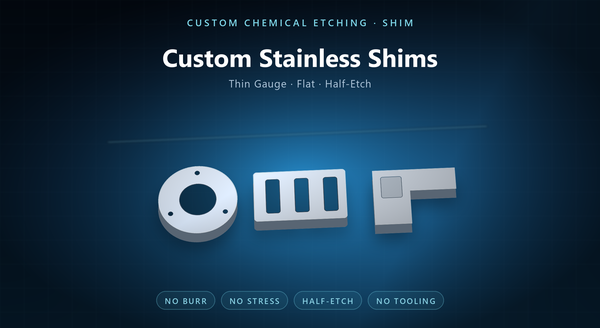
stainless shim photo etching
Stainless steel shim custom chemical etching is the making of a one-off or low-volume shim — a thin plate that sets a gap, levels a surface, takes up wear or spaces two parts — by dissolving its outline, holes and pockets through a photoresist mask. The word custom is doing real work here: a shim is usually a part that exists because a stack needed a specific thickness, and the drawing changes when the stack changes. Etching suits that because a new shim is a new artwork rather than a new die, and because it leaves the part flat and burr-free, which is what a shim has to be to work.
1. What a Shim Is For
A shim is a controlled thickness. It goes between two surfaces to set a gap, correct a height, compensate for wear or protect a softer face, and its job is done if the assembly ends up where the design wanted it.
That makes three properties matter more than shape: the thickness, the flatness, and the absence of anything that would hold the parts apart. A burr on a shim is not a cosmetic defect; it is a local thickness error that tilts the stack.
Custom shims exist because stacks are not standard. A gearbox end-float, a bearing preload, a fixture height, a sensor gap — each is a number, and the shim is how that number is hit. The same pocket can call for a dozen thicknesses, and each is a separate part. A shim that is too thick gets scraped flat by the assembly; one that is too thin leaves the gap it was meant to close, and the shim is usually the cheapest way to correct a stack that has drifted out of tolerance.
2. Why Custom Shims Suit Etching
Four properties of etching line up with what a custom shim needs.
There is no tooling. A die only makes sense when the shape is frozen and the volume is high; a custom shim is often neither, and etching lets one part be made from one file.
There is no burr. Etching removes metal chemically, so the edge is clean and the part sits flat on the surface it is shimming. A stamped shim needs a deburr step, and a deburr step is a thickness variation.
There is no stress. Blanking puts residual stress into a thin part, and a shim that relaxes after assembly changes the gap it was meant to set. Etching leaves the strip as it was, and the repeat order is made from the same file, so the second lot matches the first.
The pattern is data. Half-etched steps, etched part numbers and etched witness marks come out of the same artwork, which is what “custom” usually means in practice. Etching also leaves no heat tint or oxide to strip before plating, and it lets a kit of several thicknesses be made from one artwork — which is how a service kit is often supplied.
3. Stainless Grades for Shims
Stainless is the default shim material because it does not rust in a machine, it is available in thin accurate strip, and it is stiff enough to handle.
301 and 302 in a spring temper are used where the shim must also be a spring or must resist being deformed during assembly. 304 is the general-purpose grade: corrosion resistant, formable, and easy to source in thin gauges. 316 is chosen for chemical or marine exposure, and 430 for magnetic or cost-driven applications.
Thickness is the specification that matters most, and it comes from the mill rather than from the etch. A shim is often ordered in a standard gauge with a tolerance class, and the class is part of the design rather than a purchasing detail.
The temper matters when the shim is thin enough to bend during handling. A dead-soft shim in 0.05 mm will not stay flat on its own; a spring temper will. A shim thinner than the strip’s own thickness variation is a specification problem rather than a process problem, and the mill certificate is what makes the thickness traceable.
4. What Drives the Tolerance
A shim drawing usually carries four tolerances, and they come from different places.
Thickness is a material tolerance. It cannot be improved by the etcher, and it should be quoted as a class rather than a single number.
Outline and hole position are etch tolerances. They depend on the artwork, the resist resolution and the etch control, and they are wider than a machined part but repeatable. An etch tolerance is usually stated as a plus-minus on the outline, and it widens as the thickness grows. The drawing should say which tolerances are functional and which are incidental, or every tolerance will be treated as critical and the price will follow.
Edge quality is a process property, not a tolerance: an etched edge has a slight profile from the two-sided etch, and the drawing should accept that rather than call a square edge.
Flatness is where etching wins. Because there is no mechanical force, a thin shim comes out flat, and flatness is usually the tolerance that decides whether a stack assembles without shimming the shim.
5. Half-Etch: Steps, Pockets and Marking
Half-etching removes part of the thickness instead of all of it, and it is the feature that makes etched shims more than flat washers.
A half-etched pocket creates a step, so one shim can do the job of two: a locating recess, a relief for a fillet, a recessed seat for a fastener head.
A half-etched line can be a fold line or a witness mark, and a half-etched legend can be a part number that survives plating because it is a shape rather than an ink — which is the only way to mark a shim that will be plated.
The depth of a half-etch is controlled by time and is therefore a tolerance of its own. It should be specified as a depth with a tolerance and a datum face, because a step measured from the wrong face is a step that measures wrong. A half-etch also lets two shims be nested in one sheet, with the step as the locating feature, and it is how a shim carries a folded tab that holds it during assembly.
6. Flatness and Stacking
A shim is usually one of several in a stack, so its flatness is a system property rather than a part property.
Three shims that are each slightly bowed will trap a gap between them, and the gap is not visible after assembly. That is why a stack is qualified as a stack and not as a set of parts.
Etching helps here for the reason already given: no force, no stress, no burr. The remaining risks are handling and packing, because a thin etched shim can be bent by a thumb as easily as by a press.
The packing should therefore be specified: interleaved, taped to a card, or in a rigid tray. A flat shim in a soft bag is a shim that arrives curved. Flatness is measured on a surface plate, and the measurement is only as good as the datum; a stack that has been qualified once can then be re-ordered as a kit rather than as individual parts.
7. From Quote to Volume
A custom shim quote needs four things: the outline as a file, the alloy and thickness, the quantity, and the tolerances that matter.
With those, etching can quote a single part, a small lot or a panel of mixed thicknesses. The economics are unusual: the first part costs almost the same as the hundredth, because the cost is in the artwork and the setup rather than in the cut. A quote that arrives without a quantity is a range, and a range is not a price.
At volume the picture changes. A frozen shim at high quantity is cheaper stamped, and the die can also half-etch in the same stroke. Etching stays competitive for thin gauges, fine features, mixed-thickness kits and anything where the volume does not justify a die.
8. Inspection and Order Notes
Inspection covers thickness (from the mill certificate and a check), outline and hole position, the half-etch depth where used, flatness, edge condition and marking legibility.
A stack check is the functional test: assemble the shims and measure the resulting gap or height against the design.
An order should state the alloy and temper, the thickness with its tolerance class, the outline and holes, the half-etch depth and datum, the flatness limit and its datum, the marking, the finish, and the packing that keeps the parts flat.
The recurring mistakes are a thickness tolerance left to purchasing, a flatness callout with no datum, a half-etch depth without a reference face, and a custom shim ordered as a drawing with no quantity, which makes the quote a guess. A shim drawing with no flatness datum cannot be inspected, only argued about.
