

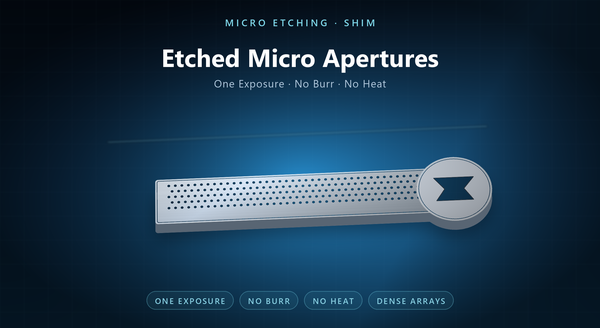
micro etching stainless steel
Stainless steel shim micro chemical etching makes the small features of a shim — apertures, slots, screens and orifice arrays, usually below a millimetre and often a few tenths — by imaging them in photoresist and dissolving the metal through the openings. The point is not that etching can make one small hole; it is that it makes every hole in the pattern in the same exposure, at the same time, with the same chemistry. For a shim whose function is a field of identical apertures, that simultaneity is the whole argument.
1. Where Micro Features Appear in a Shim
A shim stops being a spacer when it carries a pattern. Then it becomes a flow element, a screen, a mask or a diffuser.
The common cases are an orifice array that sets a pressure drop, a screen that keeps debris out of a passage, a spray plate that forms jets, an acoustic shim that tunes a cavity, and a mask that protects areas during a coating or blasting step.
In all of them the pattern is the product, and the tolerances that matter are the aperture, the pitch and the ligament between apertures rather than the outline. A screen is often the cheapest way to protect a passage from swarf. A shim that carries an apertured pattern is also usually the cheapest way to make a flow calibration, because the pattern can be revised without touching the housing, and it is how a screen gets its integral frame and locating holes in the same etch.
2. Why Etching Suits Micro Patterns
Three properties make etching the natural process for a dense pattern.
It images at once. The phototool carries every aperture in one artwork, so a thousand holes cost the same exposure as one. There is no per-hole time, which is why the cost of a dense pattern does not scale with the hole count the way a serial process does.
It applies no force. A thin shim with a fine ligament is fragile, and any mechanical process risks deforming the web between holes. Etching removes metal without touching it.
It leaves no burr. On a screen or a spray plate, a burr at an aperture edge changes the flow and, on a screen, can trap debris. A chemically formed edge has no burr to remove, and no heat tint either, which matters on a part that is going to be plated. Etching also holds the aperture count economically: the hundredth hole in a pattern costs nothing extra, which makes the aperture count a design choice rather than a cost driver.
3. How a Micro Aperture Is Etched
An aperture is etched from both faces, and the two images have to register. The etchant removes metal from each side until the cavity meets in the middle, so the wall is a shallow hourglass: wider at both surfaces than at mid-thickness when the images are aligned, and leaning when they are not.
That shape is the characteristic of the process, and it is why the aperture is specified with a measurement face. A hole that measures a given diameter on the entry face measures something smaller at the waist.
The depth of the cavity also limits what can be made. An aperture whose diameter is small relative to the sheet thickness may not break through cleanly, or may take long enough that the resist fails elsewhere on the panel. The resist has to survive the etch long enough to define the smallest aperture, which is what really sets the aspect ratio. A two-sided etch with a small offset produces a slot that is straighter than a hole.
4. Design Rules: Aperture, Ligament, Pitch
Three numbers describe a micro pattern, and they are coupled.
Aperture is the open dimension. Ligament is the metal left between apertures. Pitch is the centre-to-centre spacing. Any two fix the third, and all three affect the etch: a tighter pitch with a fixed ligament means a smaller aperture, and a smaller aperture takes longer to break through.
The practical limits are set by the thickness. A useful rule is that the aperture should not be much smaller than the sheet thickness for a clean through-hole, and the ligament should not be much narrower than the thickness if the web has to survive handling.
Nesting the array, offsetting alternate rows, changes the open area at a given pitch and can improve the mechanical behaviour of the web without changing the aperture. A ligand narrower than the thickness is a web that can fold during handling, and a pattern that is too dense traps etchant, so part of the designer’s job is to leave paths for the chemistry to flow. The same coupling is why a designer cannot ask for a small aperture, a wide open area and a strong web at once.
5. Uniformity Across the Panel
A dense pattern is a uniformity problem, not just a resolution problem.
Fresh etchant has to reach every aperture and spent etchant has to leave, so the pattern’s own density affects its etch rate. A region with many small apertures etches more slowly than an open region, because the local chemistry is more depleted, and the difference shows up as a slightly smaller aperture in the dense area.
That is why an etched panel is checked at several points rather than one, and why the tolerance on a micro pattern is often stated as a range across the panel rather than a single value.
Agitation and the etcher’s control loop are what keep that range small; a supplier who cannot describe how they control it cannot hold a tight aperture band. Panel layout helps as well: a panel with generous borders etches more evenly than one packed to the edge, because the chemistry has somewhere to circulate — and a pattern that fills the panel to the edge is the pattern that etches least evenly.
6. Materials and Thickness
The micro work is done in thin stainless: 304 and 316L for corrosion resistance, 301 where the shim also has to be stiff.
Thickness is the main lever. A thinner sheet gives a faster etch, a cleaner aperture and a smaller minimum feature, but a weaker web. A thicker sheet gives a stronger part with a larger minimum aperture and a more pronounced hourglass. 316L also etches a little more slowly than 304, which shows up at fine apertures.
Surface finish matters more than it does on a plain shim, because the resist has to adhere across a fine pattern, and a scratched or rolled-in surface can break the image locally. A thinner sheet also handles better through the resist line, which is why micro patterns are rarely made in heavy stock.
7. Etching and Laser, Side by Side
Both processes make micro apertures in shim, and the choice is a trade between shape, cost and lead time.
Etching makes the whole pattern at once, with no heat, no burr and no per-hole cost. It is the natural choice for a dense field of identical apertures over a large area, and for patterns where the aperture count is high enough that a serial process would take too long.
Laser makes one hole at a time but needs no artwork, no resist and no wet line. It suits a few holes, a mixed pattern of different sizes, a rapid revision, or a shim that must be cut and drilled in one setup. Costwise, etching wins when the aperture count is high and the part count is low; laser wins when the part count is high and the hole count is low.
The shapes differ too. A laser hole is tapered by the beam; an etched hole is an hourglass by the chemistry. Neither is a drilled cylinder, and a drawing that calls for a straight wall is asking for a third process. A hybrid is also common: etch the dense field and laser the outline, where the outline has features that are awkward to etch.
8. Inspection and Order Notes
Inspection covers aperture on a stated face, pitch, ligament, open area, panel-to-panel and within-panel variation, flatness, and the condition of the web.
The functional check depends on the part: flow or pressure drop for an orifice array, a debris-retention or bubble-point test for a screen, a spray-pattern check for a nozzle plate.
An order should state the alloy and thickness, the aperture with its tolerance and measurement face, the pitch and the ligament, the open area if it is the functional number, the panel size and the array’s position within it, the flatness limit, and the packing. A first-article panel should be measured at the densest and the most open region, because those are the two extremes of the etch.
The recurring mistakes are an aperture specified without a measurement face, a ligament left out, an open-area requirement that conflicts with the pitch, and a drawing that treats an etched aperture as a straight-walled hole. Open area is worth measuring rather than deriving from the pitch, because the etch is what decides it.
