
stainless steel shim batch pricing
The stainless steel shim photochemical machining process behaves like an area business rather than a piece business, and that one fact explains most of what surprises a buyer about output and delivery. Price tracks the sheet area a lot consumes and the setups it needs, not the number of parts on the drawing. Two requests for the same shim can land a tier apart because one nests densely across a panel while the other leaves half the sheet empty. This page follows capacity and lead time from that starting point: what sets pieces per panel, what a setup really is when no die exists, how batch tiers move unit price, where the time actually goes, and why the first part and the hundredth part come back at a similar price.
1. Panel Density Is the Real Unit of Cost
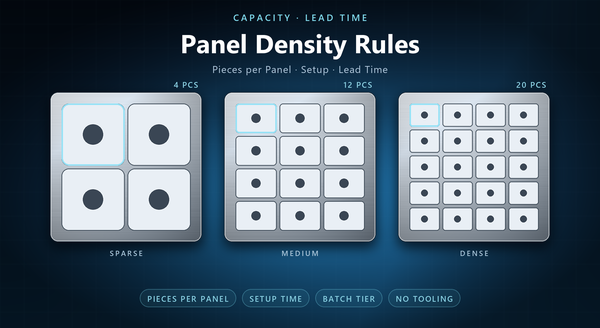
Etching consumes area. The etchant has to dissolve a fixed depth across the whole panel, the imaging step exposes the whole panel, and somebody handles, inspects and packs whatever comes off it. Almost every cost driver therefore scales with the number of panels a lot requires, not with the number of parts. Since no die exists, there is no tool whose cost collapses as volume rises; there is artwork, a phototool and a setup, and they are bought once per revision.
So unit price is best read as panel cost divided by pieces per panel, plus a per-piece finishing and inspection allowance, plus a setup block amortised across the lot. Density is fixed at nesting, which happens before the order reaches the shop floor, and it cannot be recovered later by working harder. A dense layout and a sparse layout of the same part are genuinely different products economically, even though the customer receives the same shim. A bigger panel does not automatically help: handling and etchant flow cap the useful width.
2. What Sets Pieces per Panel
Four things decide the count, and only one of them is the part itself.
The first is the part envelope against the panel size available, including the edge margin the line needs to handle the sheet without touching the parts. The second is the webbing between parts: adjacent openings need enough metal between them for the etchant to flow and for the panel to stay intact until it is unloaded. The third is tie bars, which hold each part to the panel and occupy metal that cannot carry another part. The fourth is the furniture every panel needs — registration marks, and often a test coupon for the adhesion check.
Orientation matters too. Rotating a part, mirroring it, or nesting small parts inside the window of a larger one can raise the count without changing the drawing. The ceiling on density is mechanical rather than chemical: parts that drop out early, tie bars that break in handling, panels that sag. Dense is cheaper per piece and less forgiving per event.
3. Setup Without a Die
A stamping setup means mounting a die. A photochemical machining setup means five smaller things: preparing artwork and generating the phototool, engineering the panel layout, setting the lamination and resist parameters for the gauge, exposing a test panel to confirm adhesion and development, and agreeing the first article.
None of those steps is long, but each has a start and a finish, and they run in sequence. A repeat order that reuses the same revision and the same layout skips most of it: the tool exists, the layout is approved, the first article is on file, and only the run remains.
A revision change is where buyers get caught. One moved hole, one new legend, one extra cutout, and the layout is re-nested, the tool is regenerated and a fresh first article is measured. The part looks identical on the bench and quotes as a new job. Revision discipline — freezing the drawing and batching changes — is one of the few real capacity levers a buyer controls. A revision quote should be read as a new quote, not as a discount conversation about the old one.
4. Batch Tiers Move Price, Not Always Time
Every quote has three blocks: a one-time block, a run block and a per-piece block.
At low quantities the one-time block dominates, and unit price falls steeply as it is spread over more parts. At some quantity the run block and the per-piece block take over, and the curve flattens onto a floor set by panel time and by handling. Those are the tier breakpoints, and where they sit depends on the part, the gauge and the density, so they are quoted rather than published.
Lead time does not fall with quantity in the same way. It steps. A larger lot is more panels through the same etch line and the same inspection bench, so it queues in bigger units, and a very large lot may be split across several panel runs and several inspection sessions.
That is why asking for two quantities is more informative than asking for one: the shape of the reply shows which block you are paying for. It also shows whether a larger order buys a shorter queue, which it often does not.
5. Where the Lead Time Goes
Lead time is five blocks in series, and only one of them is chemical.
Engineering sits first: the drawing is reviewed, questions are raised, the layout is agreed. This block cannot start before the drawing is final, and it is the block most often extended by a buyer’s own clarifications.
Imaging follows: the tool is prepared or the direct-imaging job is set up, resist is applied, the panel is exposed and developed. Etching comes next, and it is the least elastic block, because the time a given thickness needs in the etchant is set by chemistry and depth rather than by scheduling.
Inspection is the fourth block, and it is labour: dimensional checks, visual checks, first-article measurement and paperwork. Packing is the fifth, and it grows with fragility — thin shims need interleaving and flatness protection that a thicker part does not.
The queue in front of each block usually dominates the block itself. A shop with a free etch line and a full inspection bench is inspection-bound. On a small lot the queue can be the whole lead time; on a large one the blocks themselves begin to matter.
6. Rush Orders and Where Acceleration Stops
Expediting moves queue position and staffing. It does not move chemistry.
What can genuinely be compressed: the order’s place in the engineering queue if the drawing arrives clean, the scheduling of the panel run, the inspection session, the packing bench and the shipping method. Splitting a lot so that one panel goes first is often the fastest route into a fit check, because the rest of the lot continues behind it.
What cannot be compressed: the etch depth a gauge needs, the exposure and development cycle, the adhesion check that protects a whole panel from being lost, and the measurement time on a first article. Shortening any of them converts lead time into risk, and that risk is paid in a rejected panel rather than a late one.
The real boundary condition is information. A rush request attached to an ambiguous drawing spends its own savings on questions. Naming the milestone that matters — first parts for a fit check, or the full lot for a build — gets a more useful answer than naming a date.
7. Why the First Part and the Hundredth Cost About the Same
The first part and the hundredth part of a lot cost about the same because the expensive step is the panel, not the piece.
In a process with a die, the first part carries the die and looks wildly expensive, while the thousandth is cheap because the die has been amortised. Etching has no die. It has artwork, a phototool, a layout and a first article, and those are bought by the revision rather than by the number of parts. The first panel already pays for them. Every part after that adds run time and a share of finishing and inspection.
The result is a curve that is flat across a wide middle and steps between “no order” and “one panel”. Prototypes are therefore affordable, and the real decision is whether to release a panel at all, not whether to order one part or a hundred.
The caveat is handling. Per-piece finishing and inspection still scale, and very thin parts get harder to count, protect and pack in bulk.
8. What to Send for a Capacity and Lead Time Quote
A capacity answer is only as good as the package behind the question.
Send the drawing with its revision, the alloy and temper, the thickness, and any half-etch with depth and datum. State the milestone you actually need — first article for a fit check, a pilot quantity, or production — because it changes which block gets expedited. Give the annual or quarterly forecast and how it splits across revisions, since a forecast with three revisions is three setups, not one. Add the inspection and documentation level, the packing and cleanliness requirement, and whether a partial shipment is acceptable.
Ask back for the pieces per panel that were quoted, the panel size, where the tier breakpoints sit, the lead time for a first article as distinct from a repeat, and how much capacity is held for a repeat order. Ask what the panel count becomes at the next revision, too.
A reply that gives a unit price and a number of days but no panel count has priced an assumption rather than a part.