
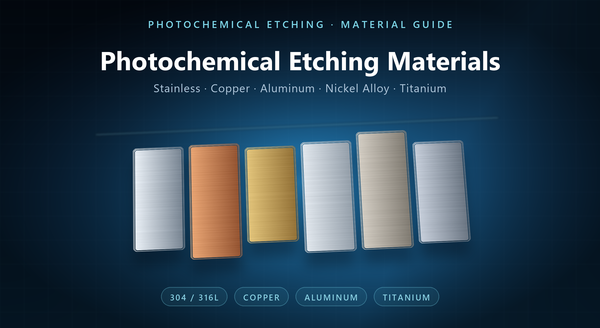
chemical etching materials
Photochemical etching materials are chosen for how they behave in the etchant as much as for how they perform in the finished part. The process dissolves metal through a photoresist mask, so the material must etch at a predictable rate, hold its flatness and accept the resist. Stainless steel, copper, brass, aluminum, nickel alloys and titanium are the common families, each with its own chemistry, process window and design rules. Material selection decides the thickness range, the smallest feature, the edge profile and a large share of the cost, so it belongs at the start of the drawing review rather than at the quotation stage.
1. The Material Families Used in Photochemical Etching
Photochemical etching works on a wide range of metals, but it does not treat them equally. The etchant has to dissolve the chosen alloy at a controlled rate while the photoresist keeps the rest of the sheet intact. A chemistry that produces a clean edge on one family may undercut another, leave a residue on a third or attack the resist itself. That is why material families are usually discussed together with their chemistry, not as a simple list of metals.
The common families are stainless steel, copper and brass, aluminum, nickel alloys and titanium. Carbon and spring steels also appear where hardness, wear resistance or cost matters. Each family covers several grades and tempers, and those conditions change how the sheet behaves in the line. The same alloy from two suppliers can etch differently if the surface condition or thickness tolerance differs. Selection therefore starts with the family, narrows to a grade and temper, and is confirmed with a test coupon before production.
2. Stainless Steel and Copper Alloys
Stainless steel dominates the field because it balances corrosion resistance, strength and etchability. Grades such as 304 and 316L etch cleanly and keep their properties through the process, which is why they appear in filter meshes, bipolar plates and medical components. The oxide layer that makes stainless corrosion resistant also affects how it etches, so the process is tuned to the grade rather than the family. Carbon and spring steels are used where hardness, wear resistance or cost matters, but they are not corrosion resistant and need different handling.
Copper and brass are specified when conductivity is the point. They etch faster than stainless, which changes the process window: the line runs faster, the resist spends less time in the bath, and undercut needs closer watching. Brass adds a second consideration: its zinc content can vary, and a different zinc level can etch at a different rate. Sheet price moves with grade, temper and thickness tolerance, and slow-etching alloys consume line time; a cheap sheet can become an expensive part if it forces a slower line or more scrap.
3. Aluminum, Nickel Alloys and Titanium
Aluminum, nickel alloys and titanium each demand their own approach. Aluminum etches quickly and needs tight process control to keep edges straight; it is soft enough that handling marks matter, so the resist and transfer steps must protect the surface. Nickel alloys resist many etchants and require longer cycles, which means more line time and a narrower choice of chemistry. Titanium is etched for lightweight, corrosion-resistant parts, but the chemistry and masking must be matched to the grade, and surface contamination can affect the result.
The material also sets the thickness range, the achievable feature size and the amount of undercut. A fine feature routine in thin stainless may be difficult in a thicker or faster-etching alloy, because the same side etch is a larger fraction of the feature width. At thin gauge it also decides whether a carrier is needed, which adds handling cost and can limit panel size. These limits are not fixed for a family; they move with grade, temper and thickness, so confirm them on a sample rather than from a data sheet.
4. Etch Rate and Chemistry Matching
Etch rate is the first process variable the material controls. The etchant, its concentration, its temperature and the dwell time are chosen around the alloy, not the other way round. A material that etches slowly needs a longer cycle or a more aggressive chemistry, and both choices affect the resist, the undercut and the edge profile. A material that etches quickly gives a shorter cycle but less margin for error, because a small drift in time or concentration changes the result.
Composition matters as much as family. Two heats of the same grade can differ slightly in alloying elements, and those differences show up as a change in etch rate or edge breakdown. That is why a coupon in the real alloy is more useful than a table of nominal rates. The coupon should run with the production artwork and chemistry, then be measured for feature size, undercut and edge quality. Once the rate is known, the artwork can be compensated for the side etch the process will produce.
5. How Material Choice Drives Cost
Material choice drives cost through several routes, and sheet price is only the first. Grade, temper and thickness tolerance all move the price per sheet, and a tighter tolerance usually costs more because the mill must hold a narrower window. Slow-etching alloys consume line time, so a cheaper sheet can cost more per part if it halves throughput. Faster-etching alloys can reduce line time but may need tighter control to hold the edge, which shifts cost into inspection and scrap.
The material also sets how much metal is left as scrap. A nested part leaves a skeleton, and the ratio of part area to sheet area depends on the shape, the tab design and the frame. Thicker sheet costs more per unit area and etches slower, so the same part in a heavier gauge carries both material and time penalties. Post-etch steps such as coating, plating or welding are priced separately, but their difficulty depends on the alloy. The practical comparison is cost per finished part, not price per kilogram.
6. Incoming Condition and Surface
The incoming condition of the sheet is part of the process, not a detail the supplier can ignore. Temper decides how the sheet behaves during handling and whether it stays flat after etching. Thickness tolerance decides how much metal the etchant must remove before the pattern is through, and a wide tolerance forces the line to etch to the thickest area. Surface finish matters because scratches, roll marks, pits and oxide transfer into the finished part, and a defect invisible on the raw sheet can become a visible mark after etching.
Surface contamination is a second risk. Oil, fingerprints, oxidation and protective film residue can prevent the resist from bonding, and a poorly bonded resist opens a path for the etchant. The result is a pinhole, a ragged edge or a feature that is out of tolerance. Incoming inspection should therefore check grade, temper, thickness, flatness and surface, and record the findings against the lot. When surface condition is critical, specify it on the purchase order rather than discover it after the first panel is etched.
7. Inspection and Material Certificates
We etch stainless steel, copper, brass, aluminum, nickel alloys and titanium from prototype coupons to series panels, with the same artwork carried from sample to production. Each lot should be checked for dimension, burr, flatness and thickness, because those four measurements catch most variation that matters to assembly. Dimension confirms the feature and outline. Burr and edge quality show whether resist and chemistry are in balance. Flatness shows whether material and handling suit the part. Thickness confirms the sheet met specification and the etch removed the expected amount of metal.
A material certificate ties the finished parts back to the sheet. It should identify the grade, the heat or lot, the thickness and the standard the material was supplied to. The certificate is only useful if the parts can be traced to it, so the lot number should appear on the packing list and, if the customer needs it, on the parts or bag. A test coupon from the same lot is stronger than a certificate alone, because it shows how that lot behaved in the process. Certificates and coupons can be supplied with the parts; the exact documents should be agreed at the quotation stage.
8. Specifying and Selecting the Right Material
Specify the grade and temper, not just “stainless steel.” State thickness and its tolerance, surface finish, and any post-etch requirement such as coating or welding. Ask for a material certificate and a test coupon in the real alloy, because etch rate and edge profile change with composition. If the part has a critical edge, sealing face or tight flatness requirement, say so on the drawing; those requirements decide temper, gauge and handling, not just the alloy name.
Selection is usually a short list, not a single answer. Start with the service environment: corrosion resistance points to stainless steel or titanium, conductivity to copper or brass, weight to aluminum or titanium, and wear to carbon or spring steel. Then the process: can the grade be etched at the required feature size and thickness, and does the surface condition support the resist? Finally check the commercial side: sheet price, line time, scrap and post-processing. A material that passes the first two checks but fails the third is still the wrong choice. Confirming the choice on a coupon before artwork release is the cheapest step in the project.