metal etching service
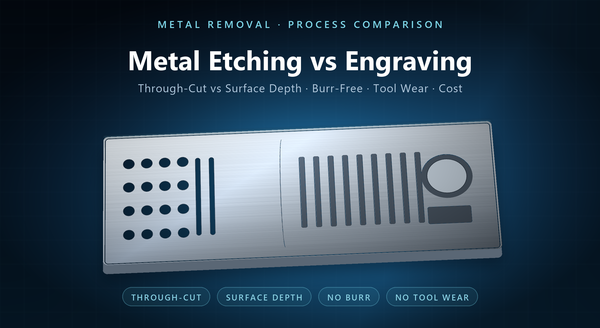
Metal etching vs engraving is usually framed as two ways to remove metal, but they answer different questions. Etching is a through-cutting process: masked sheet is dissolved to release flat parts with fine features and no burr. Engraving cuts a groove or texture into the surface for marking, depth or decoration, using a cutter, a laser or a chemical bath.
The cost of metal etching is built from artwork, chemistry, handling, yield and inspection, with material grade and thickness setting the starting point. Because the pattern lives on a phototool, a design change costs new artwork rather than a new cutter, and a whole panel is processed at once. The trade-off is isotropic removal: the etchant works sideways as well as down, so sidewall taper must be allowed for. Thin sheet, fine features and burr-free edges are where the process earns its place.
Engraving is priced by machine time and tool wear. A rotating cutter or a laser traces the path, so depth is set by passes and power, and hard materials wear tools or slow the beam. That makes engraving strong for serial numbers, logos, nameplates and shallow decorative texture, and weak for through-cutting thin sheet at volume. Chemical engraving, a partial-depth etch, sits between the two: no tool wear and fine detail, but limited depth and extra masking steps.
We run photochemical etching for through-cut parts in stainless steel, copper, brass, aluminum and nickel alloys, from prototype to series. Where a drawing needs deep engraved grooves, we say so and point to engraving rather than quote a process that will not hold the depth.
The choice follows the drawing: a flat part with holes and outlines belongs to etching, a surface mark with measurable depth belongs to engraving. Ask what depth tolerance the mark needs, whether the part is through-cut, and how many pieces share the same artwork. Then compare the finished part, not the process name. A sample settles it.