photo chemical etching
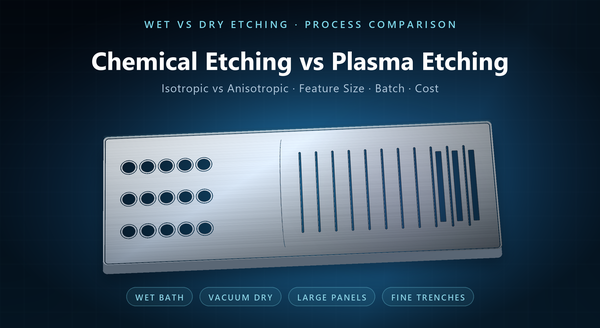
Chemical etching vs plasma etching is a choice between a wet process that dissolves metal and a dry process that vaporises it. Both remove material through a mask, and both can produce fine features, but they differ in directionality, batch size, material range and cost per part. The decision usually follows the aspect ratio of the feature, the thickness of the part and the volume required.
Chemical etching works by immersing masked metal in an etchant that removes exposed material in all directions. That isotropic behaviour produces a smooth, burr-free edge and allows large panels to be processed in a batch, with no vacuum chamber and no per-part cycle time. The trade-off is undercut: the etchant always works sideways as well as down, so feature width and wall profile depend on the etch factor and on how the part is masked.
Plasma etching removes material with reactive ions in a vacuum chamber. Because the ions travel in one direction, the process can hold near-vertical sidewalls and fine features that wet etching cannot, and it avoids liquid handling and surface tension effects on thin parts. The trade-offs are chamber size, cycle time and capital cost: parts must fit the chamber, each run has pump-down and process time, and the chemistry has to suit the material.
Cost follows those constraints. Chemical etching is cheaper for large panels, thin metal and moderate feature sizes, because batches are large and equipment is simple. Plasma etching is chosen when the feature geometry justifies the chamber cost, or when a dry process is required by the material or the next step. Volume, panel size and tolerance decide the lower curve.
The practical question is which limit binds first: feature aspect ratio, part size, material or budget. Ask both routes for a test part at the real thickness, and compare wall profile, undercut and cost per piece. A supplier who runs only one process describes the other in theory; one who runs both can show the boundary.