

laser cutting or chemical etching
Laser cutting vs chemical etching is a decision about physics before it is a decision about price. One process removes metal with a focused beam and heat; the other dissolves it with chemistry. That difference sets the feature size, edge quality and economic volume of each. Most thin metal parts can be made either way, which is why the choice should follow the drawing rather than the supplier default.
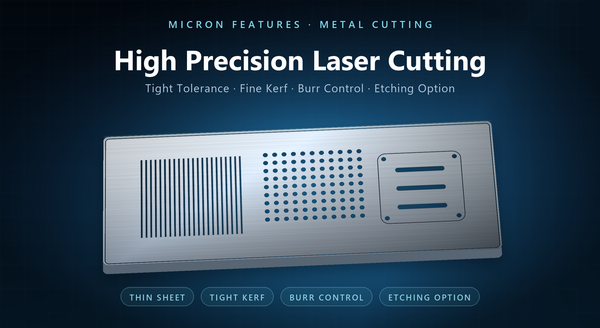
Laser cutting wins on speed and thickness range. A CAD file goes straight to the machine, so prototypes and design iterations avoid tooling entirely, and thicker sheet that etching cannot handle is routine work. The trade-off is thermal: a heat-affected zone, a small taper and a burr that may need removal. On thin sheet, heat input and vibration also make tight flatness and fine features harder to hold. For simple outlines, that trade-off is easy to accept.
Chemical etching wins on feature size and edge quality. It removes material chemically, with no heat, no burr and no mechanical stress, so it holds fine features, straight walls and flat parts in thin metal that laser cutting cannot match. The trade-off is workflow: artwork and photoresist instead of a cutting program, and a chemical line with its own process controls. Very thick material and simple outlines are usually not its best use.
Cost follows the same split. Laser cutting carries no tooling, so it is cheap to start and expensive per part at high volume only through machine time. Etching also avoids hard tooling, but its cost is driven by artwork, chemistry and handling rather than by cut length. Quantity, feature density and tolerance class decide which curve is lower.
The practical answer is often both. Laser cut the outline and mounting holes, etch the fine pattern, and keep both steps with one supplier so the boundary is resolved once. Ask for a sample by each route, compare edge condition and flatness, then choose. A supplier who offers only one process will find a reason to use it.
