

precision filter mesh
Thin metal laser cutting and chemical etching are two popular fabrication technologies for custom metal filter mesh. Both can create precise holes and mesh patterns on thin metal sheets, but they have big differences in hole consistency, edge quality, production flexibility and cost structure.
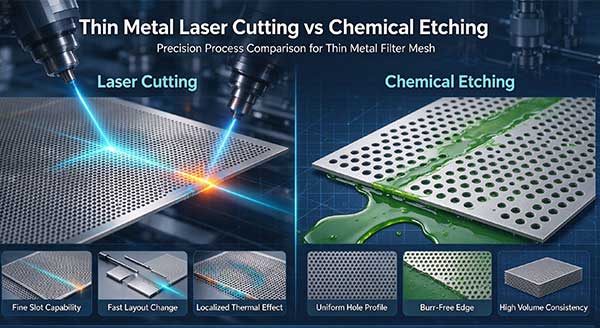
Chemical etching, also called photo chemical machining (PCM), uses photoresist masking and chemical corrosion to form mesh apertures. It produces identical hole geometry across the whole sheet, no burrs, no thermal deformation and zero mechanical stress on thin metal foils. It performs excellently for micro holes and dense multi-aperture mesh. The tooling cost is low for prototyping, and repeatability remains stable in mass production. It is ideal for thin stainless steel, nickel or copper filter mesh with micron-level small holes.
Thin metal laser cutting melts and vaporizes metal using a focused laser beam to cut mesh holes. It is very flexible for quick design changes without photo tooling. It works well for large apertures and simple mesh layouts. However, laser cutting may introduce heat-affected zones, minor edge burrs or hole distortion for ultra-fine micro holes. When holes are densely arranged, thermal accumulation can affect dimensional tolerance. For very thin foils, warping risk increases.
Selection guide for filter mesh:
- Choose chemical etching if you need dense micro holes, consistent aperture size, burr-free edges, thin foil substrates and high-volume orders with strict tolerance requirements.
- Choose thin metal laser cutting if you need fast one-off samples, simple mesh patterns, larger hole sizes and frequent design revisions.
The final choice depends on mesh thickness, aperture dimension, hole density, tolerance requirements, material type and order quantity.
