
metal filter mesh
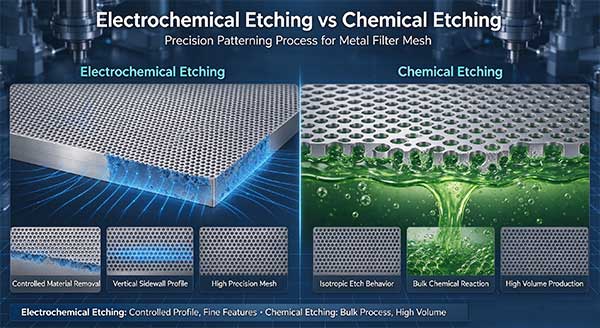
Electrochemical etching and chemical etching are two common subtractive manufacturing methods used to produce precision metal filter mesh. Both processes can create micro holes and fine mesh structures, but they differ in working principle, machining accuracy, surface finish, material limitation and production cost.
Chemical etching, also known as photo chemical machining, uses photoresist masking and chemical corrosive solution to etch unprotected metal areas. It is widely used for thin stainless steel, nickel and copper filter mesh. It can achieve uniform hole geometry, high repeatability for mass production, and no mechanical stress on the raw material. It works well for complex multi-hole patterns and thin foil filter mesh with aperture down to tens of microns.
Electrochemical etching (electrochemical machining) relies on the electrochemical dissolution of metal under electric current. The workpiece acts as the anode, and material is removed without physical contact. It delivers ultra-smooth burr-free edges and minimal thermal impact. It is suitable for thicker metal filter mesh and hard-to-machine alloys. However, it has higher tooling cost for custom patterns and is less flexible for frequent design changes compared with chemical etching.
For filter mesh selection:
- Choose chemical etching if you need thin foil mesh, fast prototype turnaround, low setup cost, and high volume mass production of intricate micro-aperture mesh.
- Choose electrochemical etching if you process thick metal substrates, require superior edge surface quality, and work with high-hardness metal materials.
Both processes produce burr-free filter mesh, unlike laser cutting which may leave heat-affected zones. The final decision depends on mesh thickness, aperture size, material, tolerance requirement and total order quantity.