
precision filter screen manufacturing
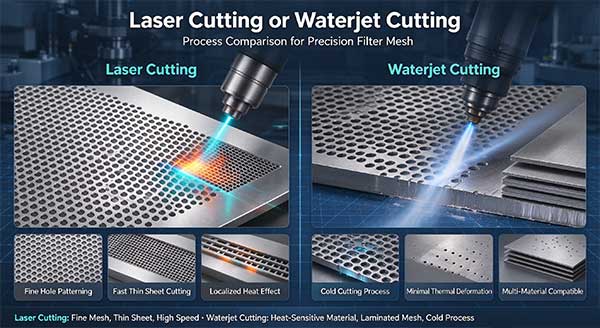
Precision metal filter mesh demands stable aperture dimension, consistent hole spacing and clean edge quality for liquid, gas and particle filtration. Laser cutting and waterjet cutting are two widely used subtractive cutting technologies, with obvious differences in precision, heat impact, material suitability and cost when producing filter mesh.
Laser Cutting for Filter Mesh
Laser cutting uses focused high-energy laser beam to melt and vaporize metal locally to punch holes and mesh patterns on metal sheets.
- Advantages:
- High precision and narrow kerf, good for small uniform holes on thin and medium metal sheets.
- Fast processing speed for simple mesh patterns, suitable for prototype sampling and small-batch custom filter mesh.
- Great pattern flexibility, directly work from CAD drawings without complex custom tooling.
- Capable of stainless steel, nickel, titanium, copper and other common filter metals.
- Limitations:
- Heat-affected zone exists around each hole. Ultra-thin foil may suffer oxidation, minor burrs or thermal warping.
- Mass processing of dense micro holes is time-consuming and costly. Not economical for large volume ultra-fine microporous filter mesh.
- Thick plate cutting will increase production cost significantly.
Waterjet Cutting for Filter Mesh
Waterjet cutting uses high-pressure water mixed with abrasive garnet to erode metal material mechanically without heat generation.
- Advantages:
- Zero thermal stress and no heat-affected zone. No burning, oxidation or thermal deformation on metal parts.
- Wide material compatibility, can cut nearly all metals, including heat-sensitive alloy materials.
- Good edge finish on thick metal filter plates, no thermal burn marks.
- Limitations:
- Larger kerf width compared with laser cutting. It is difficult to produce tiny micro holes required by fine filter mesh.
- Much slower for mesh with hundreds or thousands of holes. The abrasive consumption raises unit cost heavily.
- Minimum hole size is restricted. Not suitable for ultra-fine, densely packed microporous filter mesh.
- Extra post-cleaning is needed to remove abrasive residue from holes.
Selection Guide for Filter Mesh Production
- Choose laser cutting: thin/medium metal sheets, small holes, quick sampling, custom small orders, simple to moderately complex mesh patterns.
- Choose waterjet cutting: thick metal filter plates, heat-sensitive alloys, parts where thermal distortion and oxidation are strictly forbidden, and aperture size is relatively large.
Summary
Waterjet cutting is a cold cutting process with no thermal damage, yet it cannot efficiently produce fine microporous filter mesh. Laser cutting delivers better speed and economy for small-hole custom filter mesh prototypes and small batches. For mass production of thin metal ultra-fine mesh with dense micro holes, chemical etching remains the most cost-effective manufacturing option.