
laser cut filter mesh
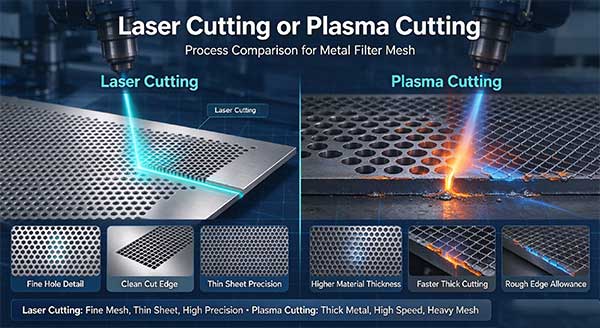
Metal filter mesh requires precise aperture size, consistent hole spacing and clean edge quality for filtration applications. Laser cutting and plasma cutting are both thermal cutting processes, but they differ greatly in precision, material thickness suitability and surface finish when manufacturing filter mesh.
Laser Cutting for Filter Mesh
Laser cutting uses a concentrated high-energy laser beam to melt and vaporize metal locally to form holes and mesh patterns on metal sheets.
- Advantages:
- High dimensional accuracy and tight tolerance. Suitable for thin and medium metal sheets to produce small, uniform holes for filter mesh.
- Narrow kerf, minimal material waste, clean cutting edges with less slag.
- Great pattern flexibility; complex custom mesh designs can be directly generated from CAD files. Works well for sampling and small-batch custom filter mesh.
- Lower heat input compared with plasma cutting, reducing thermal deformation for thin metal foils.
- Limitations:
- Cost rises sharply when cutting thick metal plates.
- Processing massive dense micro holes takes long time, not cost-effective for ultra-fine microporous filter mesh mass production.
- Still has minor heat-affected zone on ultra-thin material, which may cause slight oxidation.
Plasma Cutting for Filter Mesh
Plasma cutting uses high-temperature ionized plasma to melt and blow away metal material for cutting.
- Advantages:
- Excellent for cutting thick metal plates at high speed. Works efficiently on thick carbon steel and stainless steel filter plates.
- Low equipment running cost for thick sheet rough cutting.
- Limitations:
- Low cutting precision and wide kerf. It cannot produce small, fine holes required by precision filter mesh.
- Heavy slag, rough edges and large heat-affected zone. Severe thermal distortion on thin metal sheets.
- Poor hole consistency. Hole shape tends to taper, making it unsuitable for filtration where accurate aperture is critical.
- Cannot process ultra-thin foils; thin material will be burned and warped easily.
Selection Guide for Filter Mesh Production
- Choose laser cutting: thin & medium metal sheets, small and uniform holes, precision filtration requirements, custom mesh prototypes and small batch orders.
- Choose plasma cutting: only thick heavy-duty filter plates with large holes, where strict aperture precision is not required.
Summary
Plasma cutting is not recommended for precision filter mesh. It is limited to thick plate rough cutting. Laser cutting is the better thermal option for custom precision filter mesh with medium or small holes. For mass production of thin metal ultra-fine mesh with numerous micro holes, chemical etching is still the preferred manufacturing solution.