
precision filter mesh manufacturing
Precision metal filter mesh is widely used in fluid filtration, oil separation, fuel cell, automotive and medical industries, requiring accurate aperture size, uniform hole distribution and smooth edge quality. Laser cutting and CNC machining are two common subtractive manufacturing methods to produce metal filter mesh, and each has unique characteristics for different filter mesh requirements.
Laser Cutting for Filter Mesh
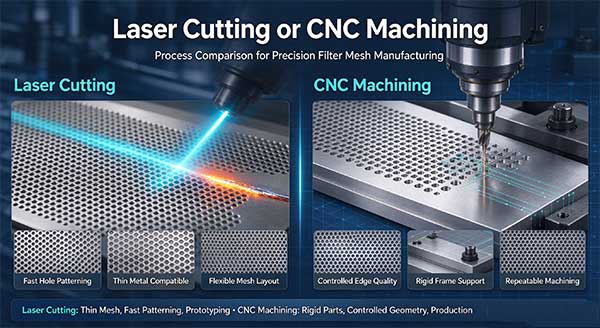
Laser cutting applies a focused high-energy laser beam to melt and vaporize metal locally to punch holes and mesh patterns directly on thin metal sheets.
- Advantages:
- High design flexibility. CAD patterns can be modified quickly without complex tooling. Ideal for custom filter mesh prototypes and small-batch orders.
- Capable of processing many metal materials, including stainless steel, nickel, titanium and copper foils.
- Fast turnaround for simple mesh structures; short lead time for sampling.
- Limitations:
- Heat-affected zone exists around each hole. Heat may cause edge oxidation, minor burrs or material warping on ultra-thin foils.
- Low efficiency for mesh with massive dense micro holes. Thousands of tiny holes will greatly extend processing time and raise unit cost.
- Minimum hole size is limited by laser spot; not economical for ultra-fine microporous filter mesh.
CNC Machining for Filter Mesh
CNC machining removes material by rotating cutting tools to drill or mill holes on metal plates to form filter mesh.
- Advantages:
- Good edge quality for relatively large holes on thick metal plates. Less thermal distortion compared with laser cutting.
- Stable dimensional tolerance for thick, heavy-duty filter mesh. Suitable for high-pressure working environments.
- Less oxidation on hole edges, no thermal burn marks on thick substrates.
- Limitations:
- Very slow when producing large quantities of small holes. Each hole needs individual drilling operation, leading to high cost for fine mesh.
- Tool wear is obvious during mass production. Tool replacement increases production cost and cycle time.
- Not suitable for ultra-thin metal foils. Thin sheets are easy to vibrate and deform under cutting force. Tiny micro holes are difficult to drill.
Selection Guide for Filter Mesh Production
- Choose laser cutting for custom samples, low volume orders, simple mesh patterns, medium hole sizes, and quick delivery requirements.
- Choose CNC machining for thick metal filter plates, large hole specifications, high-pressure working conditions, and strict anti-oxidation demands on hole edges.
Summary
Neither laser cutting nor CNC machining is the best choice for ultra-fine microporous filter mesh. Laser cutting works well for custom small-batch filter mesh, while CNC machining is mainly reserved for thick plate filter mesh with large holes. For mass production of thin metal fine mesh, chemical etching is usually the more cost-effective alternative.