
metal encoder disc fabrication
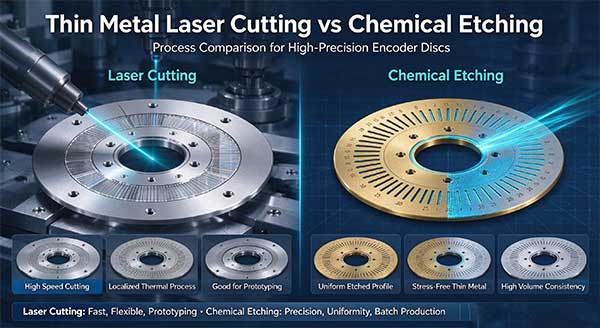
Encoder discs are the core precision components of rotary encoders, requiring ultra-fine slits, high dimensional accuracy, stable flatness and consistent edge quality. Thin metal laser cutting and chemical etching (photo etching) are two mainstream manufacturing methods for metal encoder discs, and each has distinct strengths and limitations for encoder disc production.
Thin Metal Laser Cutting for Encoder Disc
Laser cutting uses a focused high-energy laser beam to melt and vaporize thin metal sheet locally to form the required slit patterns on encoder discs.
- Advantages:
- Great flexibility for custom, low-volume orders. Tooling cost is minimal, no custom photomask needed. Fast prototype turnaround for new encoder disc designs.
- Works for thicker metal substrates that chemical etching cannot easily handle.
- Simple design modification; adjust CAD files directly without mask remaking.
- Limitations:
- Heat-affected zone (HAZ) occurs along cutting edges, which may cause slight metal deformation, burrs or oxidation, impacting optical reading precision of encoder slits.
- Not ideal for ultra-fine, dense slits. Narrow pitch patterns are hard to achieve compared with chemical etching.
- Higher unit cost for mass production. Long cutting time when there are hundreds or thousands of slits on one encoder disc.
Chemical Etching for Encoder Disc
Chemical etching, also called photo etching or PCM, fabricates encoder disc patterns by exposing photoresist and selectively removing unwanted metal via chemical corrosive solution.
- Advantages:
- Burr-free, stress-free slits. No thermal damage to the metal substrate. The slit edges are clean and uniform, which is critical for high-resolution optical encoder discs.
- Excellent capability for dense, ultra-fine, high-precision slit arrays. Consistent tolerance across the whole batch.
- Low per-piece cost for mass production. Once the photomask is finished, mass production runs efficiently.
- Preserves material flatness; no mechanical or thermal stress to warp thin metal encoder discs.
- Limitations:
- Requires photomask fabrication, so higher upfront tooling cost for one-off small prototypes.
- Pattern depth is limited by metal thickness; suitable for thin foils typically under 0.5mm.
- Design changes need new photomask, less flexible for frequent design revisions.
Selection Guide for Encoder Disc Manufacturers
- Choose chemical etching when you need high resolution, dense slits, zero burr, large batch quantity, thin metal foil encoder discs for high-precision optical encoders.
- Choose thin metal laser cutting when you need quick prototypes, low quantity custom encoder discs, thicker metal substrates, or frequent design changes.
Summary
For high-performance optical encoder discs, chemical etching is the preferred process for mass production thanks to stress-free clean edges and superior fine pattern capability. Thin metal laser cutting serves as a perfect prototype solution for small batch and custom encoder disc development.