

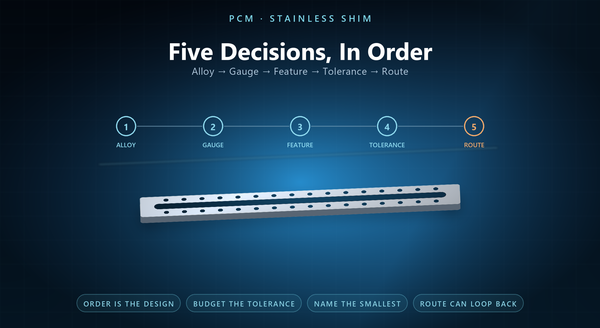
shim tolerance budget
Photochemical machining for stainless steel shim is usually described one subject at a time: alloys here, tolerances there, cost somewhere else. That is useful once you know what you are doing, and unhelpful when you are starting, because the five decisions a shim carries are coupled, and the order in which they are made decides whether the part is cheap or impossible. This page is the order. It does not repeat the depth that the other pages in this family already carry; it tells you which decision comes first, what it forecloses, and where to read more.
1. A Shim Is a Stack Element
A shim is not a part that stands alone; it is a part that makes a stack come out right.
Its job is usually one of three: to set a gap, to take up a tolerance that the rest of the stack cannot hold, or to carry a feature that the stack needs — a port, an aperture, a locating notch. Almost every shim decision follows from which of those three it is.
That matters because a shim chosen as “a flat piece of stainless” gets designed backwards: the alloy is picked by habit, the thickness by what is in the rack, and the features by what the drawing looks like. A shim is also the cheapest part to get wrong and the most expensive to discover late. The result etches, and it does not do its job. The two failure modes are not symmetric: a shim that is too thick shows up immediately, and one that is too thin shows up as a leak three months later, which is why shim tolerances are usually quoted on the thin side; a shim is also the part most often left to the end of a design, which is why it is the part most often late.
2. Decision One: The Alloy
The alloy comes first because it constrains everything after it.
Etch rate, undercut, edge quality, temper retention and post-treatment all move with the grade. A grade that etches slowly costs more per part at the same thickness; a grade with a hard temper can lose some of it in the etch; a grade that needs a passivation step adds a process.
The practical rule is to pick the alloy for the function — corrosion, spring, conductivity, magnetic response — and then accept the etch consequences, rather than picking an alloy because it etches nicely and discovering later that it corrodes.
Where to read more: the grade-fit page in this family covers 301, 302, 304, 316 and 430 against etch rate, cut edge, temper and cost. A grade chosen for spring also has to survive the etch with its temper and not every grade does, and the alloy is a procurement decision too, because a rare grade carries a lead time.
3. Decision Two: The Gauge
Gauge comes second because it is the number that sets the process window.
Two things follow from thickness. The first is what feature size is reachable: an etched aperture or slot cannot be much finer than the sheet is thick, because the two-sided etch has to meet in the middle. The second is how much undercut the part will carry: a thicker sheet etches wider at a given feature.
That is why a designer who needs a fine feature and a stiff part is in a conflict that has to be resolved before the drawing is finished — usually by changing the design (a formed rib instead of a thick plate) or by accepting a two-piece stack.
Where to read more: the capability-envelope page covers thickness against minimum feature and the tolerance stack that follows. A thickness chosen to fit an existing stack has already been optimised away, a thin sheet is also easier to keep flat, which is a hidden benefit at the tolerance stage, a gauge available off the shelf is worth more than one that is perfect on paper, and a thick shim is easy to etch and hard to make flat.
4. Decision Three: The Smallest Feature
The smallest feature comes third, because it is the number that decides whether the part is a shim or a project.
It is worth identifying the single smallest thing on the drawing — not the average, and not the nominal. That number, against the gauge, is what tells you whether the part is comfortable, marginal, or outside the process.
Two mistakes recur. Designing to the finest feature on every feature, when only one of them needs it. And specifying a minimum feature without specifying the tolerance that goes with it, which turns a comfortable part into a rejected lot.
Where to read more: the micro-etching page covers the fine-feature regime and its own economics. A part with one fine feature and fifty coarse ones is a comfortable etched part provided it is designed that way, and a drawing that never names its smallest feature leaves the supplier to find it at first article.
5. Decision Four: The Tolerance Budget
The tolerance budget comes fourth, and it is a budget rather than a tolerance.
A shim’s error comes from several places: the artwork, the etch (undercut and its variation), the material’s own thickness variation, and any forming afterwards. Those errors add, and the sum is what the stack sees.
That is why a drawing that puts a tight tolerance on every dimension is not a better drawing; it is a drawing that has spent the budget four times. The useful move is to decide which dimension the stack actually locates on and spend the budget there, leaving the rest at a commercial tolerance.
Where to read more: the DFM page covers web width, hole pitch, corner radii and tie bars; the chemical milling page covers depth tolerance when a pocket or a step is involved. A budget is spent once and a shim has several dimensions competing for the same allowance, while a tight tolerance on a non-functional dimension is a cost with no benefit, and the dimension the stack locates on is usually the one that couples to the customer’s own tolerance.
6. Decision Five: Quantity and Route
Quantity and route come last, because they are the only decision that is allowed to change the other four.
Three routes exist: etch, stamp, and laser. Etching has no tooling and a panel-based cost, so it wins at low and medium volume and on parts with many features. Stamping has tooling and a per-stroke cost, so it wins at high volume on simple parts. Laser has no tooling and a per-unit time cost, so it wins on prototypes and on parts with few features.
The order matters here: a part that was designed for etching and then moved to stamping usually needs a design change, because stamping wants radii and drafts that etching does not care about. Deciding the route early is cheaper than discovering it late.
A route decision is also a tooling decision and tooling is a commitment. Where to read more: the process page covers etching in detail; Where to read more: the process page covers etching in detail; the laser page covers where laser takes over; the process-long-read page covers capacity and lead time. A route change after the design is fixed is a redesign rather than a quote, and a stamped shim needs a draft an etched one does not, which is the cost of switching late.
7. Why the Order Is Not Arbitrary
Each decision forecloses the next, which is why the order is what it is.
Choosing the alloy fixes the etch behaviour, which fixes the achievable feature at a given gauge. Choosing the gauge fixes the feature, which fixes the tolerance the process can hold. Choosing the tolerance fixes the inspection, which fixes the price. Choosing the price fixes the route, which can send you back to the alloy.
The loop is real, and it is why a shim programme that starts with a finished drawing and asks for a price usually ends with a redesign. Starting with the function and walking the five decisions in order takes longer in the first hour and much less time overall. Walking the decisions in order is cheap and walking them backwards is a redesign.
8. The One-Page RFQ
A quotation for a stainless shim needs seven things, and they map onto the five decisions.
The alloy and its standard. The gauge and its tolerance. The smallest feature, named as the smallest rather than left implicit. The critical dimension, named as the one the stack locates on. The tolerance on that dimension. The quantity, with the batch structure if it is a programme. And the finish, including whether a passivation or a coating is required.
A drawing that carries those seven can be quoted without a meeting, and a supplier who asks for them is a supplier who has done this before. A named critical dimension also tells the supplier which feature to inspect first. Seven items are short enough for an engineer to write Seven items are short enough for an engineer to write and complete enough for a supplier to quote.
