

reusable filter drawdown
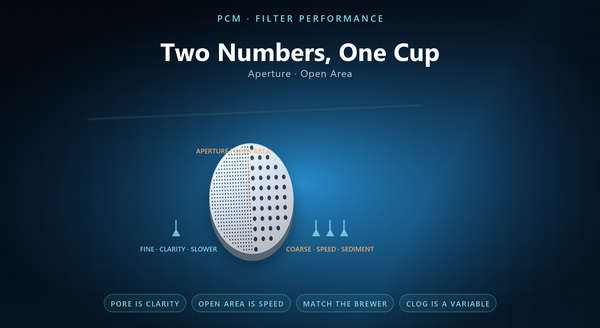
Photo chemical machining for stainless steel coffee filter is where a pore specification turns into a cup, and the cup is decided by two numbers that are often treated as one. Aperture sets what passes. Open area sets how fast everything else passes. A filter with the right aperture and too little open area stalls; a filter with generous open area and too large an aperture runs clear and fast and leaves sediment. The filter is also the cheapest variable in the system to change, which is why it is blamed first. Etching controls both independently, which is why a filter can be tuned rather than merely chosen. A filter judged by its pore size alone will disappoint one of the two jobs, and the cup is the only test that matters while also being the one nobody specifies.
1. What an Aperture Does to a Brew
An aperture does two jobs at once, and they pull in opposite directions.
It filters: it holds back the fines that would make the cup muddy. Finer apertures hold back more fines, so the cup is clearer.
It drains: it lets the brew leave the cone at a rate that the brew deserves. A slower drain means a longer contact time, which extracts more, which is good up to the point where it is bitter.
Those two jobs are why arguing about “the right pore size” in the abstract goes nowhere. The right pore size is the one that gives the clarity you want at the drain time your brewer and grind can tolerate.
2. Fine and Coarse: The Actual Trade
Going finer buys clarity and costs time.
A finer filter is also more sensitive to a tired grinder, because more fines are produced. A finer field holds back more fines, A finer field holds back more fines, so the cup is cleaner and the texture is thinner. It also slows the drawdown, and a slow drawdown on a fine grind is how a cone stalls with the bed still full of water. A stall is visible because the bed stays covered and the drawdown time doubles, and the clarity difference between two adjacent aperture steps is small while the time difference is large.
Going coarser buys speed and costs clarity. The brew drains quickly, the bed does not over-extract, and the cup carries sediment that settles in the bottom of the server.
Neither is better. A filter for a Chemex and a filter for a moka pot are different products because the two brewers want different points on that line.
3. Open Area Is a Separate Number
Open area is the fraction of the surface that is hole, and it is not the same thing as aperture.
Two filters can have the same aperture and different open areas, because one has more holes and one has fewer. The one with more holes drains faster and, at the same aperture, is also weaker and more flexible.
A quick way to compare two filters is to time a fixed dose with a fixed grind. For a coffee filter, open area is the number that governs the drawdown, For a coffee filter, open area is the number that governs the drawdown, and aperture is the number that governs the clarity. A specification that names only the aperture has named half the filter. Open area is also a strength number, because a field with more holes has less metal between them, and a filter specified by aperture and open area can be quoted without a sample.
That is why an etched filter can be tuned in two dimensions where a woven cloth is tied to its weave: the aperture and the open area can be set separately in the artwork.
4. Matching a Filter to a Brewer
Four brewers, four different points on the same line.
A filter that is too fine for its brewer makes every brew slower than the recipe. A pour-over cone with a fine grind wants a filter that drains slowly enough A pour-over cone with a fine grind wants a filter that drains slowly enough to keep the bed saturated but fast enough not to stall, which usually means a moderate aperture with generous open area. An immersion brewer’s filter is judged on how cleanly it empties rather than on how finely it strains, and a pressure brewer’s filter is a gasket as much as a screen, which is why thickness appears in its specification.
An immersion brewer wants a filter that drains cleanly at the end, because the extraction has already happened in the water; aperture matters less for flavour and more for the press.
A moka or a pressure brewer wants a filter that resists the pressure and does not deform, which is a thickness and stiffness question as much as an aperture one.
A cold brew or a large batch wants open area, because the limiting factor is time rather than extraction.
5. The Grind Interaction
A filter is half of a pair, and the other half is the grind.
A fine grind and a fine filter is the classic stall: the fines fill the apertures, the flow stops, and the bed sits in water until it turns bitter.
A coarse grind and a coarse filter is the classic under-extraction: the water passes through before it has taken anything out, and the cup is weak and gritty.
A grinder that produces many fines will clog a fine filter regardless of how the recipe is written. The pair that works is a filter and a grind that drain in the time the recipe expects, The pair that works is a filter and a grind that drain in the time the recipe expects, which is why a filter sold with a recommended grind is a more useful product than one sold with a pore size alone. A recipe’s time is the constraint both the grind and the filter have to respect, and changing the filter without changing the grind is the most common cause of a recipe that suddenly stops working.
6. Uniformity Is What Makes It Repeatable
A filter is a repeatable product only if its apertures are uniform.
A field with a mix of sizes does not average out; the largest apertures take most of the flow, and the fines that would have been held back pass through the largest hole. The result is a cup that is both slower than expected and dirtier than expected.
That is where etching has a structural advantage: an etched field is imaged from one file, so the aperture distribution is narrow by construction rather than by sorting, and the filter behaves the same on the hundredth brew as on the first.
A uniformity claim should come with a distribution rather than an average. A woven cloth can be equally uniform, A woven cloth can be equally uniform, but its uniformity is a property of the weave rather than of a drawing, so it cannot be tuned per product. A wide distribution also makes clogging unpredictable, because the biggest hole clogs last, and uniformity is what allows a supplier to promise a drawdown rather than a range.
7. Clogging Is a Performance Variable
A metal filter clogs, and a clogged filter is a different filter.
The mechanism is simple: coffee oils and fines lodge in the apertures and on the wall texture, and the open area falls. The drawdown lengthens, the extraction rises, and the cup gets bitter and eventually stale.
Two design responses follow. A smoother etch texture holds less oil, which is why the etch finish matters as much as the aperture. And a filter with generous open area has more margin before the clogging becomes visible in the cup.
A filter rinsed immediately after use clogs far more slowly than one left wet, and a clean filter is part of the recipe. The cleaning instruction is therefore a performance instruction, not just a hygiene one. A filter that has been in service for a year has a different open area from the day it shipped, and a descaling soak restores some of the open area and none of the smoothness.
8. Choosing and Verifying
A buyer choosing a filter should ask for three numbers: the aperture with a stated measurement basis, the open area, and the thickness.
At home, the verification is a brew: the drawdown time for a fixed dose and grind, and the sediment in the cup. Two filters can be compared on those two numbers in a single morning.
A supplier should be able to state how the aperture is measured and on which face, because an etched aperture has more than one size and the number means nothing without the face.
A filter should be bought on the drawdown it produces, with the pore number as supporting evidence. The recurring mistakes are a pore size quoted without an open area, The recurring mistakes are a pore size quoted without an open area, A drawdown test is more useful than a pore measurement because it integrates everything the filter does, and a filter bought on a pore number alone is bought on the number the supplier can measure rather than the one the drinker feels. The recurring mistakes are a pore size quoted without an open area, a filter chosen for a brewer it was not designed for, a grind that fights the filter, and a clogged filter judged as a bad filter rather than as a dirty one.
