
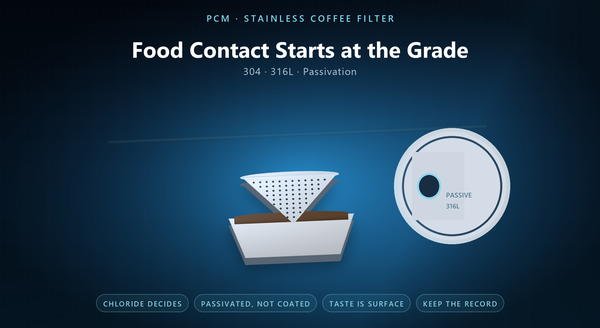
food contact etched filter, passivated coffee filter
Photochemical machining for stainless steel coffee filter is where the etching process meets a food-contact requirement, and the process is the easy half. A filter is a part a customer puts in their mouth’s path every morning, so the questions that matter are not about aperture tolerance but about what the metal is, what is on its surface, and what can come off it. This page is about the material side of that: the grade, the passivation, the cleaning, and the documents a buyer should expect.
1. Why Stainless for a Filter
Four materials make a reusable filter, and stainless wins on the combination rather than on any single property.
Glass is the most neutral and the most fragile. Plastic is the cheapest and the least durable, and it takes on odour over time. Paper is single-use by design. Stainless is the one that survives being dropped, boiled, scrubbed and put in a dishwasher, while staying chemically inert in the presence of coffee acids.
It is also the only one of the four that can be etched into a fine, uniform aperture field and still hold a shape — which is what makes a metal filter a filter rather than a strainer.
A reusable filter also avoids the paper habit, which is the argument most buyers actually make. The trade is weight and cost, and both are accepted because the product is expected to last years. A metal filter is also the only one of the four that can be cleaned back to bare metal and put back into service, and the weight is the price of that durability.
2. 304 and 316L: Where the Line Is
Two grades cover almost the whole market, and the difference is chloride rather than coffee.
304 is the default: it resists coffee acids, it takes a passivation step, and it is available in the thin gauges an etched filter needs. For a filter used with tap water of moderate chloride content and rinsed after use, 304 is adequate and it is what most of the market uses.
316L is chosen where the chloride load is higher: hard water areas, frequent dishwasher cycles with a chloride-containing detergent, or a product sold into a market where the water is aggressive. The molybdenum addition raises the pitting resistance, which is the failure mode that matters in a wet, warm, chloride-bearing environment.
A 304 filter in a hard-water market is a return waiting to happen. The practical difference shows up as pitting The practical difference shows up as pitting — small dark spots that become pinholes — and it shows up after months, not on the first day, which is why the grade choice is a warranty decision rather than a performance one. A water analysis is cheap and settles the question faster than any datasheet, and the grade also sets the price, because a 316L filter is a premium product rather than a default one; chloride pitting is the failure a warranty claim will describe as rust, which it is not.
3. Passivation Is the Food-Contact Step
Passivation is the step that makes an etched filter a food-contact part, and it is not a coating.
Etching leaves the surface chemically disturbed: residue in the grain boundaries, a disturbed oxide, and whatever the resist and the rinse left behind. Passivation removes that residue and regrows the chromium oxide film that makes stainless stainless.
Two things follow. The first is that passivation is a process with a record — bath, time, temperature, and a verification — and a filter sold as food-contact should be able to show that record.
The second is that passivation does not survive being ground off: a filter that is passivated and then mechanically polished at the rim has a polished rim that is no longer passivated. A passivation record is a page rather than a certificate, and it is the page that wins an audit; the rinse after passivation matters as much as the bath, because residue left behind is residue in the cup. That is why the sequence matters as much as the step.
4. Taste Neutrality Is a Claim About the Surface
A metal filter is sold as taste-neutral, and the claim is really about three things.
The first is the absence of oil. Etching leaves none, but a forming or a polishing step can, and a filter with oil residue tastes of it for the first few brews.
The second is the absence of a coating. A coating that is not declared is a coating that can wear, chip or taste; an uncoated, passivated stainless surface has nothing to give up.
The third is the absence of retained residue. A filter with a rough, textured wall can hold coffee oils in the texture, and a filter that holds oils turns rancid between uses. That is a design issue as much as a cleaning one: a smoother etch texture is easier to keep neutral. A filter that smells of yesterday’s coffee is a filter that was not rinsed. A first-brew taste test is a cheap check A first-brew taste test is a cheap check and a good habit with a new supplier, and an uncoated filter has nothing to flake, which is a quiet food-safety argument.
5. Dishwasher Cycles Are the Real Test
A reusable filter is expected to go in a dishwasher, and that is the harshest environment it sees.
Three things happen in a dishwasher: temperature cycling, a detergent that is alkaline and often chloride-bearing, and a long wet dwell. For 304 that combination is a slow pitting risk; for 316L it is a much smaller one.
Two practical consequences. The grade choice should be made against the dishwasher, not against the brew. And the cleaning instruction matters: a rinse before the basket, and a detergent that is not the harshest available, will extend the life of either grade.
A filter that pits in a dishwasher usually shows it first at the weld or the rolled edge, where the surface is least uniform. A filter sold as dishwasher-safe should be tested in one, on the harsh cycle rather than in a beaker, and the detergent is worth naming because dishwasher safe is not a chemistry.
6. Thickness, Rigidity and the Edge
A filter has to be thin enough to etch a fine aperture and stiff enough not to deform in the hand.
A cone or a basket gains rigidity from its form, so it can be thinner than a flat disc of the same diameter. A flat disc that sits loose in a basket needs a rim or a rolled edge to stay flat, which is a forming step and a place where passivation is at risk.
The edge that a drinker’s mouth or a spoon touches is worth specifying: The rim is also where a filter gets dropped, so its shape should survive a fall. A rolled edge also hides a lap that can trap coffee oils, A rolled edge also hides a lap that can trap coffee oils, so it should be specified as a closed edge, and a thin disc with no rim will oilcan, which is a design failure rather than a process one. The edge that a drinker’s mouth or a spoon touches is worth specifying: an etched edge is burr-free by nature, which is one of the few places where the process directly improves the product rather than the tolerance.
7. The Paperwork
A food-contact filter should travel with four documents, and a supplier who cannot produce them is a supplier to avoid.
A material certificate for the strip, which ties the filter to a heat and a grade rather than to a colour.
A passivation record, which ties the filter to a process rather than to a claim.
A cleaning and packing statement, which says what the filter was cleaned with and how it was protected afterwards.
And a declaration of compliance with whichever food-contact regulation the market requires, which is a legal document rather than a test report. A declaration also names the market, because a declaration for one market is not valid for another, and a test report is not a substitute for one, A test report is not a substitute for a declaration, and none of the four documents costs much while all four are asked for eventually.
None of those is expensive; together they are what separates a component from a product.
8. Specifying a Filter Material
A drawing for an etched coffee filter should state the grade by designation, A drawing that names the water environment can be quoted without a meeting. A drawing for an etched coffee filter should state the grade by designation, the thickness and its tolerance, the passivation requirement with its verification, the finish (and explicitly whether any coating is present), the edge condition, and the packing.
It should also state the intended use environment — tap water hardness, dishwasher use, or a market with aggressive water — because that is what decides whether 304 is sufficient.
The recurring mistakes are a grade chosen by cost without a water analysis, a passivation step assumed because the material is “stainless”, a coating present but undeclared, a polished rim that is no longer passivated, and a food-contact claim made without a declaration.