
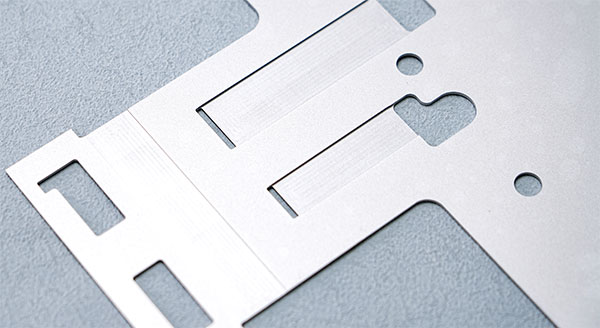
Precision Laser Cutting Processing: A Full Analysis of Technology, Materials and Industry Applications
In the field of precision manufacturing, the accuracy, efficiency and quality of metal processing directly affect the performance and competitiveness of end products. From miniature heat sinks in 3C electronics and battery connectors for new energy vehicles, to precision brackets for medical devices and structural parts for communication equipment, almost all high-tech industries require metal components with micron-level machining standards. Precision laser cutting has become one of the core technologies to meet such requirements.
Different from traditional mechanical cutting, stamping and wire cutting, precision laser cutting uses high-energy-density laser beams to melt or vaporize metal materials instantly. It realizes non-contact cutting, which features ultra-high precision, capability for complex profiles and special-shaped structures, as well as smooth burr-free cutting edges. It is an indispensable technology in modern precision manufacturing. This article comprehensively analyzes the core value of precision laser cutting from technical principles, material adaptation, precision control and industry applications.
- Core Technical Principles and Advantages of Precision Laser Cutting
1.1 Technical Principle: Non-contact High-energy Machining
The working principle of precision laser cutting is to focus high-power laser beams on metal surfaces to rapidly heat materials to melting or boiling points. Meanwhile, coaxial high-pressure gas such as oxygen, nitrogen or compressed air blows away molten metal to form cutting slits. The whole process is non-contact without mechanical stress, so it will not cause deformation or wear of workpieces. It is especially suitable for processing thin, fragile and high-precision metal parts.
Precision laser cutting is divided into fiber laser cutting, CO₂ laser cutting and YAG laser cutting. Among them, fiber laser cutting has become the mainstream technology thanks to excellent beam quality, high energy density and low maintenance cost. It is particularly ideal for high-precision cutting of highly reflective materials including stainless steel, copper and aluminum.
1.2 Core Advantages
Ultra-high precision and consistency: The machining accuracy reaches ±0.01mm, and the slit width can be controlled within 0.1mm, fully meeting the tolerance requirements of precision parts with high consistency in mass production. Burr-free & no secondary processing: The cutting surface is smooth without burrs, flashes or slag. Most finished products can be assembled directly without extra polishing. One-time forming for complex shapes: It supports one-time cutting of arbitrary complex outlines, special holes and hollow patterns. No molds are needed, which greatly shortens R&D cycle and reduces sampling costs. Wide material compatibility: It can process almost all metal materials such as stainless steel, carbon steel, copper, aluminum, brass and titanium alloy, with no special limits on material hardness and brittleness. Efficient & flexible production: Controlled by CNC system, it can quickly switch processing patterns. It is applicable to customized sampling of small-batch & diversified products as well as stable mass production.
- Multi-material Adaptation and Processing Key Points
Different metal materials have distinct physical properties, which require customized parameters including laser power, cutting speed and auxiliary gas. The processing characteristics of common materials are as follows:
2.1 Stainless Steel (SUS304/316)
Stainless steel features excellent corrosion resistance and mechanical strength, which is the most widely used material for laser cutting. Nitrogen is usually adopted as shielding gas to achieve oxidation-free and slag-free slits. It is widely used for precision parts of food equipment, medical devices and electronic products.
2.2 Copper and Brass
Copper and brass have high reflectivity and thermal conductivity, which put forward strict requirements on parameter control. High-power fiber laser combined with oxygen cutting can improve cutting efficiency and surface quality. They are commonly used for new energy battery connectors, copper busbars and heat dissipation parts.
2.3 Aluminum and Aluminum Alloy
Aluminum alloy is soft and easy to deform, and traditional processing tends to produce burrs and stress deformation. By optimizing cutting speed and air pressure, laser cutting can realize burr-free and distortion-free processing. It is widely applied to automotive lightweight parts, communication equipment shells and aerospace components.
2.4 Special Alloys and Thin Sheets
For special materials such as nickel alloy and titanium alloy, as well as ultra-thin metal sheets with thickness from 0.1mm to 2mm, precision laser cutting can complete micron-level hole processing and complex pattern cutting, catering to high-standard industries like semiconductor and medical equipment.
- Industry Applications of Precision Laser Cutting
3.1 3C Electronics Industry
A large number of structural parts, heat dissipation components and shielding parts for smart phones, laptops and other consumer electronics adopt precision laser cutting. Typical products include special-shaped heat sinks, hollow shielding covers, connector shrapnels and conductive sheets. These thin parts have strict tolerance requirements, and the high-precision & stress-free features of laser cutting perfectly match the manufacturing demands of 3C industry.
3.2 Automotive and New Energy Industry
With the rapid development of new energy vehicles, the market demand for lightweight, high-conductivity and high-heat-dissipation metal components keeps growing. Precision laser cutting is used to produce battery module connectors, busbars, lightweight brackets, sensor parts, as well as stainless steel shells and heat sinks for charging piles. Its high efficiency and stability guarantee large-scale and high-reliability production for the automotive industry.
3.3 Medical Device Industry
Medical devices set strict standards on cleanliness, precision and biocompatibility of metal parts. Laser cutting can process stainless steel and titanium alloy to manufacture surgical instrument parts, blades, metal brackets, sensor shells and microfluidic components for diagnostic equipment. Non-contact processing avoids pollution and deformation caused by traditional technologies, fully complying with high cleanliness standards of medical industry.
3.4 Communication and Semiconductor Industry
RF shielding parts, filters and optical components for communication base stations, optical modules and semiconductor equipment all rely on laser cutting. These parts have complex hollow structures and micron-level holes, and the one-time forming capability of laser cutting solves the processing difficulties of traditional technologies.
- How to Select a Qualified Precision Laser Cutting Supplier
Selecting a reliable supplier is critical to guarantee product quality and delivery. Enterprises shall focus on the following points: First, equipment and technical strength. Check whether the supplier is equipped with advanced fiber laser cutting machines and professional engineering teams to optimize parameters for different materials and thicknesses. Second, precision and quality control. Verify the complete quality management system and dimensional inspection reports to ensure consistency in mass production. Third, material and process experience. Confirm rich experience in processing stainless steel, copper, aluminum and other materials, as well as supporting surface treatment services such as polishing, passivation and electroplating. Fourth, delivery capacity and flexible service. Make sure the supplier can support small-batch sampling and large-scale production with stable supply chain and on-time delivery. Fifth, industry certifications and practical cases. Prioritize suppliers with ISO9001 certification and mature cooperative cases in related industries.
- Conclusion
As industries raise higher requirements on precision, complexity and reliability of metal components, precision laser cutting has evolved from an optional technology to an essential manufacturing solution. It overcomes the defects of traditional processing technologies, and promotes technological upgrading of the whole precision manufacturing industry with flexible and efficient production modes.
For enterprises engaged in 3C electronics, automotive, new energy, medical and other fields, choosing a professional and reliable laser cutting supplier can reduce production costs, shorten R&D cycle and enhance product competitiveness. With the continuous upgrading of laser technology, precision laser cutting will be applied to more high-end manufacturing fields and maintain its irreplaceable value.